For long stretches Sunday night, the scoreboard barely seemed connected to what was happening on the field. Spain kept possession, worked the ball around the pitch, and continued creating chances. Argentina defended deep and waited for an opening that never really arrived. By the time the breakthrough came, nearly two hours had passed.
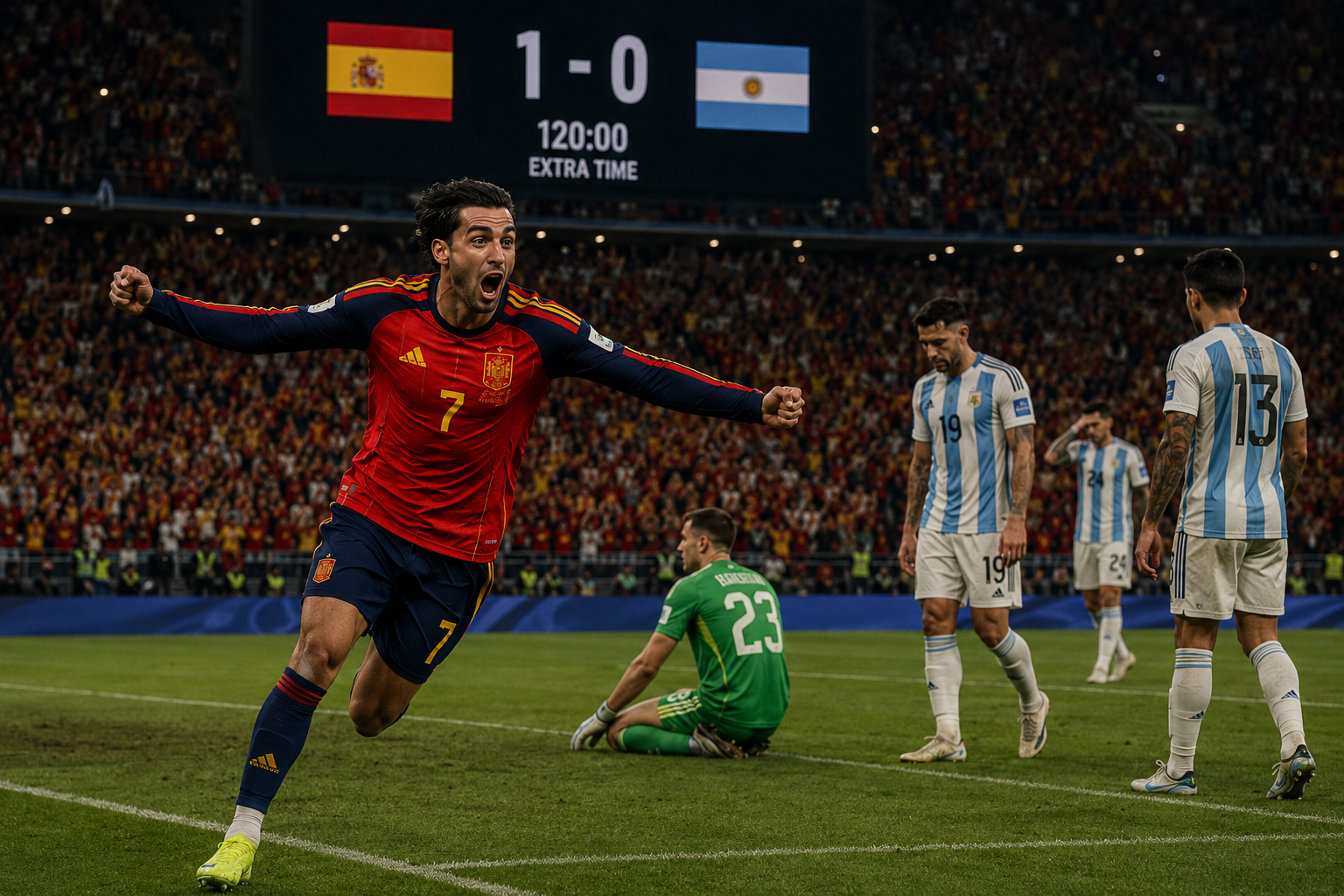
Ferran Torres scored in the 106th minute of extra time to give Spain a 1-0 victory over Argentina in the World Cup final in East Rutherford, New Jersey. The goal came after Nico Williams got a touch on Pedro Porro’s cross, sending the ball into Torres’ path inside the box. Spain’s players rushed toward the corner flag while Argentina’s players stood still for a moment, knowing there was little time left to respond.
Spain had been the better side for most of the night, but turning possession into goals proved difficult. Emiliano Martínez made save after save to keep Argentina in the match, finishing with 11 across 120 minutes. The goalkeeper had entered the tournament while managing a fractured finger on his right hand and later admitted that the injury still hurts every day. Without him, the game probably would not have remained scoreless for as long as it did.
The final unfolded much the way many people expected. Spain controlled the ball and dictated the pace, while Argentina looked for Lionel Messi whenever opportunities appeared. Messi, playing in what he said would be his final World Cup, had already collected eight goals and four assists during the tournament. This time, Spain gave him very little space. He finished with one blocked shot and never managed the kind of late moment that had rescued Argentina earlier in the competition.
Argentina’s struggles in attack became impossible to ignore as the minutes ticked away. The defending champions did not record their first shot until the 115th minute, an extraordinary number for a team that had scored 19 goals in its previous seven matches. Spain finished with 20 shots of its own and spent much of the evening camped in Argentina’s half. It was an odd sight. A team built around Messi spent most of the final chasing shadows.
The physical nature of the match also increased as frustration set in. Referee Slavko Vincic allowed plenty of contact throughout the game before finally reaching for his cards late on. Enzo Fernández was sent off after receiving a second yellow card for a challenge on Pau Cubarsí near the end of regulation. Argentina then had to play all of extra time with 10 men, and the disadvantage quickly became apparent.
Spain’s victory completed a tournament run that had been building for weeks. Luis de la Fuente’s side conceded just one goal in eight matches and stretched its unbeaten run to 38 games. Rodri was named the tournament’s best player and received the Golden Ball, while Pau Cubarsí earned the award for best young player. Goalkeeper Unai Simón added the Golden Glove to a growing list of honors for the Spanish squad.
There was little doubt about which team had controlled the final, even if the score remained level for so long. Spain moved the ball patiently and rarely looked uncomfortable. Argentina, meanwhile, continued searching for one last piece of magic from its captain. It never came, and by the closing minutes, the match felt more tense than dramatic.
After the final whistle, Spanish players celebrated near midfield while many of Argentina’s players stayed on the grass, staring into the distance. Messi eventually made his way toward the supporters behind the goal, where fans continued singing despite the result. The scene was quieter than many expected for the end of one of soccer’s greatest careers, though perhaps that felt fitting.
By Monday, attention had already shifted across the Atlantic. Crowds gathered in Madrid’s major squares ahead of the team’s arrival home, with an open-top bus parade scheduled later in the evening. Spain’s second World Cup title had finally arrived, and after 120 exhausting minutes in New Jersey, the celebrations were only beginning.
This image is the property of The New Dispatch LLC and is not licenseable for external use without explicit written permission.