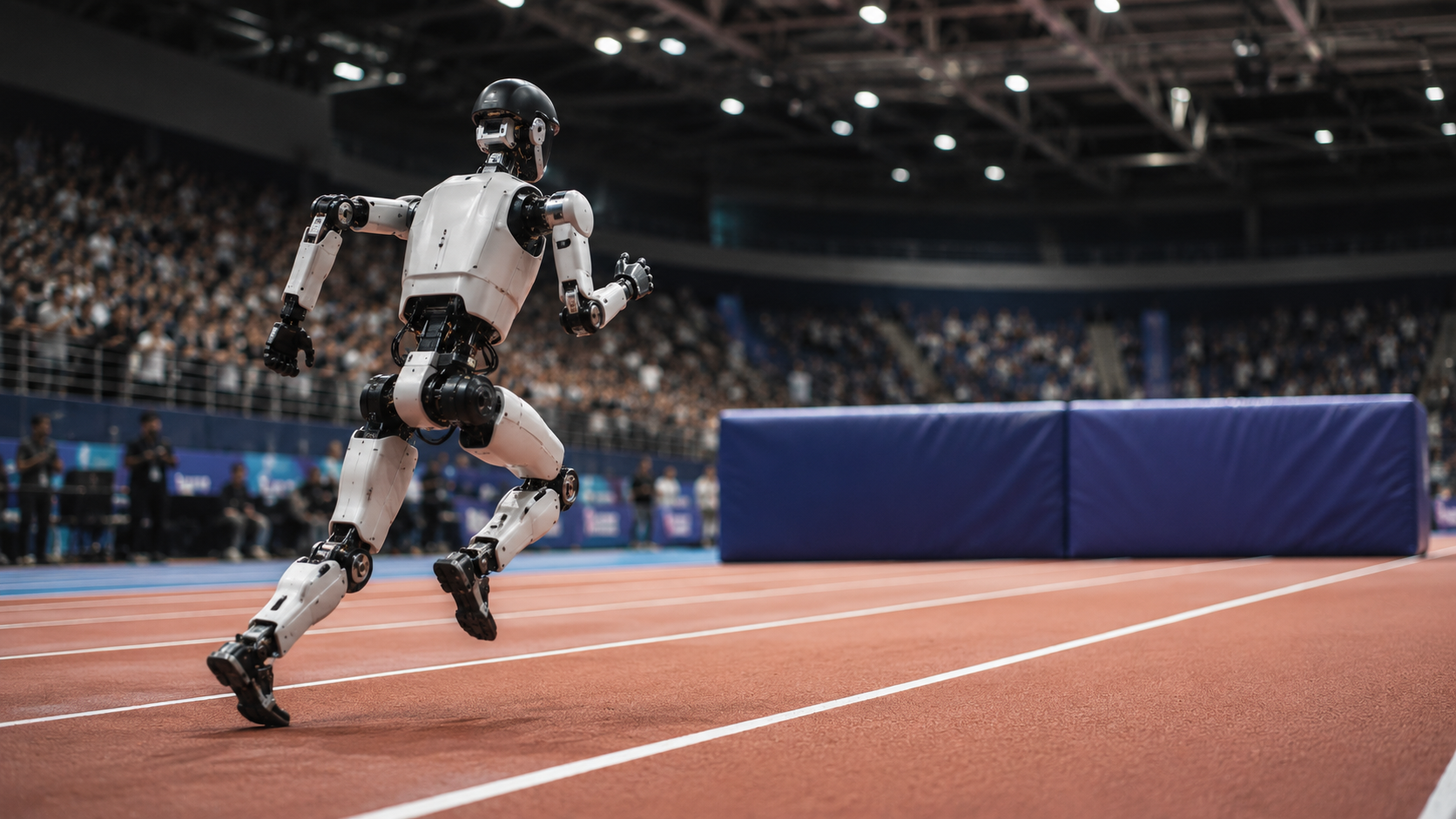
A two-legged robot raced through 100 meters in 8.86 seconds Tuesday(8/25/26), setting a new record during the World Humanoid Robot Games in Beijing. The machine finished the distance faster than any recorded human 100-meter time and also cut more than half a second from a robot record established only days before.
The previous best robot time was 9.39 seconds, recorded Saturday. For comparison, Usain Bolt ran 9.58 seconds in 2009, which remains the men’s human record.
Going that fast came with a problem at the finish. The robot did not slow down normally after completing the race. Instead, it hit a padded barrier and went down, and sparks came from around its waist after the collision.
Dennis Hong, a mechanical and aerospace engineering professor at the University of California, Los Angeles, said higher speeds create a difficult set of problems for machines that run on two legs. Keeping the robot balanced is harder, and its motors, controls and mechanical parts have to deal with stronger forces.
The crash at the end raises another issue. A fast robot is one thing, but a machine that may eventually work around people also needs to stop without causing problems. Hong said robots will need abilities such as dealing with obstacles, recovering after errors and continuing a task when something unexpected happens.
There is plenty of trial and error happening at the Beijing games. More than 2,000 humanoid robots are taking part, according to organizers, with competitors representing 16 countries. Germany, Japan and the United States are among them.
The program covers 51 events, and the machines are being tested in much more than sprinting. They play soccer and table tennis, lift weights and compete in tug of war. Other competitions are built around jobs a robot might someday perform, including work in homes and hotels or during emergencies.
Some attempts have gone badly. Robots have fallen during events, broken into pieces and, in a few cases, caught fire. Sprinting machines have also used padded cushions as a way to stop after reaching the end of a race. Some had to be carried away afterward.
The games have produced unusual results in jumping too. One X-Humanoid machine cleared 2.88 meters from a standing position. Javier Sotomayor’s human high jump record, which was set in 1993, is 2.45 meters. The two events are not performed in the same way, since the robot result came from a standing jump.
There was another fast sprint before the competition officially began. Honor said one of its humanoid machines completed 100 meters in 9.32 seconds during a trial and reached 14.5 meters per second at its fastest point.
The five-day event is being held at Beijing’s National Speed Skating Oval, a venue originally constructed for the 2022 Winter Olympics. It is the second year of the robot games, which are taking place as China expands its humanoid robotics industry.
Chinese manufacturers say government agencies and private companies have placed thousands of robot orders. The machines are still largely seen in research projects, demonstrations and performances rather than being widely used for everyday work.
For people watching in Beijing, that gap was visible during the competition. The robots could run at speeds beyond human records in some events, yet they could also finish a race by crashing into a cushion and being carried away.
This image is the property of The New Dispatch LLC and is not licenseable for external use without explicit written permission.