Saudi Arabia’s oil industry faced another attack Monday, November 9, when a fire broke out along a major crude transportation route near Medina. Authorities managed to put out the flames, and the incident did not interrupt the movement of oil through the pipeline.
An official from the country’s energy ministry confirmed the attack in a statement carried by the Saudi Press Agency. Emergency workers and technical personnel went to the location to check the equipment and secure the area. There were no reported injuries, and officials have not said what caused the damage or who might have carried out the attack.
The pipeline is currently handling a large share of Saudi Arabia’s oil shipments because the country has had to change how it gets crude to international markets. The war involving Iran, Israel and the United States has severely restricted passage through the Strait of Hormuz, a shipping route that normally carries oil from the Persian Gulf.
Saudi Arabia has been using its East-West pipeline to get around those restrictions. Crude travels across the country to Yanbu, a port on the Red Sea, rather than depending on ships passing through Hormuz.
The amount of oil moving along this route has grown during the conflict. According to figures reported by Reuters, Saudi Arabia has redirected approximately four million barrels each day toward Yanbu. That volume accounts for around four percent of worldwide oil supply.
The system was designed to move even larger quantities. Saudi Aramco lists its daily transportation capacity at approximately seven million barrels, with the route covering about 1,200 kilometers between the country’s eastern oil-producing areas and its western coast.
Keeping that connection working has allowed Saudi Arabia to continue sending crude abroad despite the problems affecting regional shipping. Other oil-producing countries have experienced more difficulty getting their exports out because of the restrictions at Hormuz.
The route has already been damaged once in recent months. In September, a series of drone attacks led to a temporary closure that lasted several days. Saudi officials said armed groups from Iraq were responsible for those strikes.
Monday’s incident came shortly after another reported attack involving Saudi Aramco. On Sunday, authorities said an administrative building belonging to the oil company in Riyadh had been targeted. Falling debris damaged part of the property, but nobody was injured.
Officials have not announced whether the two incidents are connected. Responsibility for the latest pipeline attack also remains unknown, with no organization publicly claiming to have carried it out.
The incidents come as Saudi Arabia remains involved in the conflict in Yemen, where government forces supported by Riyadh are fighting Houthi rebels. The Houthis have previously used drones and missiles against Saudi oil installations, including facilities used to process and store crude.
Saudi authorities have not accused the Houthis of carrying out Monday’s strike. The ministry has also provided no information identifying the weapons involved.
Following the fire, crews were assigned to assess conditions at the pipeline and check for safety concerns. The government reported that oil continued flowing through the route, with no announced changes to its operations.
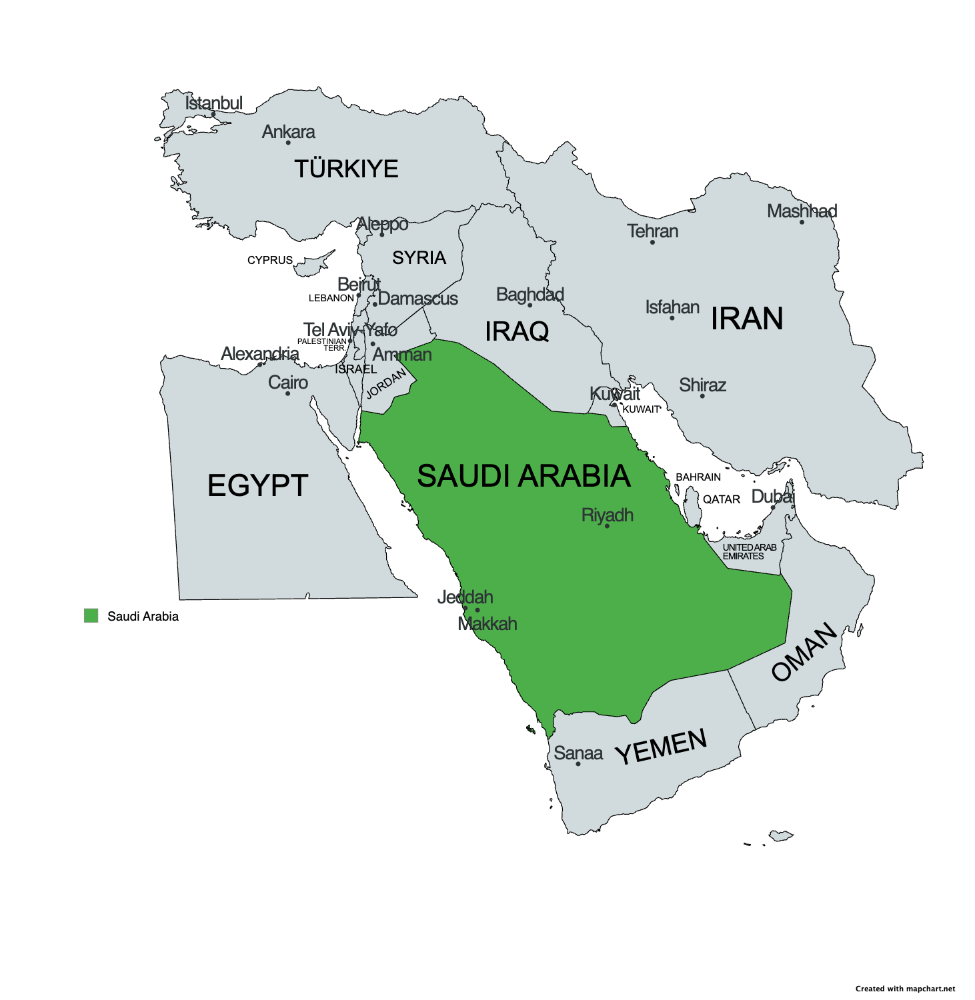
Saudia Arabia = Green
Image is licensed under the Creative Commons Attribution-Share Alike 4.0 International license and was created using MapChart (https://mapchart.net).