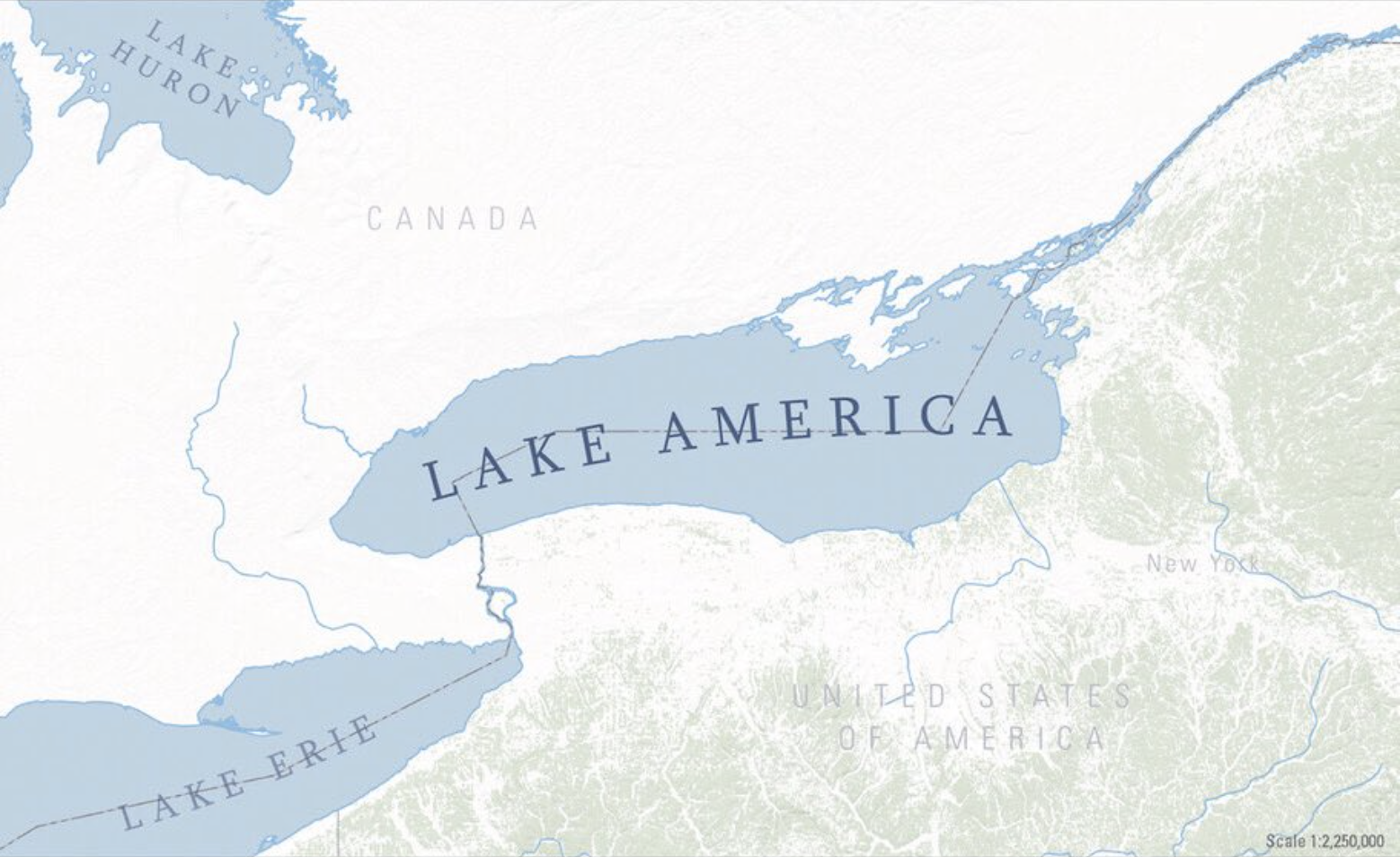
President Donald Trump signed an executive order Thursday changing what the U.S. government calls Lake Ontario. Under the order, federal agencies are now expected to refer to the Great Lake as “Lake America,” a name Canadian leaders have rejected.
Trump had mentioned the possible change Tuesday, after trade negotiations between the United States and Canada broke down days earlier. At Thursday’s signing, he marked up a paper map himself, replacing the old label with his preferred one.
The Interior Department was given responsibility for putting the decision into effect. The federal database that keeps official U.S. geographic names was changed within hours, so government maps, paperwork and communications will now reflect Trump’s choice.
The change only determines what the U.S. federal government calls the lake. It does not make Canada, businesses, other governments or individuals use Lake America instead of Lake Ontario.
Canadian Prime Minister Mark Carney responded by saying his country would keep the familiar name. He also discussed its origins, explaining that Ontario comes from “Ontari’io,” a Wendat term connected to descriptions of the lake as beautiful or great.
Carney said the name has roots going back more than 400 years. That history stretches to a period before Canada became a confederation and before the United States declared independence.
Other Canadian politicians rejected Trump’s decision as well. Ontario Premier Doug Ford said Sunday that people were not going to adopt Lake America, and Conservative opposition leader Pierre Poilievre argued that an American president cannot decide the lake’s name on his own.
Reaction also came from politicians south of the border. Vermont Republican Gov. Phil Scott criticized the move and said attention should instead be placed on resolving economic problems affecting families and businesses in both countries.
Some Democrats are looking to Congress for a response. Michigan Rep. Debbie Dingell plans to introduce legislation with New York Reps. Tim Kennedy and Joe Morelle that would overturn the order and stop presidents from making future name changes to the Great Lakes.
The dispute comes during a rough stretch in relations between the neighboring countries. Trade negotiations collapsed Aug. 21, tariffs followed, and Trump and Ford exchanged insults before Trump announced that he was considering the lake name change.
For Americans using Google Maps, the difference is already starting to show up. Google said its U.S. maps will display Lake America because its naming practices follow official American geographic records.
People opening Google Maps in Canada will still get Lake Ontario. Those using the service outside the two countries will be shown both names, similar to how Google handled Trump’s earlier change involving the Gulf of Mexico.
Indigenous groups have also spoken against the decision. Wendat Grand Chief Pierre Picard objected to replacing a name with deep Indigenous roots, while the Seneca Nation asked Trump to reverse his action.
The Seneca Nation pointed to an agreement dating to 1794 between the United States and Haudenosaunee leaders. Lake Ontario appears in that treaty when the boundaries of Seneca territory are described, and the Seneca language has its own name for the lake meaning “beautiful lake.”
Trump’s order gives U.S. environmental spending and the location of the lake’s deepest waters as reasons supporting the American name. Canadian officials, meanwhile, have continued calling the body of water Lake Ontario.
Image is in the public domain and was created by the U.S. Department of the Interior.