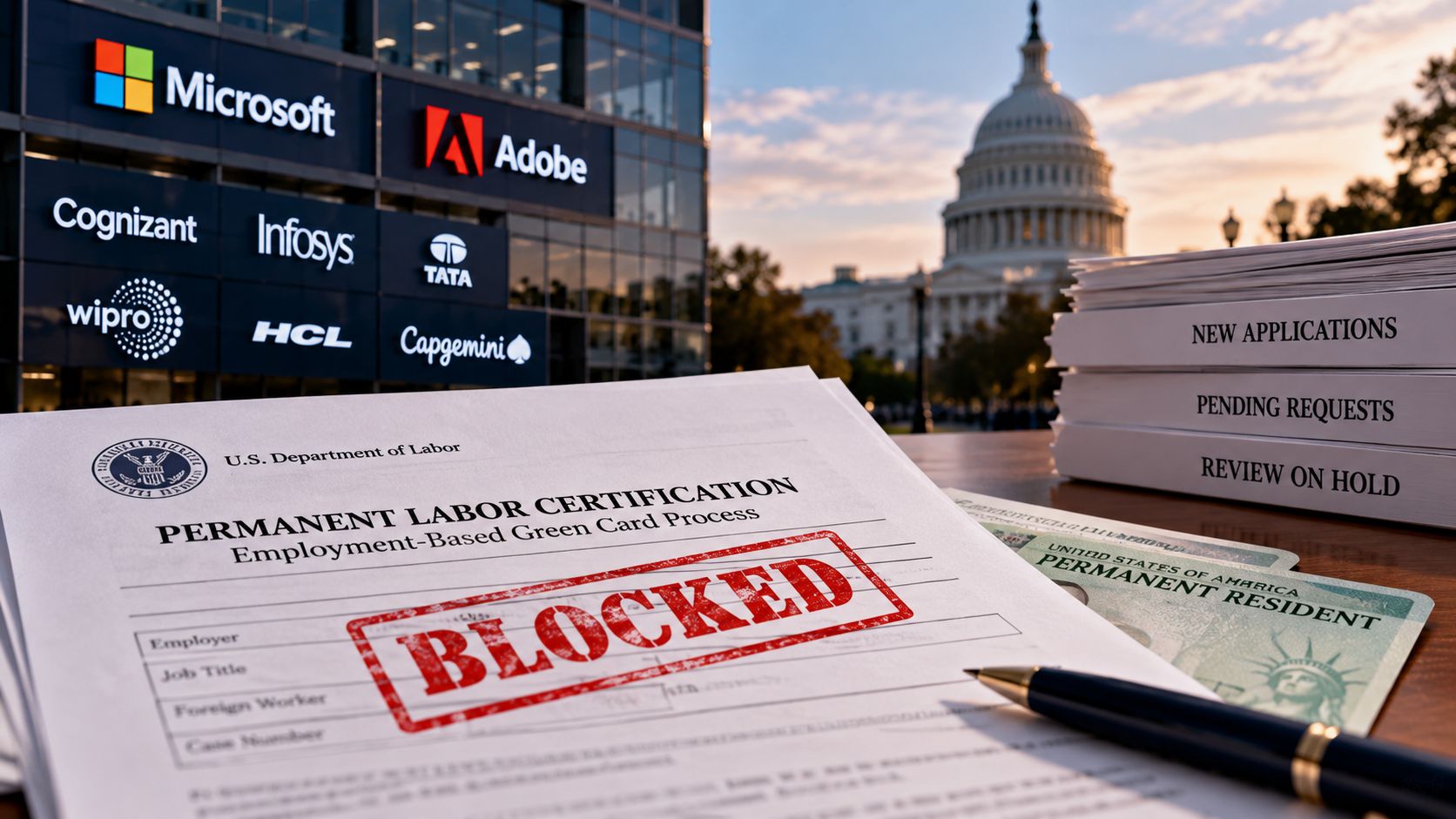
Eight major technology and consulting businesses have lost access to a federal immigration process used to help foreign employees remain permanently in the United States. The decision, announced October 8, affects Microsoft, Adobe and six companies that provide technology services to other businesses.
The Labor Department will no longer review new or pending requests from those employers under a system known as Permanent Labor Certification. The process is one of the steps companies ordinarily take when seeking employment-based green cards for workers who are not American citizens.
For employees hoping to remain in the country permanently, the change creates a new obstacle. Their employers cannot move forward with this part of the application process while the restrictions are in place. Vice President JD Vance said the suspension could continue indefinitely.
The administration says its concerns involve how employers recruit workers and whether Americans are being given a fair chance at available positions. Under the certification process, businesses must first establish that they cannot find suitable domestic applicants for particular jobs.
Microsoft became the main subject of criticism during Thursday’s announcement. Vance questioned the company’s decision to eliminate thousands of positions in 2025 while continuing to use immigration programs for its workforce. He argued that the company’s employment practices were putting American workers at a disadvantage.
The company rejected that account, explaining that many of its immigration filings were related to employees who already had jobs at Microsoft. According to its response, most of those requests involved maintaining or adjusting existing immigration status rather than recruiting additional workers.
Microsoft also defended the way it pays employees. It said people working in similar positions receive equivalent compensation, including those employed through the H-1B program.
H-1B visas permit foreign nationals to work temporarily in specialized occupations. The program is widely used in technology, where employers recruit people with particular technical backgrounds. Whether those arrangements help fill vacancies or reduce opportunities for American applicants has remained a point of disagreement.
Labor Secretary Keith Sonderling identified Adobe as another company facing active federal investigations. The remaining businesses covered by the suspension are Cognizant, Infosys, Tata, Wipro, HCL and Capgemini.
The decision came during a broader effort to change employment-related immigration rules. The administration has proposed substantially increasing the cost of H-1B visas after an earlier fee increase was rejected in federal court.
Microsoft faced the restrictions on the same day its chief executive received a federal technology award. President Donald Trump presented Satya Nadella with the National Medal of Technology and Innovation, recognizing his contributions to the industry.
Federal investigators are also examining how colleges use temporary exchange visas. Nine institutions, including Harvard, Yale, Stanford, Brown and MIT, are part of an inquiry into J-1 programs. Caltech, Arizona State, UC Davis and the University of Pittsburgh were also named.
Some universities have received subpoenas, and others have offered to cooperate with investigators. MIT said the federal government had already authorized its exchange visitors.
The administration separately proposed requiring colleges to pay $70,000 for each international student participating in Optional Practical Training, which allows eligible students to gain employment experience connected to their academic studies.
This image is the property of The New Dispatch LLC and is not licenseable for external use without explicit written permission.