Saudi Arabia was still trying to get its airports back to normal on Monday, October 12. After several days of attacks, flights were canceled across the country, the main airport in Riyadh remained closed, and there was no immediate end to the fighting with Houthi forces in Yemen.
For passengers, the disruption has been widespread. Nearly half of flights at Saudi airports were canceled Monday, according to aviation data company Cirium. King Khalid International Airport in Riyadh was expected to remain shut until October 17, leaving airlines and travelers with several more days of uncertainty.
The closure came after a particularly deadly weekend. An attack Saturday killed 13 people and injured more than 300 at the Riyadh airport. Saudi authorities said the victims included citizens of the kingdom and several foreign countries.
The explosion happened while people were waiting inside a terminal. Some were preparing to travel to religious sites, and others were seated nearby. Security footage showed a sudden flash, followed by passengers running or dropping to the floor as parts of the ceiling fell.
The next day, the airport was hit again. One person died and 11 were injured when a projectile struck Terminal 4 and caused a fire. By that point, flights had already been suspended because of Saturday’s attack.
Dammam, on the other side of the country, also experienced an airport strike Sunday. A passenger aboard a plane preparing to leave said something hit the ground near parked aircraft, starting a fire. The plane returned to its gate, and those aboard were told to get off.
The Houthis said they were responsible for attacks on Saudi airports and two facilities belonging to oil company Aramco. The group operates in Yemen and has backing from Iran. Saudi officials confirmed the Dammam airport attack and began checking the damage.
Saudi military forces reported intercepting additional missiles and drones in different parts of the country. Some of the threats were near Riyadh, while others were directed toward southern areas.
The fighting has been building in Yemen, where Saudi Arabia supports government troops trying to recover territory taken by the Houthis. The two sides have been at war since 2015, although a ceasefire in 2022 brought a period of reduced violence.
Houthi officials said Saudi forces had carried out 124 airstrikes in Yemen during a single day. They warned that more attacks against Saudi Arabia could follow if the military campaign continued.
The United States is considering becoming involved in those operations. President Donald Trump said a decision had not been made about joining Saudi strikes against the Houthis. Iran’s foreign minister, meanwhile, offered to help arrange talks.
The airport attacks have affected other activities in Riyadh. Schools moved classes online through Thursday, and foreign governments warned travelers about the risks of flying through Saudi Arabia.
An international energy conference continued in the capital despite the problems. Several executives from major oil companies were no longer on Monday’s schedule, and German officials were trying to arrange a flight home for Economy Minister Katherina Reiche.
This image is the property of The New Dispatch LLC and is not licenseable for external use without explicit written permission.
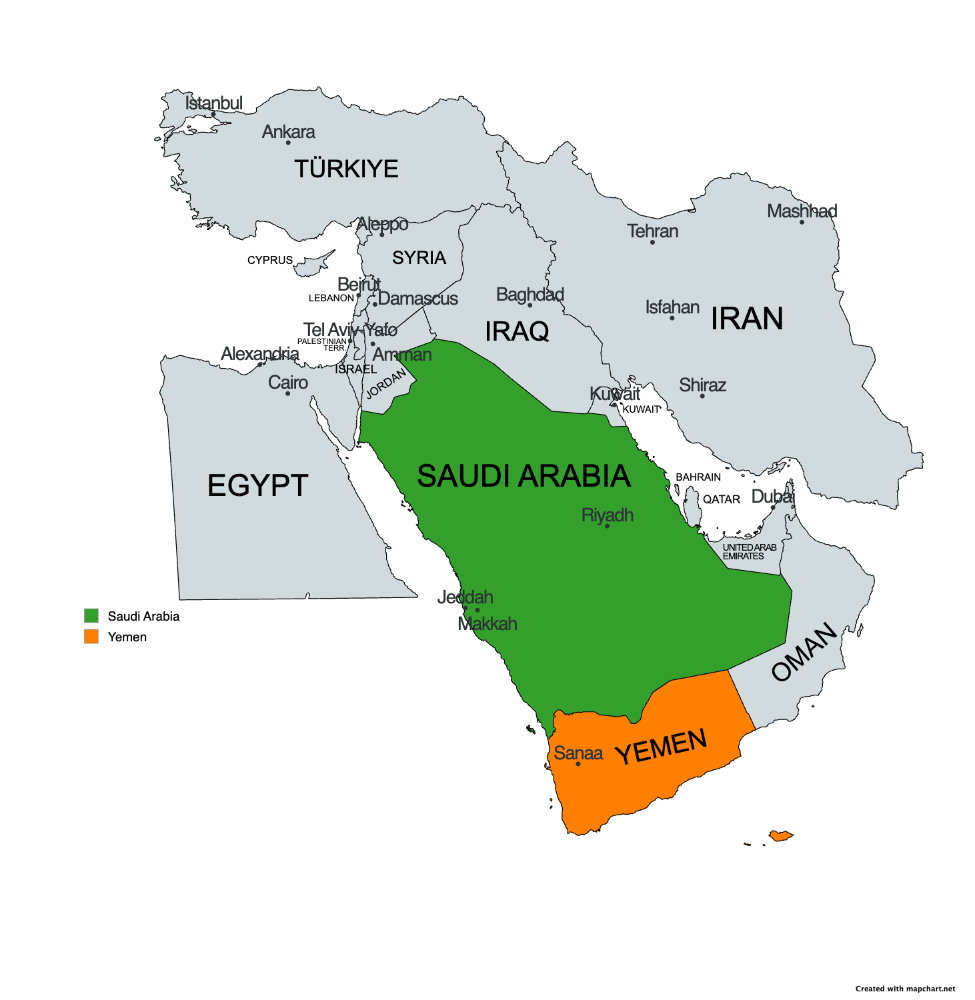
Saudi Arabia = Green
Yemen = Orange
Image is licensed under the Creative Commons Attribution-Share Alike 4.0 International license and was created using MapChart (https://mapchart.net).