Spain has moved to distance itself from the latest escalation in the Middle East, insisting that military facilities on its territory were neither used nor authorized for attacks on Iran following weekend strikes carried out by the United States and Israel.
Spanish Foreign Minister José Manuel Albares said Monday that the joint U.S.–Spanish bases at Rota and Morón de la Frontera remain under Spanish sovereignty and cannot be used for operations that fall outside bilateral agreements or international law. Speaking to Spanish television, Albares stressed that Madrid had not approved any use of the installations connected to the recent military action.
“The bases of Spanish sovereignty will not be used for anything that is not within the agreement with the United States or consistent with the United Nations Charter,” he said.
Flight tracking data reviewed by Reuters showed that at least 15 U.S. aircraft departed southern Spain after the strikes. Several of the planes, including aerial refueling tankers such as the Boeing KC-135 Stratotanker, were tracked landing at Ramstein Air Base in Germany. Nine aircraft were seen leaving Morón on Sunday, while others departed from the naval air station at Rota, with some routes not publicly visible.
Spanish Defence Minister Margarita Robles said the aircraft involved were permanently stationed in Spain and emphasized that their presence did not indicate Spanish participation in military operations.
Prime Minister Pedro Sánchez delivered one of Europe’s strongest criticisms of the strikes, describing them as unilateral actions that risk deepening instability across the region. Writing on social media, Sánchez warned the attacks could contribute to a more hostile international environment and increase tensions at an already fragile moment.
Madrid’s reaction has placed Spain apart from several European allies, many of whom called for restraint without directly criticizing Washington or Israel. Britain initially hesitated to allow the use of its own bases but later authorized access under what Prime Minister Keir Starmer described as collective self-defence.
Spanish officials also expressed concern about broader economic and security effects tied to the escalation. Albares warned that instability could disrupt shipping through the Strait of Hormuz, a key global energy route, potentially driving higher oil prices and affecting international markets.
While rejecting the U.S. and Israeli strikes, Spain also condemned Iran’s retaliatory attacks against Gulf countries and urged all parties to pursue diplomacy. Sánchez called for immediate de-escalation and full respect for international law.
The response reflects a wider shift in Spanish foreign policy in recent years. Madrid has taken a more independent stance on several international issues, including criticism of Israel’s military campaign in Gaza and advocacy for renewed multilateral diplomacy in the Middle East. Spain has also sought closer ties with Arab nations, positioning itself as a potential mediator while continuing to support a two-state solution to the Israeli-Palestinian conflict.
European leaders reacted with growing concern as the crisis unfolded. French President Emmanuel Macron called for an urgent meeting of the United Nations Security Council, while European Union officials urged all sides to avoid further military action that could widen the conflict.
As tensions remain high, Spain has continued to press for dialogue, arguing that diplomacy remains the only path capable of preventing further escalation across the region.
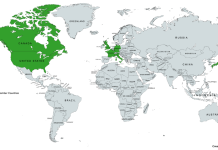
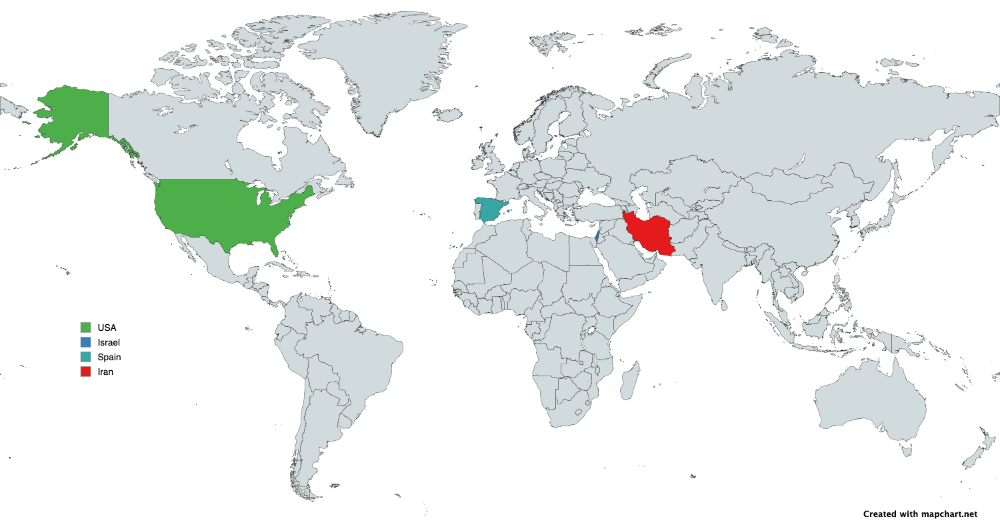
United States = Green
Israel = Blue
Spain = Teal
Iran = Red
Image is licensed under the Creative Commons Attribution-Share Alike 4.0 International license and was created using MapChart (https://mapchart.net).