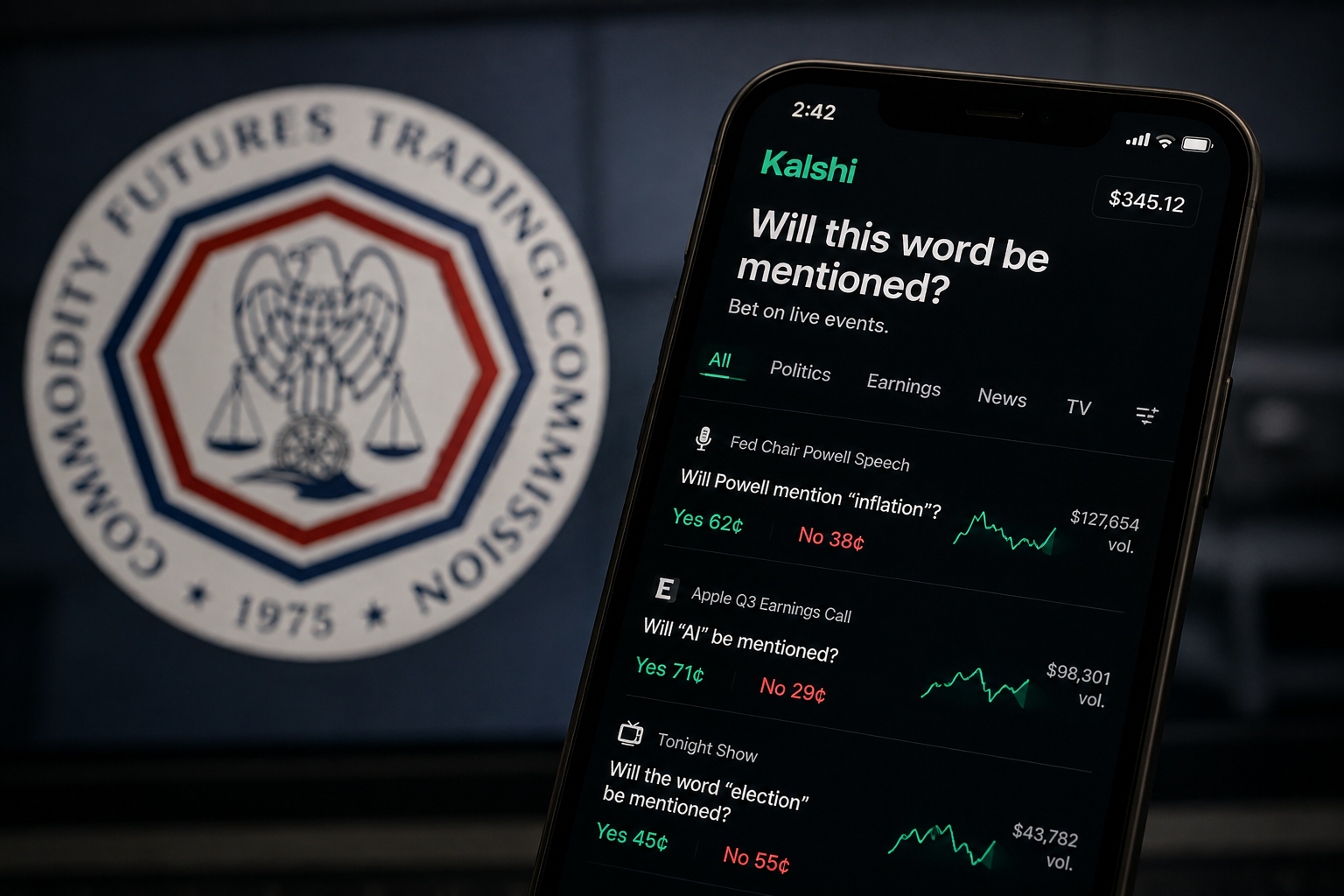
Federal regulators are reviewing “mention markets,” a type of prediction market where people bet on whether specific words will be said during speeches, sports broadcasts, earnings calls and other live events. The Commodity Futures Trading Commission is examining the markets amid concerns that they may be easy to manipulate.
Kalshi, the largest prediction market in the U.S., removed its sports-related mention markets after the CFTC began its inquiry. Those markets allowed users to bet on whether sportscasters would use words such as “MVP,” “ankle” or “redshirt.” They have been removed “until further notice,” and there is no confirmed date for when they might return.
Sports wagers make up more than 80% of the billions of dollars traded on Kalshi each week. Mention markets themselves had about $3.3 million in trading volume on the platform last month. Kalshi is still offering wagers connected to words spoken at political events, corporate earnings calls and live television newscasts.
The federal review follows an incident involving President Donald Trump’s longtime teleprompter operator. Regulators said the operator used Kalshi to make money by correctly betting on words Trump would or would not say during public appearances. The CFTC said in July that the former operator allegedly made $90,000 in profits. Kalshi said its surveillance system noticed the suspicious trades and reported them to federal authorities.
One person familiar with the CFTC’s discussions said mention markets have drawn skepticism from across the political aisle because they can potentially be manipulated. Kalshi and the CFTC declined to comment on the current review.
Prediction markets generally use a “self-certified” system. Platforms can introduce contracts after filing paperwork stating that they comply with federal rules for swaps, a type of financial derivative. One rule says a market cannot be “readily susceptible to manipulation.” Some regulators and Kalshi lawyers are concerned that certain speech-based bets may conflict with that requirement.
There have already been strange outcomes involving these types of markets. During Fox’s live broadcast of the World Cup final, traders on Kalshi placed millions of dollars in bets related to celebrities attending the event. A Fox sportscaster mistakenly identified Matt Damon as Brad Pitt. Several news organizations repeated the mistake.
Some of those outlets were used by Kalshi as “source agencies” to determine the outcome of its markets. Because of its contract rules, Kalshi settled the market as if Pitt had attended, even though he was not actually there. Bettors who wagered that Pitt was absent collectively lost $287,866.
Inside Kalshi, employees have also debated mention markets. Co-founder Luana Lopes Lara has supported them as a way to attract users interested in events outside sports, including award shows, reality television and earnings calls.
Polymarket, Kalshi’s main competitor, does not offer mention markets on its CFTC-regulated U.S. exchange but does offer them overseas. The CFTC’s Innovation Advisory Committee is scheduled to discuss prediction markets, artificial intelligence and cryptocurrency at an Aug. 20 meeting.
This image is the property of The New Dispatch LLC and is not licenseable for external use without explicit written permission.