NATO is trying to build a clearer picture of suspected Russian activity across Europe by getting member countries to exchange more of the information they collect about individual incidents. The effort comes as European governments deal with drones, suspected sabotage, cyberattacks and violations of their airspace.
Gen. Alexus Grynkewich, a U.S. Air Force officer and NATO’s senior military commander in Europe, has asked countries to provide details about suspected hybrid activity and what they did in response. Right now, information about an event in one country may not immediately be connected with something that happened somewhere else.
NATO officials believe bringing those pieces together could make it easier to spot patterns and determine responsibility. The alliance’s senior military leaders recently discussed the effort during a meeting in Copenhagen.
The push comes as Denmark’s intelligence service expects more Russian activity against Western countries that stops short of conventional warfare. That could include sabotage and cyberattacks, while Danish officials also see an increasing, though still low, possibility of a smaller military action against an alliance member located near Russia.
Moscow has denied responsibility for hybrid operations and sabotage inside NATO countries. Russia also says it is not seeking a military confrontation with the alliance.
Grynkewich does not believe an attack against NATO territory is likely at this point, but military planners are not completely excluding that possibility. He said he has the authority necessary to act if NATO begins detecting signs that aggression against a member country may be developing.
A number of events are being watched as part of the broader security picture. German authorities recently faced a drone-related attempt involving Leipzig/Halle Airport, while another encounter involved a Danish military helicopter and flares launched from a Russian vessel.
There have been separate airspace incidents farther east. A Russian military helicopter was inside Polish territory for approximately 42 seconds after crossing from the Kaliningrad region, and Romania reported that a Russian strike drone entered its territory from Ukraine before coming down in a forest.
NATO has not responded to these developments by declaring that a Russian military attack is about to occur. Its current assessment does not identify such an attack as imminent.
The intelligence-sharing effort could give NATO another way to respond to activity that does not rise to the level of traditional warfare. It may also help countries establish connections between events sooner rather than examining each one separately.
The alliance is changing some of its leadership arrangements as this is happening. A British general is replacing an American naval officer at NATO’s command based in Norfolk, Virginia, a headquarters with responsibilities involving northern Europe and the Arctic.
The Norfolk command also plays a role in keeping military supplies moving between North America and Europe. Another NATO command, located in Naples, is set to come under European leadership as well.
These changes are taking place while European countries assume more responsibility for defense and Washington reviews its military presence on the continent. Roughly 80,000 American troops are currently based in Europe, and no final decision has been made about how many will remain or whether particular U.S. capabilities will be relocated.
NATO is also preparing an initiative involving private companies that operate important energy infrastructure. The program is expected to begin in November and include security briefings and exercises, along with work on defenses against drones, physical attacks and threats involving advanced artificial intelligence.
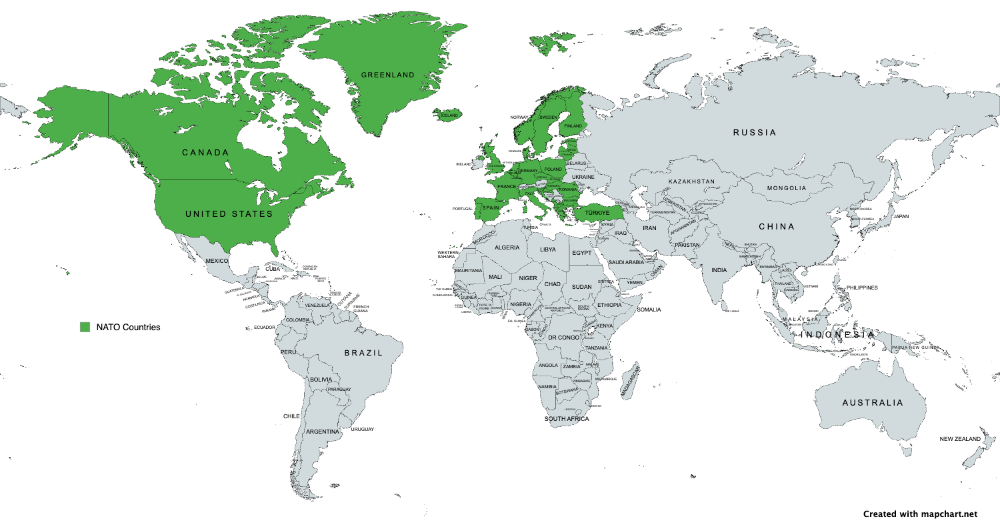
NATO Countries = Green
Image is licensed under the Creative Commons Attribution-Share Alike 4.0 International license and was created using MapChart (https://mapchart.net).