China launched a new wave of military drills this week in the waters and airspace surrounding Taiwan, heightening concerns across the Asia-Pacific. The exercises, which began Tuesday and extended into Wednesday, featured a broad deployment of aircraft, navy vessels, and missile units, including an aircraft carrier battle group. Taiwan has responded by activating its own forces and closely tracking movements across the Taiwan Strait.
The drills, which were not given a formal code name until Wednesday’s announcement of “Strait Thunder-2025A,” were described by Chinese authorities as a stern warning to Taiwan’s leadership. China’s military stated that the operations were aimed at preventing efforts by Taiwan to assert further independence from the mainland. No prior notice was given for the drills, which involved land, sea, and air elements of the People’s Liberation Army (PLA).
Beijing views Taiwan as part of its national territory and has vowed to reclaim it, by force if necessary. Taiwan’s government, however, continues to assert its de facto independence and democratic system of governance. Taiwanese officials, including Defense Minister Wellington Koo, have criticized the PLA’s drills as an attempt to undermine regional stability. Taiwan’s Presidential Office further accused China of threatening peace and security not only in the Taiwan Strait but across the broader Indo-Pacific.
In response to the growing military pressure, Taiwan has deployed aircraft, naval assets, and missile systems. Its Defense Ministry reported detecting over 70 Chinese military aircraft and more than a dozen naval vessels operating near the island within a 24-hour period. Some of the aircraft reportedly crossed the Taiwan Strait’s median line — a buffer zone long respected in practice but not officially recognized by Beijing.
China’s state media has taken a sharp tone, publishing videos and posters aimed at President Lai Ching-te, who has openly criticized the mainland and proposed security measures that restrict Chinese influence on the island. One video released by the PLA depicted Lai as a green insect, an image Taiwan officials condemned as inflammatory and dehumanizing.
Despite the sharp rhetoric, Taiwan’s civilian life remained largely unaffected, with most residents focused on economic issues. Local sentiment suggests that many in Taiwan are growing accustomed to Beijing’s increasingly frequent military demonstrations.
The exercises also come shortly after U.S. Defense Secretary Pete Hegseth visited key regional allies, including Japan and the Philippines. The U.S. has reiterated its support for Taiwan, condemning China’s actions as provocative. A State Department spokesperson stated that the United States remains opposed to any effort to alter the status quo through coercion or force.
Military officials in the Philippines, located just south of Taiwan, are preparing contingency plans to evacuate thousands of Filipino workers in the event of a conflict. This highlights growing concern among regional governments that a flashpoint in the Taiwan Strait could trigger broader consequences.
The drills are seen by analysts as a show of strength and a way for China to test its joint operation capabilities. But they also raise concerns about the potential for miscalculation, especially amid ongoing diplomatic strain and unresolved cross-strait disputes.
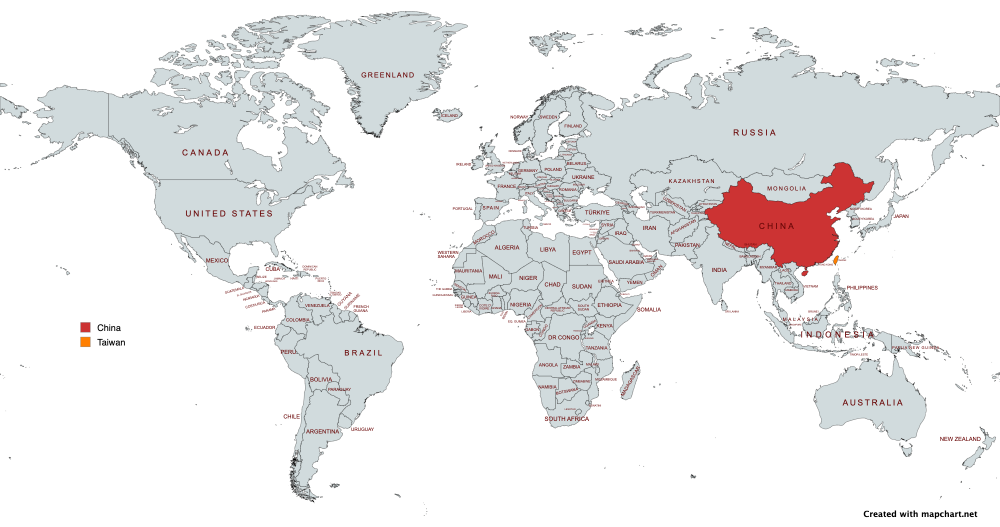
China = Red
Taiwan = Orange
Image is licensed under the Creative Commons Attribution-Share Alike 4.0 International license and was created using MapChart (https://mapchart.net).