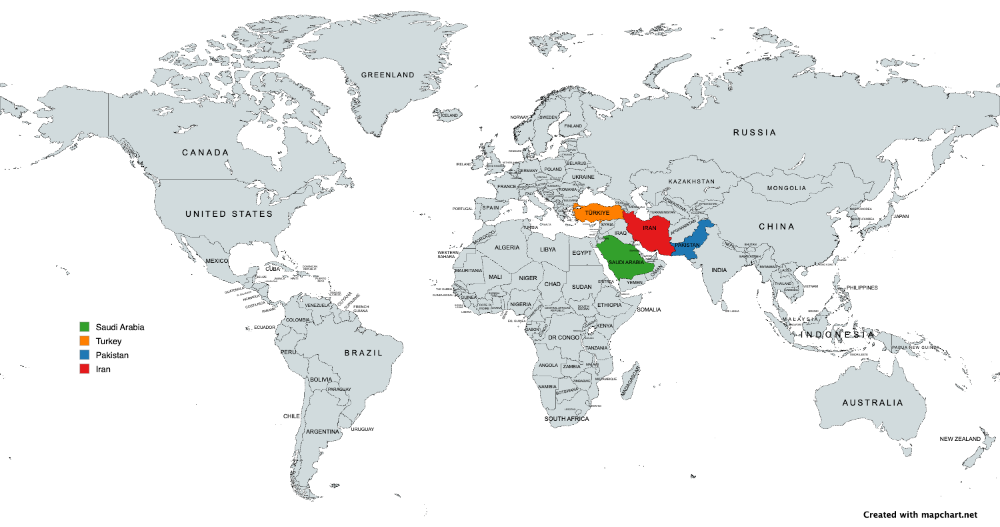
Eight months into the war involving Iran, efforts to prevent another major confrontation are continuing through diplomatic meetings and indirect communication with Washington. The latest discussions took place Monday in Tehran, bringing together governments that have their own concerns about what another round of fighting could mean for the region.
Saudi Arabia, Turkey and Pakistan sent representatives to the Iranian capital for meetings about security and the possibility of reducing military tensions. The three countries formed a defense alliance in August, and this was their first joint visit to Iran since that arrangement began.
The gathering ended without a new agreement. Iranian officials gave a favorable account of the conversations, and the governments involved said they intended to remain in contact.
Iranian President Masoud Pezeshkian participated in the discussions alongside Foreign Minister Abbas Araghchi. Mohsen Rezaei, who heads the country’s Supreme National Security Council, also met with the visitors and spoke positively about the atmosphere surrounding the negotiations.
The Saudi delegation was led by Defense Minister Khalid bin Salman. Pakistan’s army chief, Asim Munir, attended, as did Ibrahim Kalin from Turkey’s intelligence service. Their conversations included the situation in Yemen, where military activity has continued despite attempts to prevent a wider conflict.
Saudi Arabia has faced repeated threats from the Houthi movement, which controls Yemen’s capital, Sanaa. The group announced Tuesday that it had launched a missile toward the Ras Tanura oil complex on the Saudi coast.
Houthi representatives reported a fire following the operation. The facility includes a refinery and a terminal handling oil shipments, although Saudi authorities had not immediately confirmed the group’s account of the attack.
Other Houthi statements concerned military aviation facilities in southern Saudi Arabia. The group reported operations involving aircraft at Najran and Khamis Mushait, but officials in the kingdom did not immediately verify those claims.
The capital also experienced a security warning Tuesday. Authorities in Riyadh briefly alerted residents to an aerial threat, and coalition officials subsequently reported that two missiles had been destroyed before reaching the city.
In Yemen, government forces backed by Saudi Arabia have regained coastal positions lost during September. Houthi fighters have continued resisting further advances, including one they reported stopping in the vicinity of the Bab el-Mandeb shipping passage.
The fighting has broken the ceasefire arrangement reached through United Nations mediation in 2022. Concerns about oil transportation have grown as attacks and military operations continue near facilities and waterways used for exports.
Meanwhile, Qatar has been involved in a separate diplomatic effort. Its representatives traveled to Tehran on Sunday, and Iran’s Foreign Ministry acknowledged that communication with the United States was continuing through intermediaries.
President Donald Trump has left further American military action as a possibility. Turkish President Recep Tayyip Erdogan has warned that another escalation could affect countries beyond those directly fighting.
Egypt’s parliament has authorized possible defensive assistance to Saudi Arabia if requested. No details have been provided about what Egypt might supply, while United Nations Secretary-General Antonio Guterres has urged governments to avoid another major exchange of attacks.
Saudi Arabia = Green
Turkey = Orange
Pakistan = Blue
Iran = Red
Image is licensed under the Creative Commons Attribution-Share Alike 4.0 International license and was created using MapChart (https://mapchart.net).