Japanese food companies are changing the packaging of some popular products as supply problems tied to the conflict in the Middle East continue affecting materials used in printing ink.
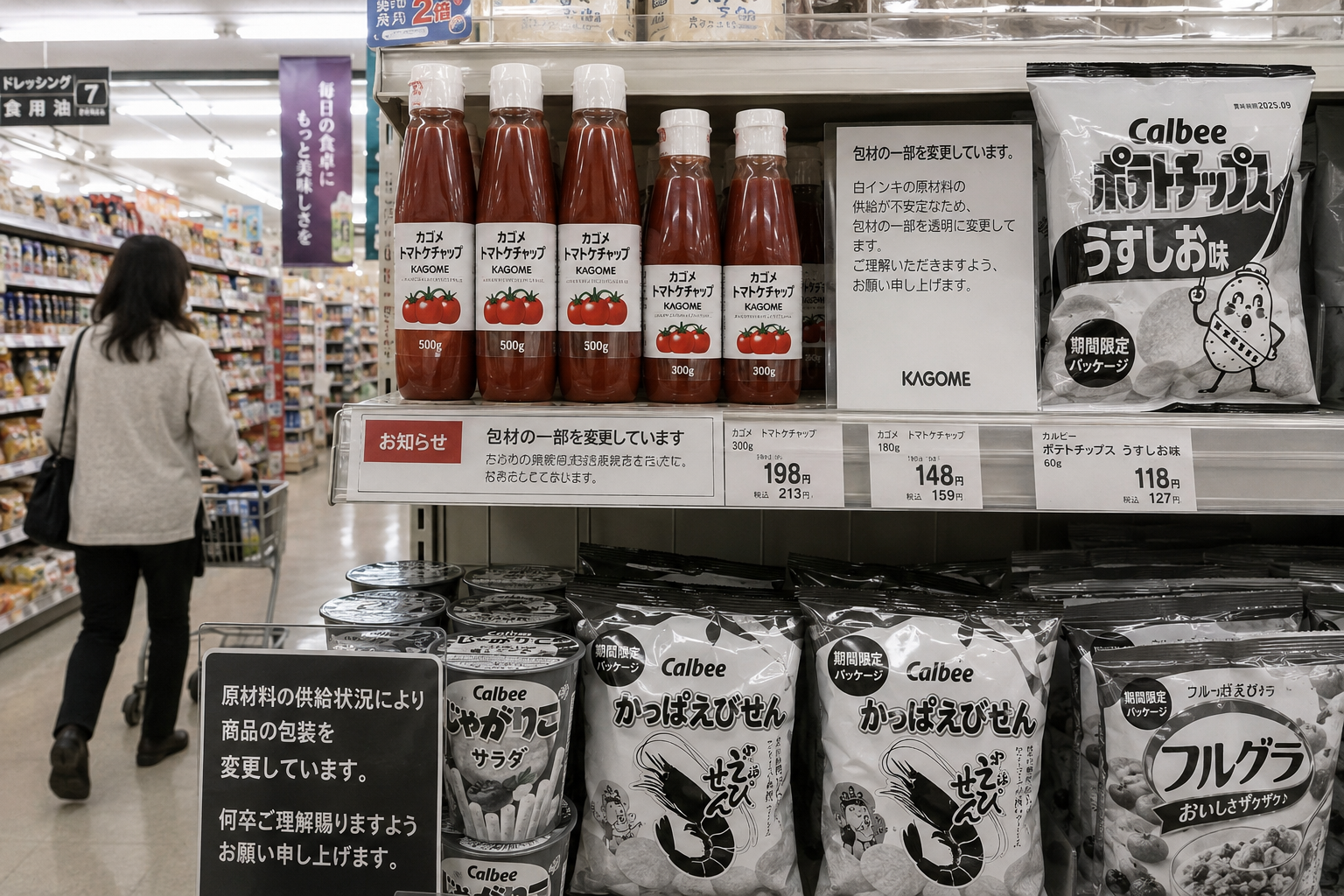
Kagome Co. announced Thursday that several of its tomato ketchup products will soon appear in simpler packaging because of shortages involving raw materials used to make white ink. The company said the lower half of its ketchup bottles will become transparent instead of fully covered with the usual tomato illustrations and white background.
The packaging changes will apply to Kagome’s 500-gram, 300-gram and 180-gram ketchup bottles. The redesigned versions are expected to start appearing in stores later this month.
Kagome explained on its website that replacing the white ink has been difficult because of “printing compatibility.” White ink is used as the base layer in the package printing process.
The announcement came only a few days after snack company Calbee revealed similar plans. Calbee said it would temporarily switch 14 snack products to black-and-white packaging as supplies of oil-derived materials become tighter.
The affected products include some of the company’s best-known potato chip flavors, along with Kappa Ebisen snacks and Frugra cereal products. Calbee said the monochrome packaging will begin rolling out on May 25.
The shortages are linked partly to naphtha, a petroleum-based material used in making printing inks, plastics and synthetic rubber. Japan imports around 40 percent of its naphtha from the Middle East. Shipping disruptions in and around the Strait of Hormuz have made supplies less stable in recent months.
The waterway is one of the world’s main oil shipping routes. Since fighting involving Iran escalated earlier this year, transport through the area has faced repeated disruptions. Companies that depend on oil-related materials are starting to feel the effects.
Calbee said its packaging changes are meant to help maintain stable product shipments during the supply issues. The company also announced price increases for 25 snack products starting Sept. 1.
Potato chip prices are expected to rise between 5 and 10 percent. Jagarico snack products will increase by around 3 to 10 percent. The higher prices will also apply to products sold in the temporary black-and-white packaging.
Some international chemical and ink manufacturers have already raised prices because of rising material and energy costs. U.S.-based Sun Chemical said higher raw material, logistics and energy expenses were forcing broad price increases across product lines.
German ink manufacturer Hubergroup also announced higher prices, saying key materials were experiencing major cost increases tied to supply constraints.
Another material affecting the industry is nitrocellulose, which is used in both printing inks and military explosives. Demand for nitrocellulose has increased in Europe following higher defense spending and the war in Ukraine. That has tightened supply for civilian industries that use the material for packaging and coatings.
Japanese government officials said they are monitoring the situation and working with companies dealing with shortages. Deputy Chief Cabinet Secretary Kei Sato said imports from outside the Middle East had increased this month compared to levels before the conflict began in late February.
“We have not received any reports of immediate supply disruption for printing ink or naphtha,” Sato said during a briefing.
Other companies in Japan have also been adjusting operations because of supply problems and rising petrochemical costs. Snack maker Yamayoshi Seika temporarily suspended production of one product after difficulties securing heavy oil for factory operations. Food manufacturer Mizkan halted sales of some items and raised prices on others because of shortages involving containers and other petroleum-based materials.
This image is the property of The New Dispatch LLC and is not licenseable for external use without explicit written permission.