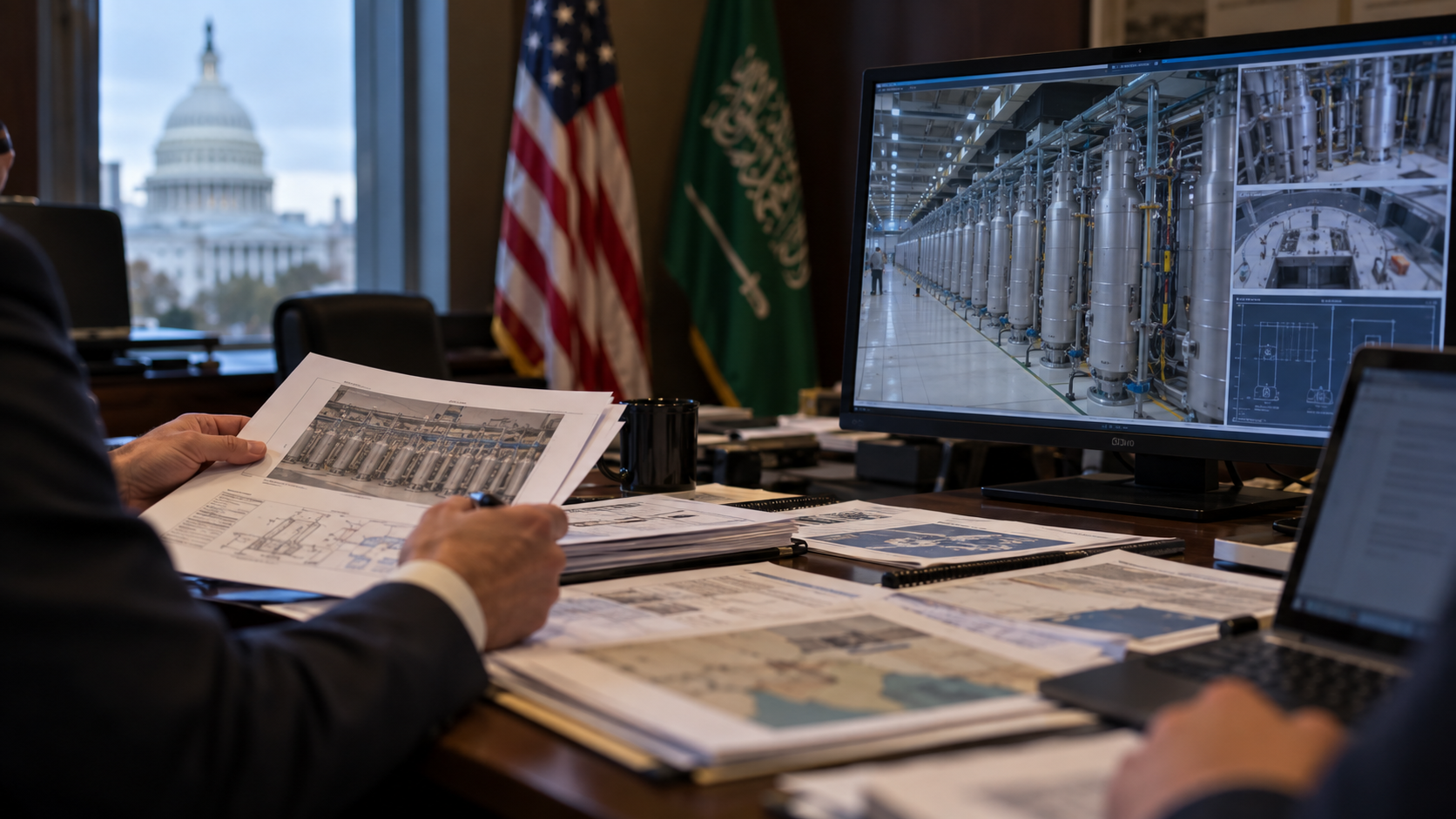
Congress is examining new information about Saudi Arabia’s possible long-term nuclear ambitions while reviewing an agreement that could greatly expand U.S. involvement in the kingdom’s civilian nuclear industry. Intelligence materials sent to lawmakers indicate that American analysts believe Riyadh is still leaving open the option of pursuing nuclear arms someday.
The United States and Saudi Arabia completed the agreement in July after years of negotiations. It creates a framework for American companies to work on Saudi nuclear facilities, including civilian power plants, with potential projects worth tens of billions of dollars.
Uranium production has become a major part of the debate. Saudi Arabia would begin by obtaining enriched fuel from abroad, rather than producing it inside the country.
For two years, Washington and Riyadh would examine whether there is an economic reason for Saudi Arabia to develop its own enrichment operation. They would also consider what protections would be required if the idea moves ahead.
Any facility approved after that review would involve U.S. companies and other suppliers. The first stage would keep enrichment at a relatively low level, below 5%.
The agreement does not necessarily make that a permanent ceiling. A later evaluation could result in permission for Saudi facilities to process uranium at concentrations reaching 20%, but the two governments would have to formally approve such a change.
Experts cited in the provided material say uranium at that level still has civilian purposes. Their concern is that reaching that concentration means a large portion of the technical effort needed to eventually reach weapons-grade levels has already taken place.
The Trump administration argues that American participation would make it harder for the civilian program to be redirected toward military purposes. U.S. companies would control enrichment activities, and the technology they use would not be transferred to Saudi Arabia.
Administration officials also say Riyadh could seek nuclear assistance from China or Russia if the United States does not participate. The State Department has expressed greater confidence in the safeguards and Saudi assurances than the intelligence assessment appears to provide.
Saudi Arabia maintains that its nuclear plans are peaceful. At the same time, the kingdom declined to permanently give up domestic enrichment during negotiations and did not accept the IAEA’s Additional Protocol. The United Arab Emirates accepted tighter conditions in its 2009 agreement with Washington.
Questions about Saudi intentions also go back several years. Crown Prince Mohammed bin Salman said in 2018 that the kingdom’s nuclear decisions would change if neighboring Iran succeeded in obtaining an atomic weapon. In that situation, he indicated Saudi Arabia would pursue the same capability.
Some Democratic senators have raised objections to the agreement. Jeff Merkley of Oregon and Ed Markey of Massachusetts were among lawmakers who contacted Secretary of State Marco Rubio about the direction the Saudi program could take if domestic enrichment is eventually approved.
The agreement is now before Congress for a review lasting 90 days while lawmakers are in session. Stopping it would ultimately require enough congressional support to overcome a presidential veto.
There is also a diplomatic requirement separate from the nuclear provisions. Trump has said implementation depends on Saudi Arabia normalizing relations with Israel and joining the Abraham Accords.
This image is the property of The New Dispatch LLC and is not licenseable for external use without explicit written permission.