Military strikes carried out by the United States and Israel against Iran have heightened tensions across the Middle East and introduced fresh uncertainty into global energy markets, raising concerns about oil supply disruptions and broader economic fallout. While the full consequences remain unclear, analysts say the greatest risks may depend less on immediate damage and more on how Iran chooses to respond in the coming days and weeks.
President Donald Trump announced that U.S. forces had joined Israel in what he described as major combat operations aimed at weakening Iran’s ballistic missile capabilities and nuclear program. Israeli officials said their air force targeted locations connected to senior Iranian political and military leadership. Satellite imagery and early reports suggest heavy damage at several sites in Tehran, including areas associated with the country’s leadership infrastructure. Iranian Foreign Minister Abbas Araghchi said senior commanders may have been killed but insisted the government remains intact.
Iran responded quickly, launching missiles and drones toward Israel and U.S. military installations across the region, including bases in the United Arab Emirates, Qatar, Kuwait, Bahrain, and Jordan. Security agencies in the United States have increased patrols around sensitive locations, though officials say no specific domestic threats have been identified.
Financial markets were closed when the attacks occurred, leaving traders waiting until late Sunday to gauge investor reaction. Oil prices had already been edging higher for weeks amid fears that military action could threaten supply routes or production facilities. Iran continues to export roughly 1.9 million barrels of oil per day despite sanctions, largely through a network of tankers designed to conceal shipments. Much of that oil flows to China, which analysts say maintains large strategic and commercial reserves that could cushion short term disruptions.
Experts caution that the largest danger lies not in Iranian exports themselves but in potential retaliation affecting regional infrastructure. Iran controls the Strait of Hormuz, a narrow waterway through which roughly 20 million barrels of oil and petroleum products pass daily, about one fifth of global demand. Any attempt to restrict shipping there could trigger rapid price increases and strain supply chains worldwide.
Political risk consultant Raad Alkadiri warned that spillover effects could reshape energy markets if the conflict widens. Strikes against Gulf producers such as Saudi Arabia, Kuwait, the United Arab Emirates, or Qatar would likely have far greater consequences than disruptions tied solely to Iranian exports.
For now, global oil supply remains relatively abundant, helping prevent sharper price swings even as tensions rise. During earlier confrontations between Iran and Israel last year, both sides avoided targeting energy infrastructure, allowing markets to remain stable. Whether that restraint continues may determine how severe the economic impact becomes.
Diplomatic pressure is mounting as well. The United Nations Security Council has scheduled an emergency meeting following condemnation from Russia and calls from China for an immediate halt to military action. Araghchi said Tehran remains open to de escalation talks if attacks cease, arguing that negotiations over Iran’s nuclear program had been close to reaching agreement before the strikes occurred.
As the situation develops, energy traders, policymakers, and governments worldwide are watching closely. The next phase of the conflict, especially any threat to shipping routes or neighboring producers, may shape oil prices and economic stability far beyond the Middle East.
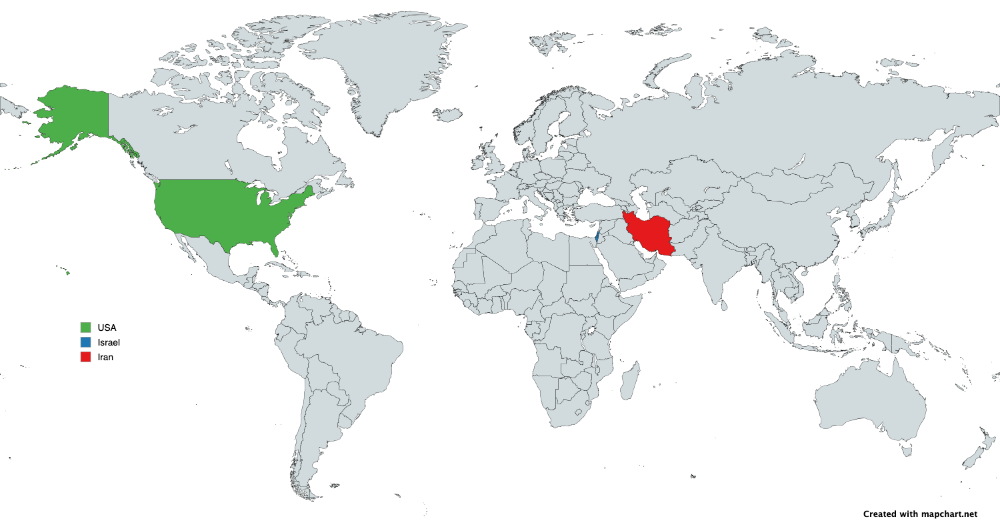
United States = Green
Israel = Blue
Iran = Red
Image is licensed under the Creative Commons Attribution-Share Alike 4.0 International license and was created using MapChart (https://mapchart.net).