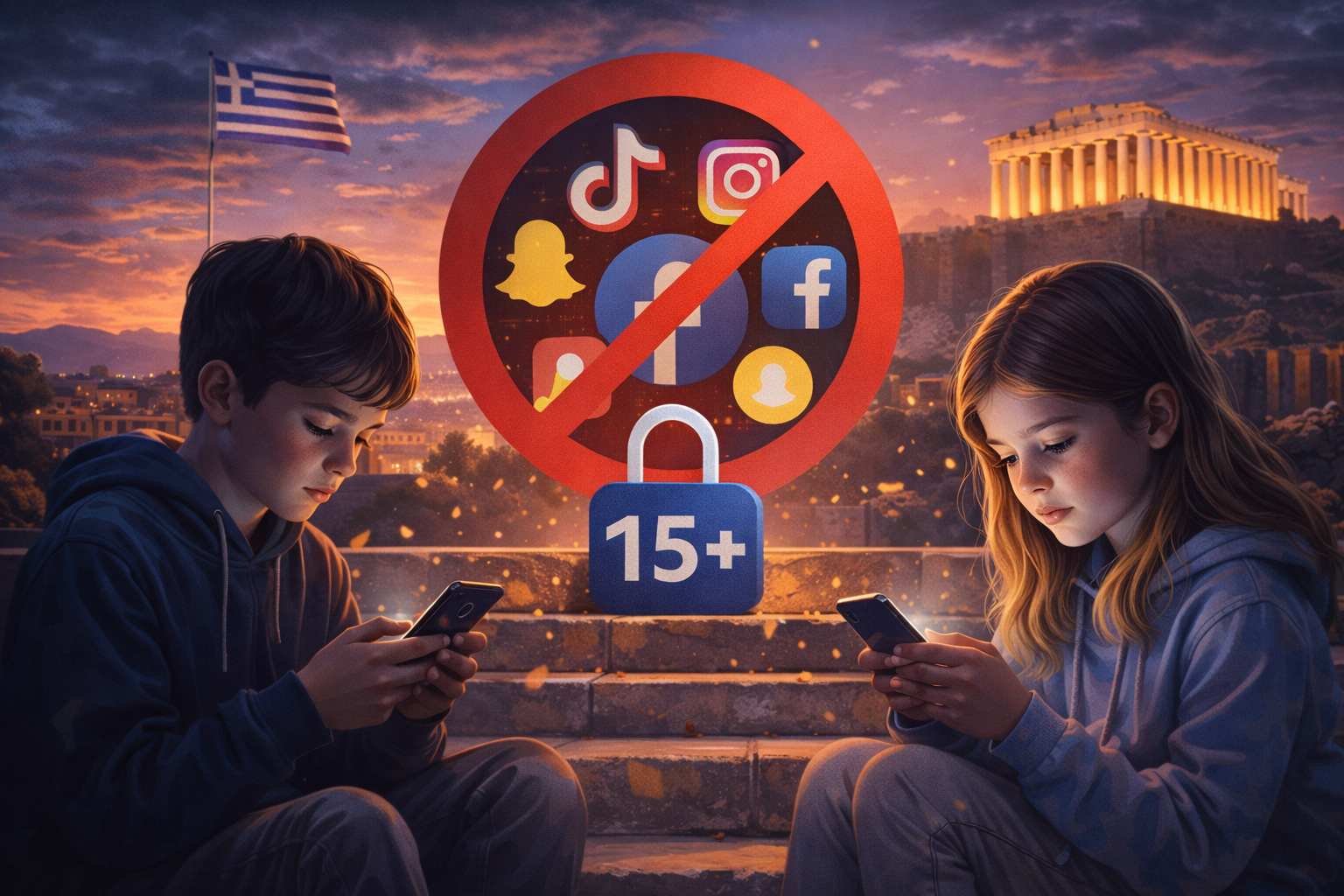
Greece is moving forward with a plan to restrict social media access for younger users, announcing that children under the age of 15 will be banned from using these platforms starting on 1 January 2027. The policy was introduced by Prime Minister Kyriakos Mitsotakis, who said the decision was based on growing concerns about children’s mental health, sleep patterns, and the design of social media apps.
In a video shared on TikTok, Mitsotakis addressed younger audiences directly, explaining that the goal is not to remove technology from their lives. Instead, the government wants to reduce the negative effects linked to long hours spent online. He pointed to research suggesting that excessive screen time can prevent children’s minds from properly resting. He also acknowledged that many young people may not agree with the decision.
The proposed law is expected to go before Greece’s 300-seat parliament in the summer, where the ruling New Democracy party holds a majority. If approved, the measure will apply to all children born after 2012 and will block access to platforms such as Facebook, Instagram, TikTok, and Snapchat. Unlike some other countries, the Greek plan does not allow exceptions based on parental consent. Instead, enforcement will rely on a state-required application installed on personal devices.
This move builds on earlier steps taken by the Greek government. Mobile phones have already been banned in schools, and tools for parental control have been introduced to help limit screen time. Officials say these efforts reflect ongoing concerns raised by parents and teachers, including reports of cyberbullying and children becoming overly dependent on apps.
Greece is not the only country exploring restrictions like this. France has begun passing similar legislation, while Australia has already introduced a ban affecting children under 16. Other countries, including Spain, Denmark, Poland, and Malaysia, are also considering or developing comparable laws.
Public opinion across Europe appears to support these kinds of restrictions. Surveys show that majorities in several countries favor limiting social media use for younger age groups. In some cases, support reaches close to 80%, particularly among parents of children under 18. However, views differ on whether such bans will actually work. In countries like the United Kingdom, many people who support the idea still question how effective it will be in practice.
In Greece, concerns about the impact of social media have also come from educators. Some teachers report that students are arriving at school extremely tired, which they link to late-night screen use. A retired primary school headteacher described a noticeable change in children’s behavior over the years, connecting it to increased exposure to screens.
Alongside national measures, Mitsotakis has called for broader action at the European level. In a letter to European Commission president Ursula von der Leyen, he argued that individual countries cannot address the issue alone. He proposed creating a unified system for verifying users’ ages across the European Union by 2027.
As Greece prepares to implement the ban, it is positioning itself among the first European countries to take this step. The plan reflects a wider debate about how to balance access to technology with concerns about its effects on younger users.
This image is the property of The New Dispatch LLC and is not licenseable for external use without explicit written permission.