Military exercises in southeastern Poland have become part of an investigation into three Russian weapons that reached the country on Friday, November 20. Polish leaders are questioning whether their arrival was connected to the presence of European troops training nearby.
The incidents occurred while Russia was carrying out an extensive overnight attack on Ukraine. Although no injuries or damage were reported in Poland, the government responded by deploying military aircraft and contacting NATO officials.
Prime Minister Donald Tusk expressed concern about the circumstances. He questioned whether Moscow had deliberately allowed the weapons to cross into Poland, rather than the objects arriving there because of an error during the attacks on Ukraine.
At the center of those concerns is Koalicja 2026, a training operation taking place at Nowa Dęba. Military personnel from 11 European countries are participating in preparations for possible duties in Ukraine if a peace agreement eventually brings the war to an end.
Defense Minister Władysław Kosiniak-Kamysz said he also suspected a provocation. He indicated that Poland would seek additional assistance from NATO as authorities continued examining the incidents.
Investigators were sent to three communities in the southeastern part of Poland. Near Nowy Lipowiec, they identified a Russian Kh-101 cruise missile. The community is located approximately 31 miles from the Ukrainian border.
Authorities were also examining an object found near Rudnik nad Sanem, which they believed could be another missile. A separate discovery near Mołodycz was thought to involve an unmanned aircraft equipped with a jet engine.
The incident at Nowy Lipowiec happened shortly after 6:30 a.m. Natalie Szponar, who lives in the area, was getting her children ready for school when she heard a whistling noise followed by an impact. A camera at a nearby farm captured what happened.
Polish fighter jets were sent into the air during the emergency, and allied aircraft also took part. Air defense crews were placed on alert while officials assessed whether additional weapons might approach the country.
NATO Secretary General Mark Rutte discussed the situation with Tusk. He criticized the airspace violations and reaffirmed NATO’s commitment to Poland. Russian authorities had not publicly responded to the allegations.
The events in Poland were only one part of a much larger night of fighting. Ukrainian President Volodymyr Zelenskyy reported that Russian forces had sent more than 400 drones toward Ukraine, along with 110 missiles.
Ukraine managed to intercept 79 missiles, according to Zelenskyy. However, its defenses did not stop any of the 27 ballistic missiles involved. He said Ukraine needed more interceptor supplies to improve its protection against future attacks.
At least eight people were killed in Ukraine, and more than two dozen others were injured. The strikes damaged bridges and infrastructure in Kyiv, along with residential buildings, businesses and energy facilities elsewhere in the country.
A hospital in Kharkiv was among the buildings damaged. Some Ukrainian nuclear facilities also reduced electricity production after the attacks.
The bombardment followed a warning from Russian President Vladimir Putin that Moscow would respond to Ukrainian strikes against the bridge connecting Russia with occupied Crimea.
Poland has faced earlier incidents involving missiles during the war. Two farmers were killed in November 2022 by a missile believed to have been launched by Ukrainian air defenses. Another missile reached Polish territory in July 2026.
Moldova reported a separate incident Friday involving a drone crossing its airspace. Its defense ministry said it had recorded 118 such violations since February 2022.
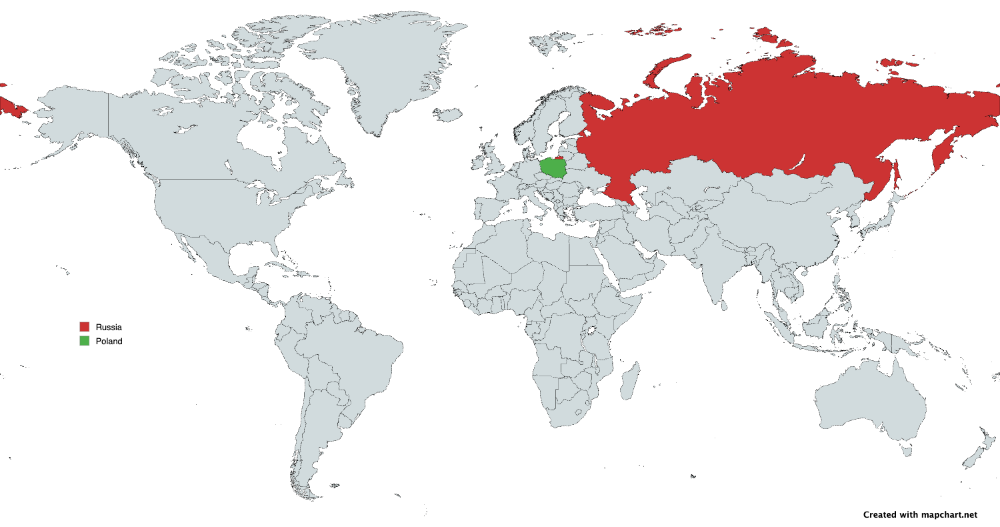
Poland = Green
Russia = Red
Image is licensed under the Creative Commons Attribution-Share Alike 4.0 International license and was created using MapChart (https://mapchart.net).