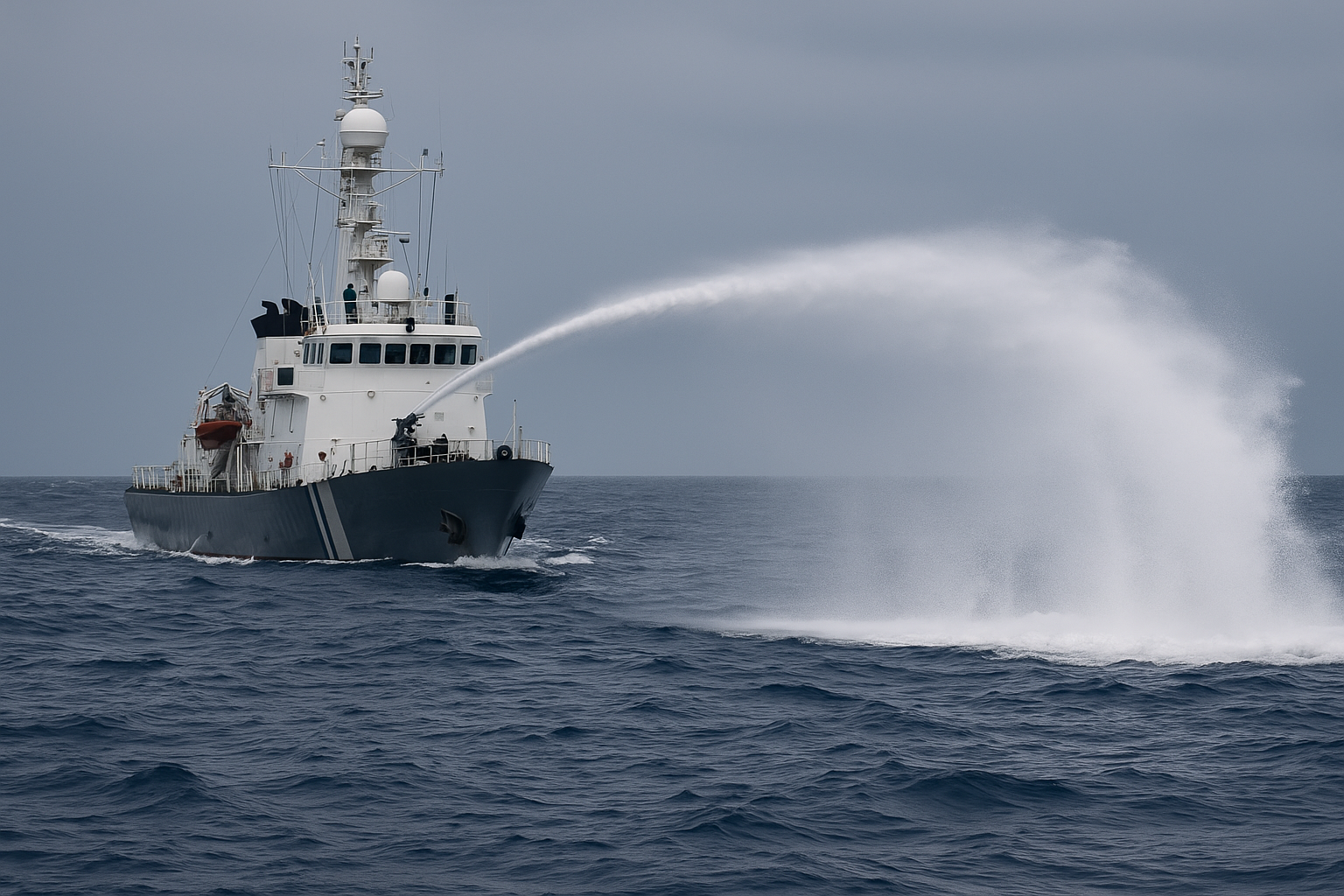
A maritime incident near the Philippine-held island of Thitu has reignited tensions between Manila and Beijing, with both governments accusing each other of responsibility for a collision between their vessels in the South China Sea.
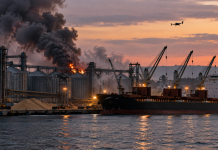
The Philippine Coast Guard reported that one of its support ships, the BRP Datu Pagbuaya, sustained damage after being struck by a Chinese coast guard vessel on Sunday morning. The confrontation occurred while the Pagbuaya and two other Bureau of Fisheries and Aquatic Resources vessels were anchored close to Thitu Island, known locally as Pag-asa. The Philippine vessels were there to assist local fishermen operating within the country’s exclusive economic zone.
According to Philippine authorities, a Chinese coast guard ship identified as CCG 21559 fired high-pressure water cannons toward the Pagbuaya before making physical contact with its stern. The blast damaged railings and equipment, though no injuries were reported. Video footage released by Manila shows the incident unfolding at close range, with the Filipino ship maneuvering away as the Chinese vessel advanced.
Commodore Jay Tarriela, a spokesman for the Philippine Coast Guard, said the action demonstrated “continued intimidation at sea” but emphasized that operations would persist. Coast Guard Commandant Admiral Ronnie Gil Gavan described the episode as another reminder of the crew’s duty to maintain their presence. He said that while the event was confrontational, his personnel remained calm and focused on their mission to safeguard the livelihoods of Philippine fishing communities.
China offered a sharply contrasting version of events. In a statement, coast guard spokesperson Liu Dejun said that two Philippine ships had “entered waters near Tiexian Reef without authorization,” adding that one had approached dangerously close to a Chinese vessel, resulting in a scrape. Beijing maintained that its coast guard had acted lawfully to protect what it considers Chinese territory.
The contested area lies near Sandy Cay, a chain of sandbars situated between Thitu Island and China’s fortified base on Subi Reef. Beijing claims nearly the entire South China Sea under what it calls “historic rights,” a position rejected by an international arbitration ruling in 2016. That decision declared China’s sweeping claims invalid under the United Nations Convention on the Law of the Sea, a verdict China refuses to recognize.
The United States, Japan, Australia, and several European nations have all expressed support for the Philippines following the incident. U.S. Ambassador MaryKay Carlson criticized what she called China’s “reckless use of force” and reiterated Washington’s commitment to defend its treaty ally in the Pacific.
Thitu Island is home to a small civilian community and a Philippine military outpost and remains a flashpoint between the two countries. China’s nearest installation, Subi Reef, sits just over 12 miles away and contains missile systems, aircraft hangars, and port facilities.
Despite mounting friction, Manila has pledged to continue patrols and support missions in the region. Diplomatic consultations between the two countries are expected soon, but analysts believe incidents of this kind may continue as both sides attempt to assert control in one of the world’s busiest and most contested waterways.
This image is the property of The New Dispatch LLC and is not licenseable for external use without explicit written permission.