North Korea’s involvement in Russia’s war against Ukraine is increasingly being viewed as more than military support for Moscow. Ukrainian intelligence officials say Pyongyang is using the conflict to give its soldiers firsthand experience in modern warfare and bring those lessons back home.
According to Ukrainian intelligence, North Korean troops remained stationed in Russia’s Kursk region as of January 2026, conducting artillery and drone operations against Ukraine. Intelligence assessments in June 2026 continue to indicate that North Korean forces remain deployed in Russia.
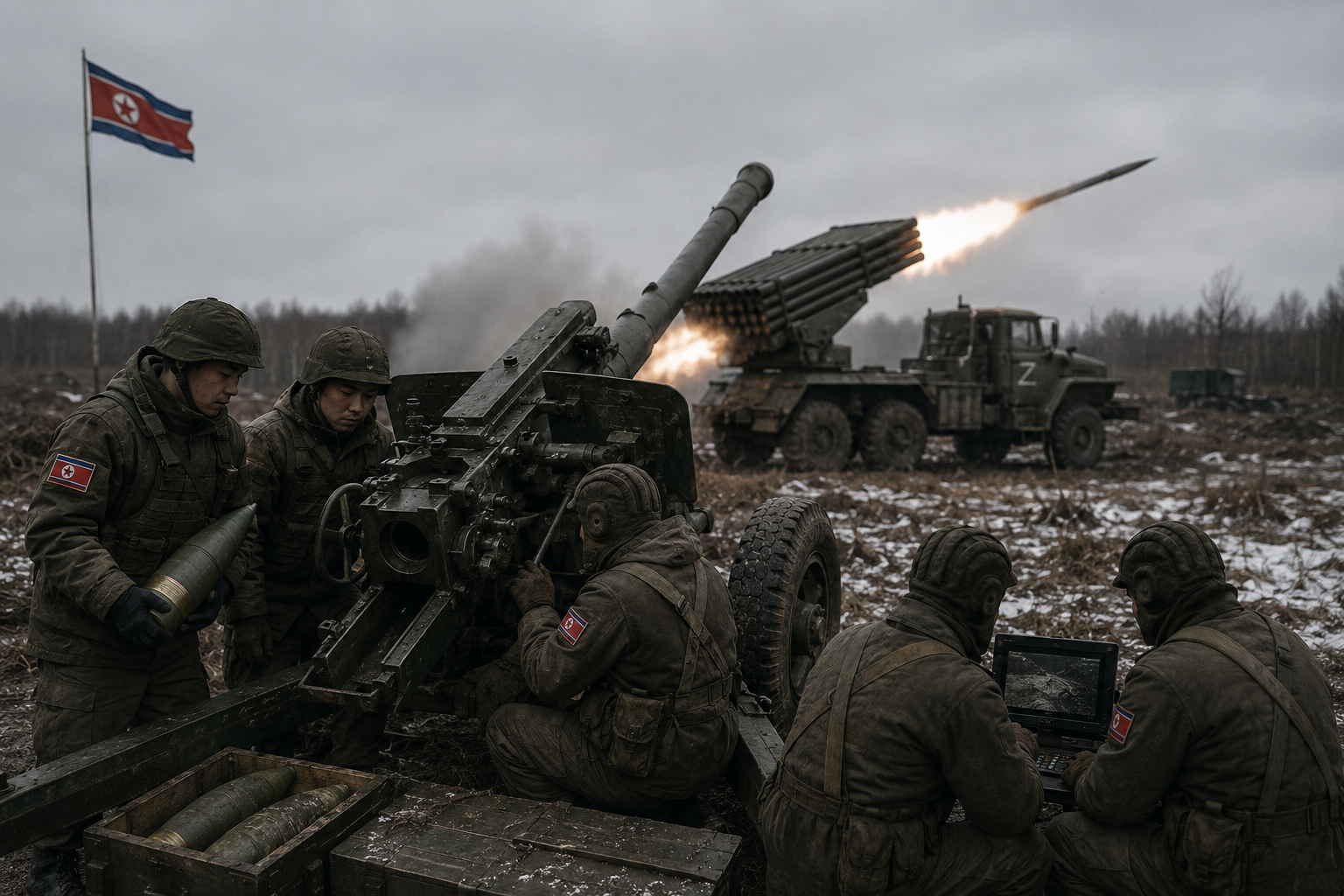
The agency said North Korean soldiers are conducting artillery and multiple launch rocket system strikes, operating reconnaissance drones, and adjusting fire using information gathered from the air. The tasks closely mirror the methods used by Russian forces during the war.
Around 11,000 North Korean soldiers were first deployed to Kursk in fall 2024 after Ukrainian forces launched a surprise incursion into the region months earlier. Their arrival marked a major expansion of North Korea’s role in the conflict.
The troops were initially used in infantry assaults that US officials described as ineffective and costly. Since then, their role has shifted toward support operations involving drones and artillery.
Ukraine’s intelligence service says the experience gained by those soldiers may be one of the main reasons for North Korea’s involvement in the war.
Under agreements between Moscow and Pyongyang, North Korean troops are regularly rotated out of Russia. According to Ukrainian officials, about 3,000 soldiers have already returned to North Korea after serving in Kursk.
Many of those returning troops have become military instructors, teaching other soldiers what they learned on the battlefield. Their training reportedly includes drone operations, artillery fire correction, and the use of multiple rocket launchers.
“I think it was more for North Korea just to get the experience of the modern war and to learn this experience in their army,” Yehor Cherniev, deputy chairman of Ukraine’s parliamentary committee on national security, defense, and intelligence, said in an interview with Business Insider.
Officials in neighboring countries are also watching those developments closely. Japan’s Defense Minister Shinjirō Koizumi said North Korean troops are learning new forms of warfare involving drones, artificial intelligence, cyberspace, and conventional weapons.
According to Koizumi, Japan and its allies will need to consider how those new capabilities could be used once the soldiers return home.
North Korea’s support for Russia extends beyond manpower. According to Ukrainian and Western officials, Pyongyang has sent millions of artillery shells and multiple rocket launcher rounds to Russia, along with the launchers and cannons needed to fire them. North Korea has also supplied ballistic missiles and anti-tank weapons.
Cherniev said the flow of ammunition remains a larger concern than the number of North Korean soldiers fighting in Russia.
“The biggest problem from North Korea is not the soldiers, but the artillery shells,” he said.
Western intelligence agencies estimate that thousands of North Korean soldiers have been killed or wounded during the fighting. Their deployment came after Russia and North Korea signed a mutual defense pact in 2024, another sign of growing military cooperation between the two countries.
Ukraine’s intelligence service also reported that North Korea reduced its weapons shipments to Russia in January, with Russian ships visiting a North Korean port only once during the month after previously making several visits each month.
This image is the property of The New Dispatch LLC and is not licenseable for external use without explicit written permission.