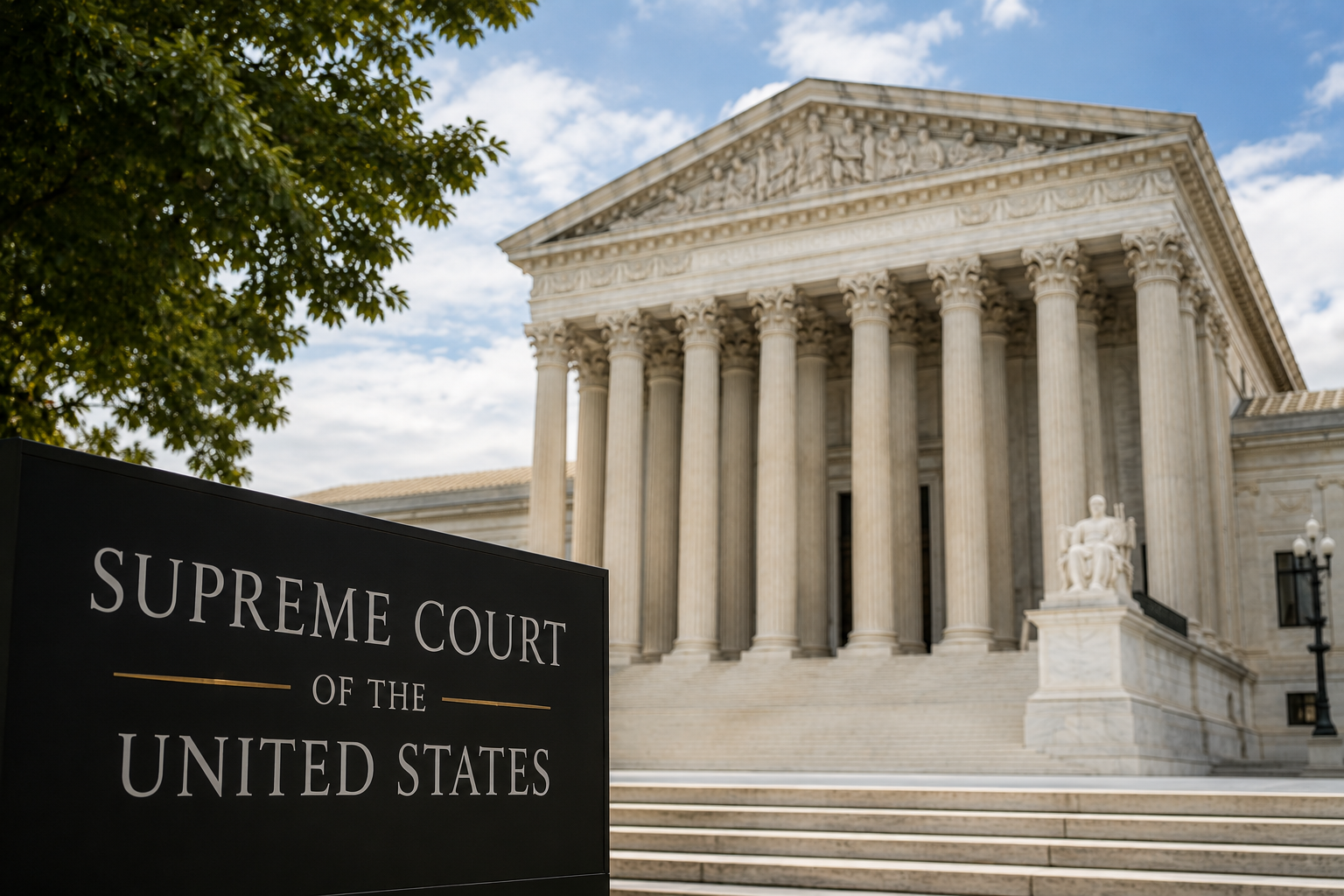
The Supreme Court ruled Thursday that the federal government cannot prosecute a Texas man under a law that bans unlawful drug users from possessing firearms, saying the law violated his Second Amendment rights as it was applied in his case. The decision was unanimous, although several justices wrote separate opinions explaining different reasons for agreeing with the outcome.
The case involved Ali Danial Hemani, whose home was searched by FBI agents in 2022. During the search, agents found a Glock 19 handgun, about 60 grams of marijuana, and 4.7 grams of cocaine. Hemani later admitted he used marijuana about every other day. Based on that statement, federal prosecutors charged him under a law that makes it a felony for anyone who is an unlawful user of or addicted to a controlled substance to possess a firearm. A conviction under the law can carry a prison sentence of up to 15 years.
Hemani challenged the charge, arguing that the law violated the Second Amendment. A federal district judge dismissed the case, relying on an earlier ruling from the 5th U.S. Circuit Court of Appeals. The appeals court later agreed, and the federal government asked the Supreme Court to review the decision.
Justice Neil Gorsuch wrote the court’s majority opinion. He said the government failed to show that applying the law to Hemani was consistent with the nation’s historical tradition of firearm regulation, which is the standard established by the court’s 2022 decision in New York State Rifle and Pistol Association v. Bruen.
The government argued that laws from early American history targeting “habitual drunkards” were similar enough to justify restricting firearm possession by regular drug users. Gorsuch disagreed. He wrote that those older laws applied to different kinds of people, served different purposes, and generally required some type of legal process before someone lost their rights. The federal law in Hemani’s case automatically removes a person’s right to possess a firearm based only on unlawful drug use.
Gorsuch also said the government was not required to prove that Hemani was under the influence when he possessed the gun or that his drug use made him dangerous. The opinion rejected the idea that anyone who regularly uses marijuana can automatically be treated as violent or unusually dangerous without additional evidence.
The ruling does not strike down the federal law entirely. Gorsuch called the decision a narrow one, explaining that the court was not deciding whether the government can prohibit firearm possession by drug addicts or by people whose drug use has been shown to make them a danger to themselves or others. The decision also does not affect other federal firearm restrictions, including those involving convicted felons.
Several justices wrote separate opinions. Justice Clarence Thomas argued that Congress does not have the constitutional authority to regulate firearm possession solely because a gun crossed state lines. Justice Ketanji Brown Jackson, joined by Justice Sonia Sotomayor, criticized the historical test established in Bruen, calling it difficult for judges to apply consistently. Justice Samuel Alito, joined by Justice Elena Kagan, agreed with the outcome but said only that the government failed to show Hemani’s marijuana use was comparable to the “habitual drunkards” covered by earlier laws.
The Supreme Court has not yet issued its decision in Wolford v. Lopez, another Second Amendment case involving a Hawaii law that limits where firearms may be carried on private property.
This image is the property of The New Dispatch LLC and is not licenseable for external use without explicit written permission.