The United States and Iran exchanged another round of military strikes overnight, with attacks reported across several countries in the Middle East. The latest fighting added more pressure to the ceasefire the two countries agreed to in April, which has become increasingly difficult to maintain after repeated military exchanges.
The US Central Command said it carried out strikes on military surveillance equipment, communication systems, and air defense sites inside Iran. The military said the attacks were ordered by President Donald Trump and were meant to respond to what it called Iran’s continued aggression. The operation lasted about four hours before US officials announced it had ended.
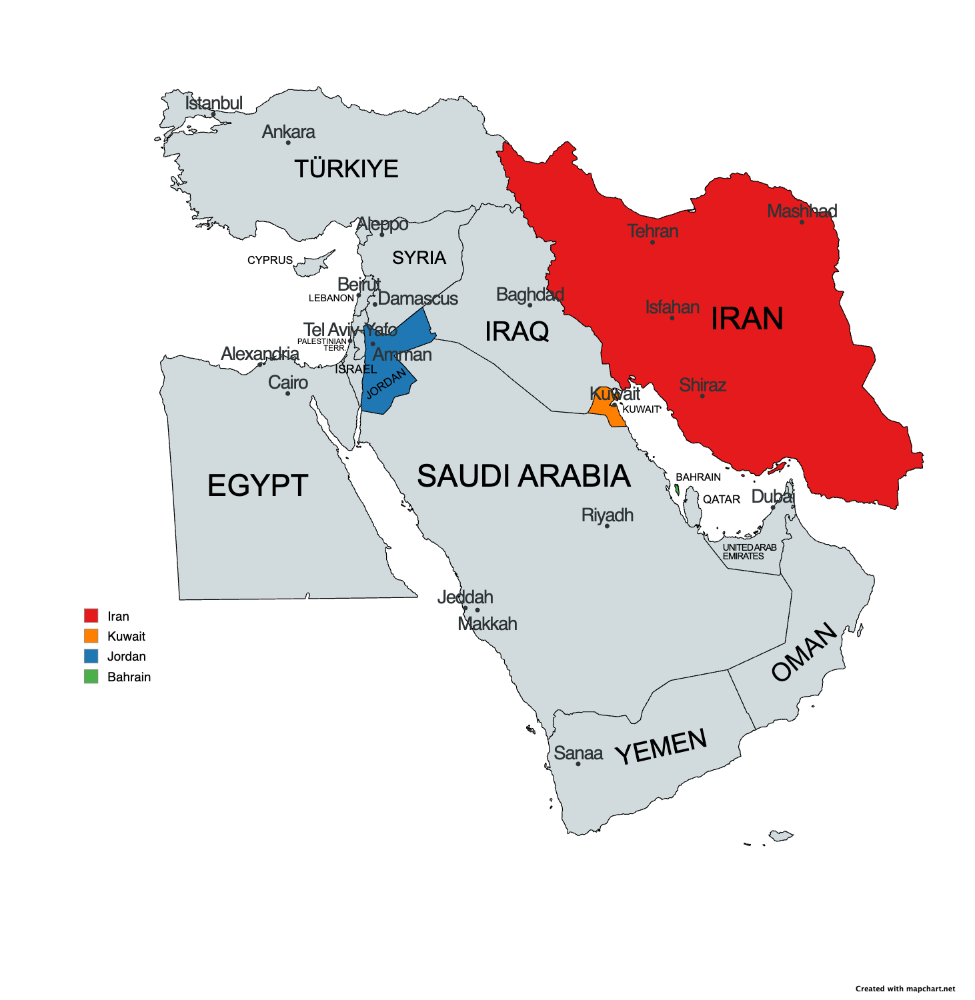
Iran answered with attacks on US military positions in Bahrain, Kuwait, and Jordan. The Islamic Revolutionary Guard Corps said it launched drone strikes at Sheikh Isa Air Base in Bahrain along with Ali Al Salem and Ahmad Al-Jaber airbases in Kuwait. It also said 12 ballistic missiles were fired toward the Muwaffaq Salti Air Base near Jordan’s Azraq region.
Jordan’s military said its air defenses intercepted 20 missiles headed toward the area and reported no casualties or damage. Bahrain activated air raid sirens twice during the attacks. Officials there said debris from intercepted Iranian drones damaged homes and vehicles in Manama and Hamad City. An 11-year-old girl suffered a minor injury from falling shrapnel. Kuwait said its air defense systems intercepted hostile aerial targets and temporarily closed its airspace before reopening it a few hours later.
Iran also claimed it had targeted two oil tankers in the Strait of Hormuz after declaring the waterway closed until further notice. The IRGC warned that any vessel attempting to pass through the strait could be attacked. US Central Command disputed that claim, saying commercial ships were still moving through the waterway despite the threats.
Explosions were reported in several parts of Iran following the American strikes. Iranian state media said blasts were heard in Karaj, Bandar Abbas, Sirik, Kargan, and on the islands of Qeshm and Kish. Iranian officials also said attacks damaged two water reservoirs and a telecommunications tower, while at least two people were reported injured in the southern city of Kargan.
President Donald Trump said Iran had taken too long to negotiate a peace agreement and warned that more attacks could follow if no deal was reached. Defense Secretary Pete Hegseth defended the military operation, saying it was intended to strengthen the United States’ position while negotiations continued. Iranian President Masoud Pezeshkian rejected the threats, saying the country would continue to resist outside pressure. Iran’s foreign ministry also accused Washington of making diplomacy more difficult through continued military action.
The latest exchange came after another day of fighting that began when a US Apache helicopter was brought down near the Strait of Hormuz, an incident the United States blamed on Iran. American forces later struck targets around the strategic waterway, while Iran launched missiles and drones toward US military facilities in the region. The US also confirmed it had disabled several tankers that it said were transporting Iranian oil in violation of its blockade.
Indirect negotiations are still taking place, but there has been little sign of a breakthrough. Iran continues to seek relief from sanctions and the release of frozen assets, while the United States says any agreement must address Iran’s nuclear program and security concerns. Fighting involving Israel and the Iranian-backed Hezbollah group in Lebanon has also continued, adding another layer of uncertainty as tensions across the region remain high.
Iran = Red
Kuwait = Orange
Bahrain = Green
Jordan = Blue
Image is licensed under the Creative Commons Attribution-Share Alike 4.0 International license and was created using MapChart (https://mapchart.net).