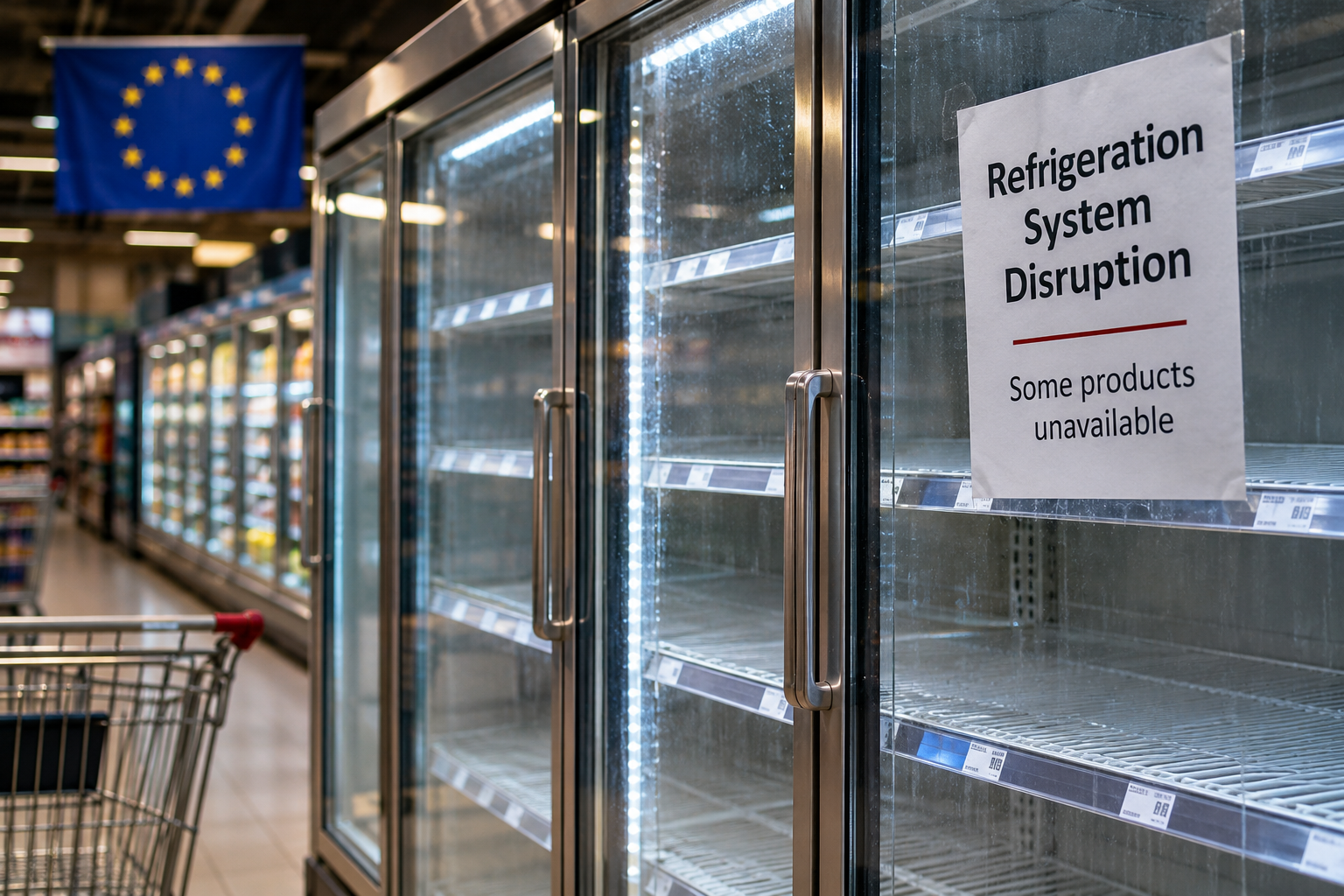
Grocery stores across Europe are dealing with an unusual problem after hackers interfered with equipment used to keep food cold. Instead of stealing customer information or shutting down payment systems, the attackers manipulated refrigeration temperatures. By the time employees discovered what had happened, some stores had already lost large amounts of food.
Reports began emerging November 1, with businesses in several countries experiencing similar problems. In some locations, equipment designed to preserve frozen and refrigerated products was operating at temperatures reaching 50 degrees Celsius, or 122 degrees Fahrenheit.
Belgium was among the hardest-hit areas, with several major supermarket chains reporting problems. Ahold Delhaize, a Dutch retail company, experienced disruptions at roughly 40 supermarkets in Belgium and Luxembourg. Employees had to dispose of affected products, although the company later reported that its stores were operating normally again.
Several competing chains experienced trouble around the same time. Carrefour identified approximately 15 affected Belgian locations, while Intermarché reported the same number. Five Spar stores belonging to Colruyt Group also experienced disruptions.
The problems were not limited to traditional grocery stores. At an IKEA location in Mons, Belgium, employees discovered that cooling equipment had been affected. The business continued welcoming shoppers while staff examined the machinery and checked whether food could still be sold.
In Sweden, ICA reported problems at a small number of locations. One supermarket in Sjöbo discovered that its cooling equipment had been programmed to reach 50 degrees Celsius. Other Swedish retailers, including Coop, also experienced disruptions.
Ireland’s SuperValu encountered a similar situation involving one particular type of refrigeration system. The company temporarily withdrew chilled and frozen merchandise from 13 locations as a precaution.
British food suppliers were affected as well. According to the British Association of Independent Meat Suppliers, two member businesses discovered their refrigerators defrosting. Equipment at another business reached 100 degrees Celsius. Those units were empty when the problems occurred, so no food was lost.
The incidents came only weeks after a much larger attack in France. During October, refrigeration equipment at hundreds of supermarkets was manipulated remotely, destroying merchandise and causing fires at some locations. Financial losses ran into millions of euros.
Investigators are still trying to determine who carried out the attacks. Nobody has publicly accepted responsibility, and authorities have not established whether the incidents were financially motivated or intended primarily to cause disruption.
One concern involves older refrigeration technology. Many businesses use equipment that technicians can access remotely, making maintenance easier. That same connectivity can create security problems when devices remain exposed online or operate without available software updates.
Cybersecurity adviser Fredrik Blix indicated that previously identified weaknesses had not been corrected across thousands of refrigeration controllers. A manufacturer had released an update in August, but many systems remained vulnerable. Some older models could not receive the update at all.
European officials are examining the wider consequences for food distribution. EU Agriculture and Food Commissioner Christophe Hansen has raised concerns about attempts to interfere with food supplies and damage public confidence. The incidents are expected to be discussed at an upcoming Security College meeting.
Cybersecurity authorities in Sweden and Britain are contacting affected businesses and examining potentially vulnerable equipment. Britain’s National Cyber Security Centre has also been warning organizations about the risks associated with aging, internet-connected technology. Officials are continuing to monitor the situation while working with businesses to identify equipment that needs additional protection.
This image is the property of The New Dispatch LLC and is not licenseable for external use without explicit written permission.