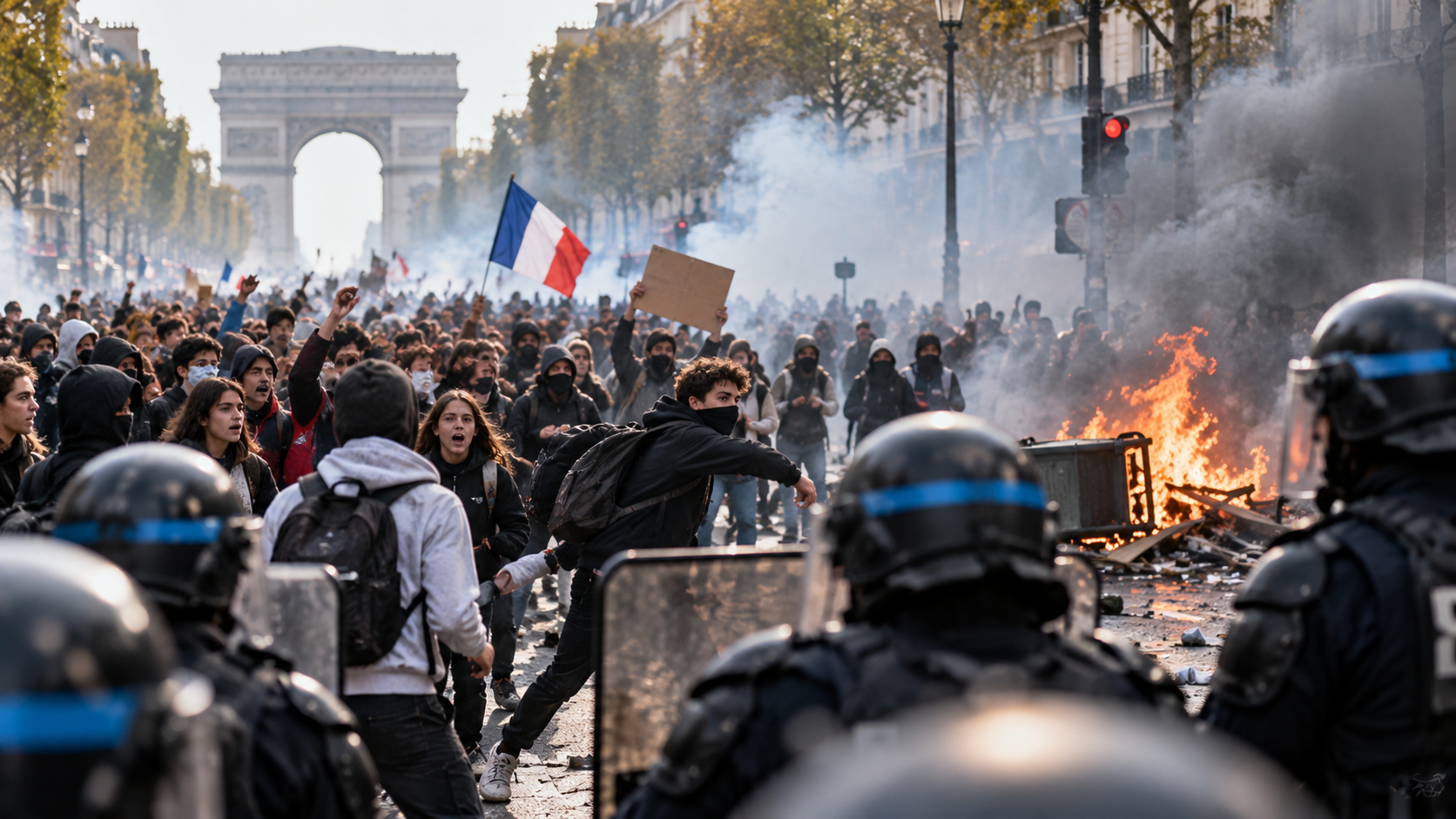
France’s student demonstrations continued to disrupt hundreds of high schools this week, with schools closing or reducing classes as officials responded to unrest that has resulted in thousands of arrests, injuries and damage to school property.
Education Minister Édouard Geffray had said around 400 to 500 schools could be affected Monday. Schools responded according to conditions at each location, with some suspending classes and others operating on reduced schedules.
The demonstrations grew out of complaints from students and teachers in the Paris area during September. They raised concerns about too few teachers, crowded classrooms, lengthy school days and deteriorating buildings.
It did not remain a local protest for long. Demonstrations eventually appeared in several cities around France, including Marseille, Strasbourg, Tours, Nantes, Toulouse and Lille.
Violence and property destruction followed as the unrest expanded. Fires have been set, buildings and other property damaged and objects thrown toward police. Assaults have also been reported. Officers have responded with tear gas and rubber bullets in some confrontations.
The number of arrests and police stops connected with the unrest has continued to climb. French authorities put the total at 6,547 following Tuesday’s demonstrations, when another 488 people were taken into custody. Minors have accounted for most of those detained since the protests began.
Schools have been among the main targets of the unrest. According to Geffray, 24 school buildings have suffered burning or looting since the demonstrations started. France has roughly 3,700 high schools, and at least 400 of them did not open Friday. Protests or other disruptions affected hundreds of additional locations. Problems continued Monday, when hundreds of schools either canceled instruction altogether or reduced their normal schedules.
The disruption continued Tuesday. The Education Ministry reported that normal instruction was interrupted at 891 high schools, with classes suspended completely at some locations and only partially at others.
The number of people hurt within the education system has also risen. The government’s latest count identifies 215 injured students along with 85 employees working in education.
There is also disagreement over who is responsible for the protests becoming more violent.
French officials have accused activists on the far left of becoming involved after the demonstrations were already underway. The government has also pointed to intelligence reporting about the involvement of far-left political and student activists in some school protests in the Paris region.
France Unbowed, also called LFI, has supported the student movement but rejects accusations that it is responsible for the violence. The party has accused the government of politicizing the unrest and criticized the police response.
Police tactics have faced criticism as well. Some critics believe officers have used excessive force against demonstrators, many of whom are teenagers. Amnesty International has called on French authorities to ensure that police actions are necessary and proportionate and that peaceful demonstrators are protected.
The situation has also drawn political commentary in the United States. Tomi Lahren discussed the unrest on “The Big Weekend Show,” calling France a warning for America. She tied the broader problems facing France to European immigration policies and argued that large-scale immigration can eventually produce resentment among existing residents.
Education remains at the center of what originally brought students into the streets. The French government recently presented its budget plans for 2027. The proposed education budget, excluding pensions, would total about €64 billion, an increase of approximately €1.2 billion from 2026.
Tuesday brought another large day of demonstrations across France. Government officials counted approximately 266,000 participants nationwide, with about 56,000 of them in the capital. Groups supporting the demonstrations offered a substantially larger estimate, placing total participation at 450,000.
Most of Tuesday’s demonstrations passed without major violence, although confrontations occurred in some locations. Police and groups of demonstrators clashed in Paris after the main march, and authorities made 488 arrests during the day.
Prime Minister Sébastien Lecornu has said his government is working on several areas raised by students and educators. Those efforts include school facilities, the structure of the school day, keeping classes available and changes involving the university admissions process.
This image is the property of The New Dispatch LLC and is not licenseable for external use without explicit written permission.