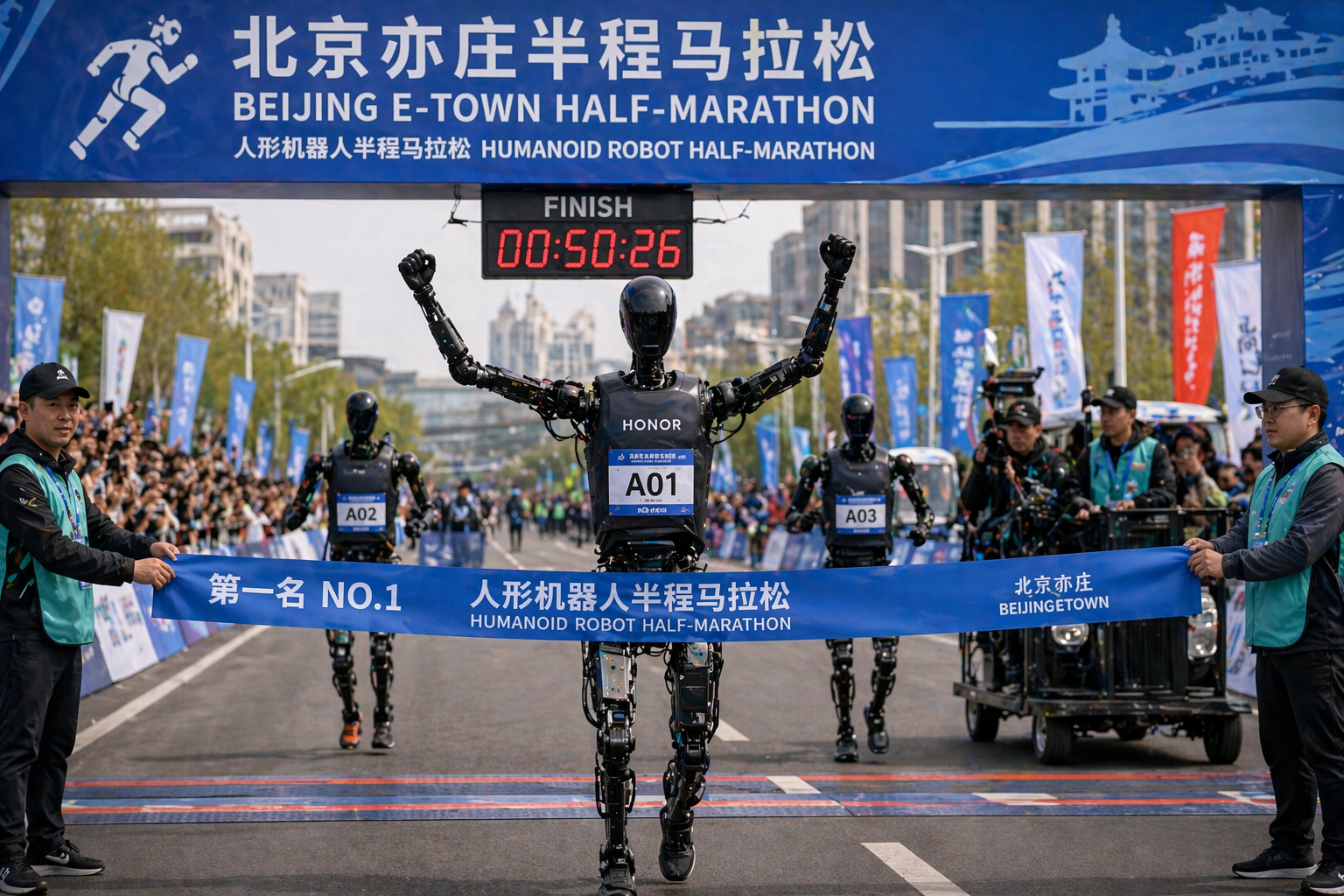
On April 19, 2026, a humanoid robot built by Chinese smartphone company Honor finished a half-marathon in Beijing in 50 minutes and 26 seconds, faster than the human world record for the distance. That record, set by Ugandan runner Jacob Kiplimo last month in Lisbon, stands at 57 minutes and 20 seconds.
The race took place in Beijing’s E-Town district and drew about 12,000 human runners along with more than 100 humanoid robots from 76 institutions across China. Organizers kept the robots and people on separate courses to avoid crashes, which turned out to be a smart decision. A lot of the machines could run on their own, using AI systems to adjust speed, keep balance, and respond to changes in the course.
Honor’s winning robot, called Lightning in some reports and Blitz in others, was designed with running in mind. It had legs measuring about 90 to 95 centimeters, close to the length seen in elite human runners. Engineers also gave it advanced balance controls and a liquid cooling system based on smartphone technology so it would not overheat during the 13.1-mile race. The company said the robot had been in development for about a year.
Honor ended up taking all three top spots in the robot division. All of those robots were self-navigated. The company also showed a separate robot that was remotely controlled and ran the same distance in 48 minutes and 19 seconds, even faster than the autonomous winner.
The jump from last year was huge. In the first version of the event, held in 2025, the fastest robot needed 2 hours and 40 minutes to finish. Many of the machines failed to complete the race at all. This year, the field was much larger, with more than 100 robot teams instead of about 20, and several of the front-runners finished in under an hour.
Not every robot made it look easy. Some fell early. Some drifted off course. Others needed technicians nearby to step in and help. Teams followed many of the machines in golf carts carrying tools, stretchers, and wheelchairs in case something went wrong. One robot reportedly crashed into a railing near the end and was helped back up before continuing. Another crossed the finish line and then wandered into a bush. One machine fell just a short distance after the start and kept going with packing tape holding part of its upper body together.
The race also worked as a public test for China’s robotics industry. It showed how much progress has been made in running speed, balance, cooling, and autonomous movement. At the same time, the event exposed some limits. Experts and developers said running in a controlled race is not the same as doing factory work, handling delicate objects, or moving through unpredictable real-world settings.
China has been pushing hard to grow its robotics and AI sectors, using subsidies, infrastructure projects, and public showcases. This race fit right into that effort. A few weeks earlier, Unitree humanoids appeared in a televised martial arts performance, adding to the country’s growing focus on machines built to move more like humans.
For now, the picture from Beijing was pretty clear: the robots were much faster than before, still a little unstable, and hard to ignore.
This image is the property of The New Dispatch LLC and is not licenseable for external use without explicit written permission.