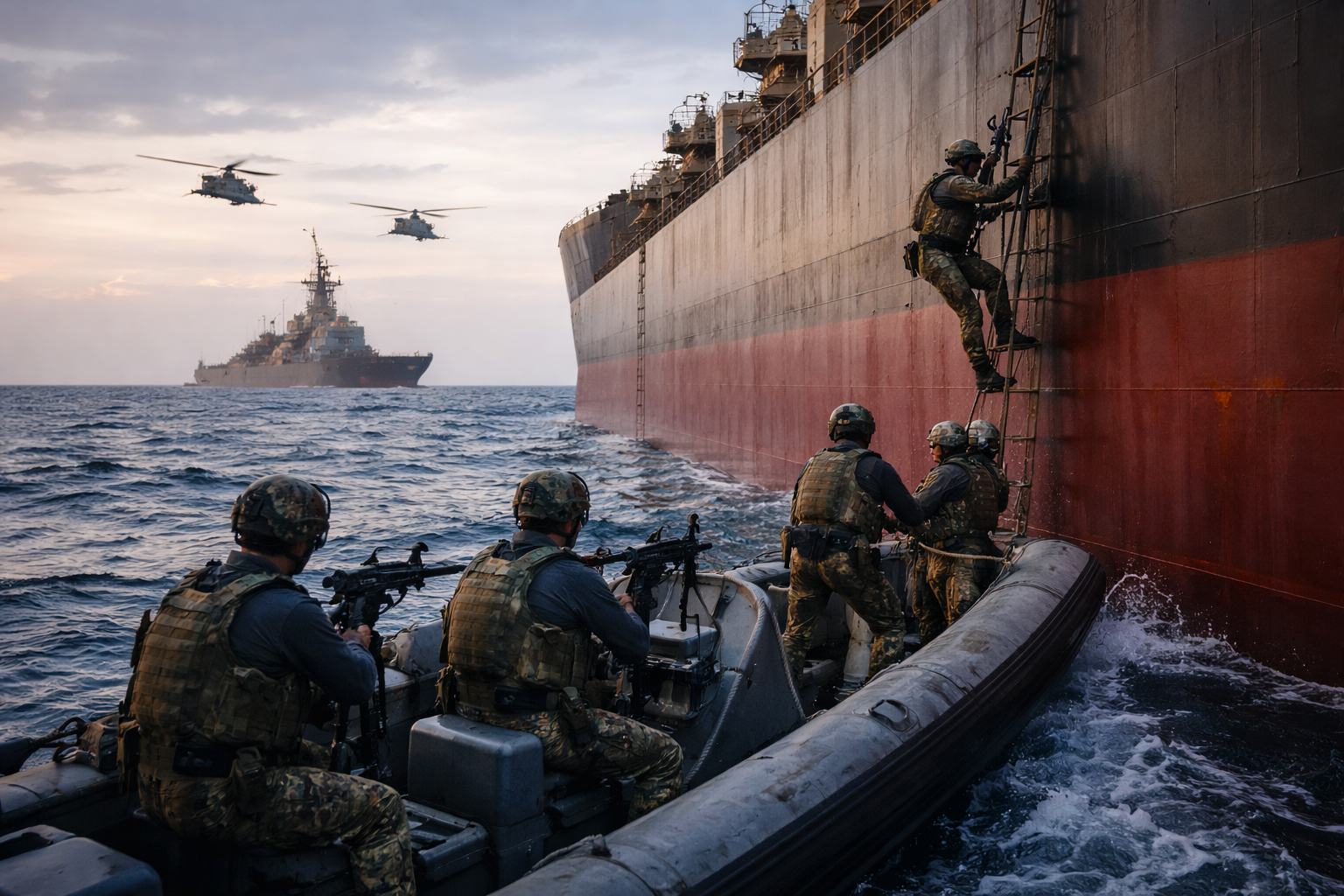
U.S. defense officials announced Sunday that American forces intercepted and boarded an oil tanker in the Indian Ocean after following its movements across multiple regions. The vessel, called the Veronica III, had allegedly tried to avoid a quarantine directive issued by President Donald Trump as part of a broader effort to restrict the flow of oil tied to Venezuela.
According to statements released by the Department of War, the tanker was located within the operating zone of U.S. Indo-Pacific Command. Personnel carried out the boarding at sea without resistance. Authorities said the ship had been under observation since it departed from the Caribbean and was followed over a long distance before the operation took place.
The government said the action was part of continuing enforcement measures aimed at vessels suspected of moving restricted oil. In a message posted online, officials stated that attempts to bypass the quarantine would not prevent U.S. forces from locating and stopping ships believed to be involved in sanction-related activity.
The Veronica III is a large crude carrier built in 2006 and registered in Panama. U.S. authorities have connected the vessel to the transportation of oil linked to sanctioned networks involving Venezuela and Iran. The ship appears on the U.S. Treasury Department’s sanctions list, which identifies entities and vessels prohibited from engaging in certain financial and trade activities. Investigators say tankers tied to these networks sometimes switch names, registration flags, or tracking information to make it harder to trace their movements.
This boarding is part of a wider campaign to curb the export of Venezuelan crude. The United States has imposed restrictions on the country’s energy sector for years, citing efforts to pressure its leadership and limit revenue streams. In December, the Trump administration introduced a quarantine targeting tankers suspected of carrying restricted petroleum. Since then, naval patrols have increased in regions where suspect vessels are known to travel.
Officials described the boarding as a maritime inspection carried out under international law. Such procedures allow naval forces to stop and examine ships suspected of violating sanctions or transporting restricted cargo. Authorities have not said whether the Veronica III will be taken into custody or allowed to continue after the inspection. Few details were provided about what was found on board.
The interception follows another recent operation involving a tanker named the Aquila II, which was boarded earlier in the Indian Ocean. That vessel remains under review while officials determine what actions to take next. These repeated operations show an ongoing attempt to monitor and control maritime activity linked to restricted oil shipments.
Shipping analysts report that several tankers left Venezuelan waters earlier this year as enforcement tightened. Some are believed to be part of a network that uses indirect routes, altered identification details, and other tactics to continue moving oil into global markets. These methods can make tracking difficult, especially when ships travel long distances across international waters.
U.S. officials say their efforts are focused on preventing unauthorized oil trade and maintaining pressure on networks that support it. The Department of War stated that forces would continue monitoring suspect vessels across the world’s oceans and respond when they believe restrictions are being ignored. The boarding of the Veronica III is the latest step in that ongoing maritime enforcement effort.
This image is the property of The New Dispatch LLC and is not licenseable for external use without explicit written permission.