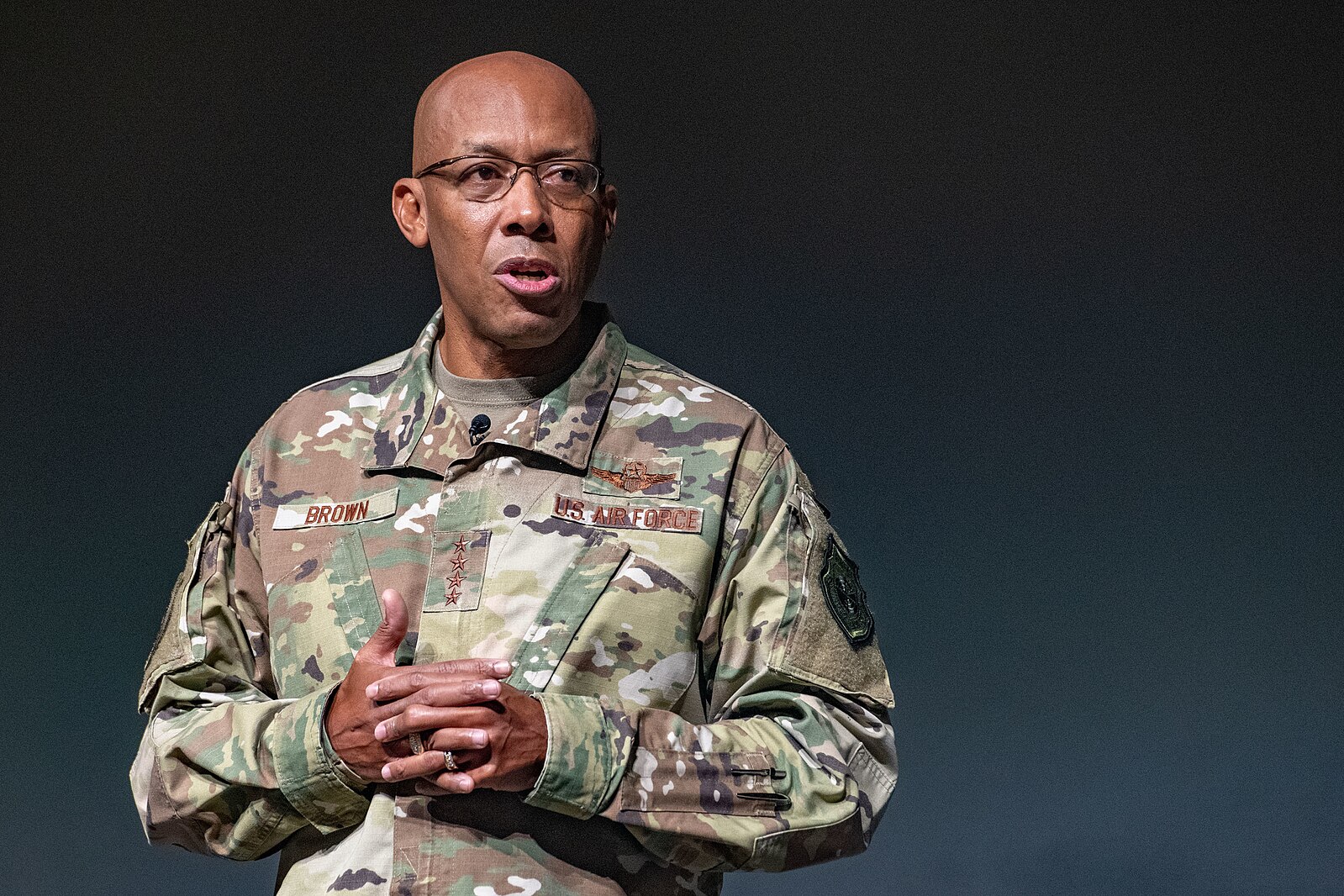
President Donald Trump revealed on February 21 that he would be replacing General Charles Q. Brown Jr. as Chairman of the Joint Chiefs of Staff. In Brown’s stead, Trump plans to nominate retired Air Force Lieutenant General John “Dan” Caine. The decision has drawn attention because Caine’s career does not fit the usual profile outlined by federal rules for the Chairman position.
Normally, the individual leading the Joint Chiefs must have served as Vice Chairman, been the top officer of a military branch, or commanded a unified combatant command. Caine has not held any of these roles. Even so, the President can request a waiver if he determines that it is in the nation’s best interest, but the Senate must consent to that exception through the confirmation process.
Caine retired relatively recently, having served as an Associate Director for Military Affairs at the CIA. He also has background in special operations and worked closely on efforts to eliminate the Islamic State group during Trump’s first term. According to sources close to the administration, Trump admires Caine’s drive, credits him for efficient operations against ISIS, and believes he can bring fresh perspective to the Pentagon.
Along with Brown’s removal, Secretary of Defense Pete Hegseth stated that several other senior officers would be replaced, including the Air Force Vice Chief of Staff and the Chief of Naval Operations. He also mentioned changes to legal leadership in multiple branches. Unnamed officials say there may be further personnel moves, suggesting a broad reorganization of top defense posts.
Brown, who started his four-year term in October 2023, was only the second Air Force leader to hold the Chairman role in this century. He had previously served as Air Force Chief of Staff, following in the footsteps of General David L. Goldfein. Although Trump decided to remove him from the Chairmanship, the President publicly expressed goodwill toward Brown, praising his service and dedication.
Military analysts are divided on the impact of this leadership overhaul. Some contend that changing so many high-level positions in quick succession could hamper organizational stability. They warn that removing experienced commanders might create gaps in institutional knowledge. Others argue that a shake-up was inevitable given Trump’s desire to steer national defense policy in a new direction—one they say focuses on streamlined warfighting strategies and a stronger emphasis on controlling costs.
Lawmakers have also weighed in on these events. Several members of the Senate Armed Services Committee, including its ranking Democrat, voiced trepidation about the potential politicization of the armed forces. The concern is that loyalty tests or ideological litmus exams might overshadow merit-based decisions. On the other side, the Committee’s Republican leadership has shown confidence in Trump’s judgment, trusting that the President and Defense Secretary will choose capable people for these critical assignments.
The next step lies with the Senate, which must vote on whether to confirm Caine. Any waiver for his lack of conventional qualifications will undoubtedly be a central point of debate. Observers expect rigorous questioning about his career trajectory, decision-making style, and views on readiness. If Caine is confirmed, he will step into one of the highest-ranking military positions at a time when defense priorities, global relationships, and internal Pentagon policies are all in flux.
Whether this shake-up brings fresh momentum or triggers more friction, the outcome will shape how the armed forces approach strategic challenges and adapt to changing threats. The Senate’s response in the coming weeks will determine if the administration’s pick moves forward or faces hurdles that could prolong the transition at the highest levels of military leadership.
Image is licensed under the Creative Commons Attribution-Share Alike 4.0 International license and was created by the U.S. Air Force Archive.