Congress will soon examine a newly signed agreement that could open Saudi Arabia’s planned nuclear power industry to American companies. The proposal now faces another obstacle after President Donald Trump attached a diplomatic requirement to its approval.
U.S. and Saudi officials announced the civilian nuclear arrangement on Wednesday. It creates a legal framework for cooperation involving reactors, fuel, technical support, and other parts of a long-term energy program. American businesses would receive preferred access to projects inside the kingdom. Saudi Arabia has described the plan as one part of its effort to rely on a wider range of energy sources instead of using so much petroleum at home.
Lawmakers will receive 90 session days to study the agreement before it can enter into force. A separate two-year review is also expected to examine whether uranium enrichment could be included. The agreement is still not final, and several parts of it remain unclear.
One day after the signing was announced, Trump said Riyadh’s participation in the Abraham Accords would be required before Washington gives its final approval. That condition had not appeared in the original public announcement. White House press secretary Karoline Leavitt said the administration would keep discussing the issue with Saudi leaders, but she made clear that the agreement would not proceed without Saudi participation in the accords.
The Abraham Accords began during Trump’s first term. They provided a way for several Arab governments to open official relations with Israel. The United Arab Emirates and Bahrain signed in 2020, with Morocco and Sudan joining afterward.
Riyadh has stayed outside that group. Saudi leaders have connected any future recognition of Israel to progress toward an independent Palestinian state. The current Israeli government rejects the creation of such a state, so the positions of the two countries remain far apart. Saudi officials did not immediately issue a response to Trump’s new demand.
Israel supported the added requirement. Prime Minister Benjamin Netanyahu’s office described Saudi entry into the accords as a step that could improve peace in the region. The White House said it was not aware of Netanyahu asking Trump to place that condition on the nuclear agreement.
There are separate concerns about the technical side of the deal. Information released when the agreement was announced suggested Saudi Arabia might be permitted to produce nuclear fuel domestically and process used material. Those methods can serve peaceful energy programs, though they receive close attention because they can also provide knowledge and equipment connected to weapons production.
Trump later said the plan would not involve enrichment. It was not clear whether his statement changed the written agreement or referred only to material enriched to the level used in weapons. Saudi Arabia’s exact rights under the proposal have not yet been fully explained.
The terms appear different from those accepted by the United Arab Emirates in its 2009 nuclear agreement with Washington. The UAE gave up domestic enrichment and reprocessing. Saudi Arabia has not made the same promise.
The International Atomic Energy Agency said it is waiting for Washington and Riyadh to request verification work. Its board would need to approve those measures after the request is received.
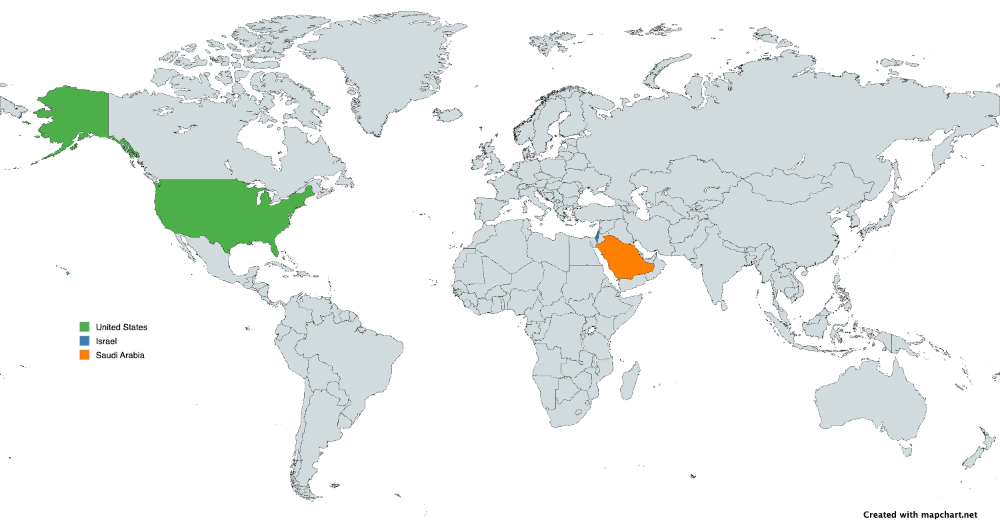
USA = Green
Israel = Blue
Saudi Arabia = Orange
Image is licensed under the Creative Commons Attribution-Share Alike 4.0 International license and was created using MapChart (https://mapchart.net).