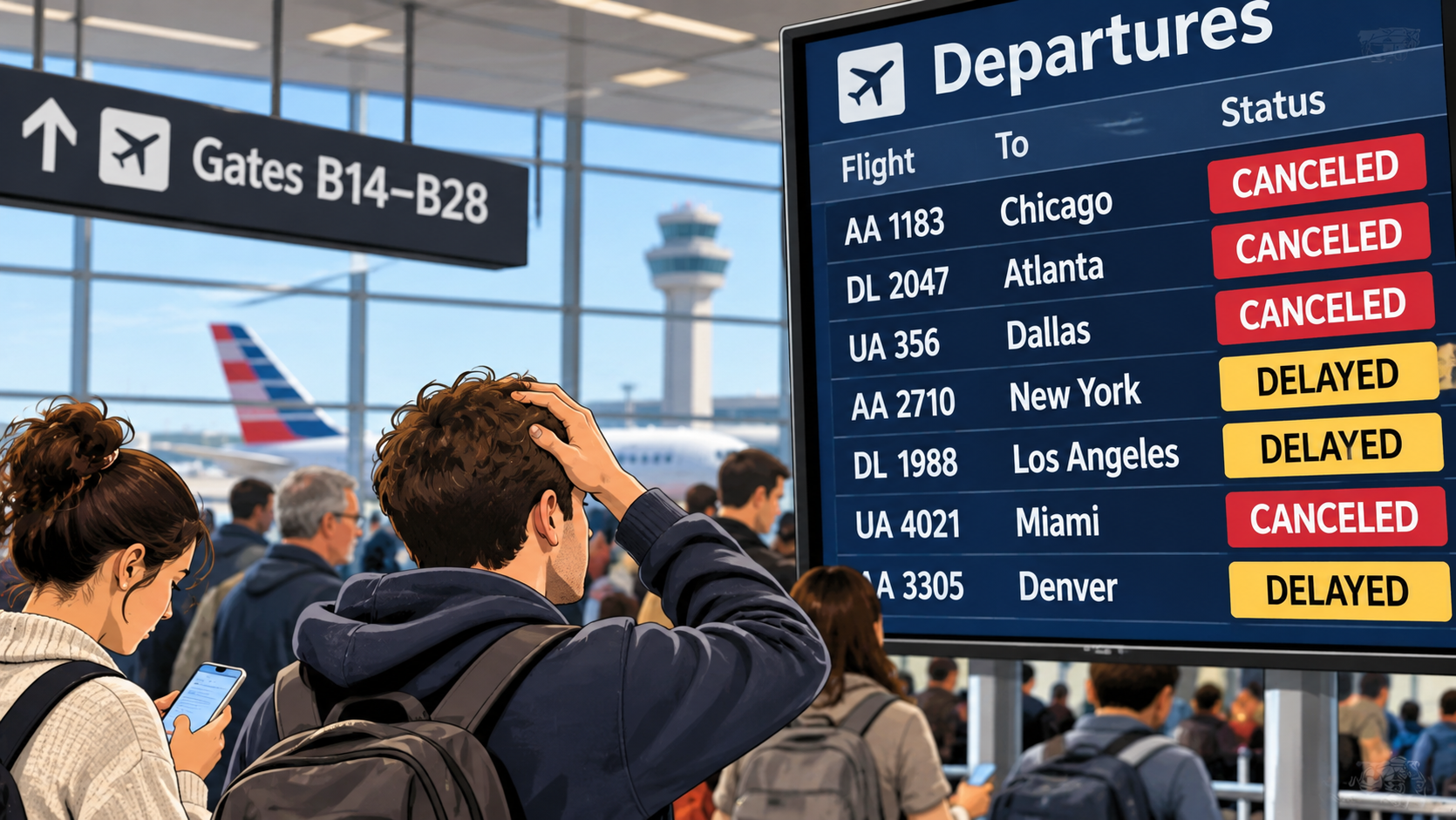
Thousands of travelers remained stranded across the United States on Saturday, November 14, after a nationwide interruption to air traffic control operations brought departing flights to a halt the previous afternoon. Airlines were dealing with canceled trips, misplaced aircraft and crews who were unable to reach their scheduled destinations.
By midday Saturday, flight tracking company FlightAware had recorded more than 4,200 cancellations and approximately 3,750 delays involving flights traveling within, to or from the United States. Airports in Chicago, Atlanta and Dallas were among the hardest hit.
The problems began Friday when a failure in the Federal Aviation Administration’s communications network interfered with the information controllers needed to manage aircraft. Federal officials responded by temporarily preventing departures throughout the country.
The restriction remained in place for over four hours. By 8:15 p.m. Eastern Time, technicians had restored enough of the network for the FAA to permit departures again. Getting flights moving was only the beginning of the recovery.
Federal aviation chief Bryan Bedford explained Saturday that roughly 20,000 flights had been caught up in Friday’s disruption. Around 8,000 eventually departed, leaving approximately 12,000 that could not operate as planned. Those numbers included commercial and private aircraft.
Airlines were expected to cancel another 4,000 to 5,000 flights Saturday. Bedford said carriers hoped to have their regular schedules operating again by Sunday evening, although passengers could still experience problems while planes and employees were moved back into position.
Investigators have focused their attention on a telecommunications upgrade taking place at an FAA facility away from the country’s major airports. The work involved changing the type of cables used to carry information through the aviation network.
Transportation Secretary Sean Duffy identified L3Harris as the company performing the work. During the upgrade, equipment handling network traffic became overloaded, and the resulting disruption spread beyond the original location.
Exactly why that happened remains unanswered. Investigators are examining the equipment itself and how the work was carried out. L3Harris has acknowledged the investigation and said it is cooperating with federal authorities.
Officials have also addressed speculation about outside interference. They reported finding nothing to suggest that hackers were responsible, and the FAA said an artificial intelligence system being developed for other aviation functions was not connected to the equipment that failed.
For passengers, the consequences extended well beyond Friday evening. American Airlines and United Airlines offered affected customers opportunities to change their reservations without certain fees. Delta also provided alternative booking arrangements.
Weekend sporting events required changes as well. Some college football teams switched to buses or adjusted their travel plans, while several game times were moved. The NFL said Sunday’s games would continue, with changes made to certain officiating assignments.
The failure has added urgency to discussions about the condition of the nation’s air traffic control infrastructure. Duffy is seeking $50 billion in federal funding for upgrades involving communications technology, airport facilities and other equipment.
Bedford said the government has spent years repairing and maintaining older systems, but those efforts cannot keep the equipment operating indefinitely. The FAA is continuing its investigation while airlines work through the remaining cancellations and delays.
This image is the property of The New Dispatch LLC and is not licenseable for external use without explicit written permission.