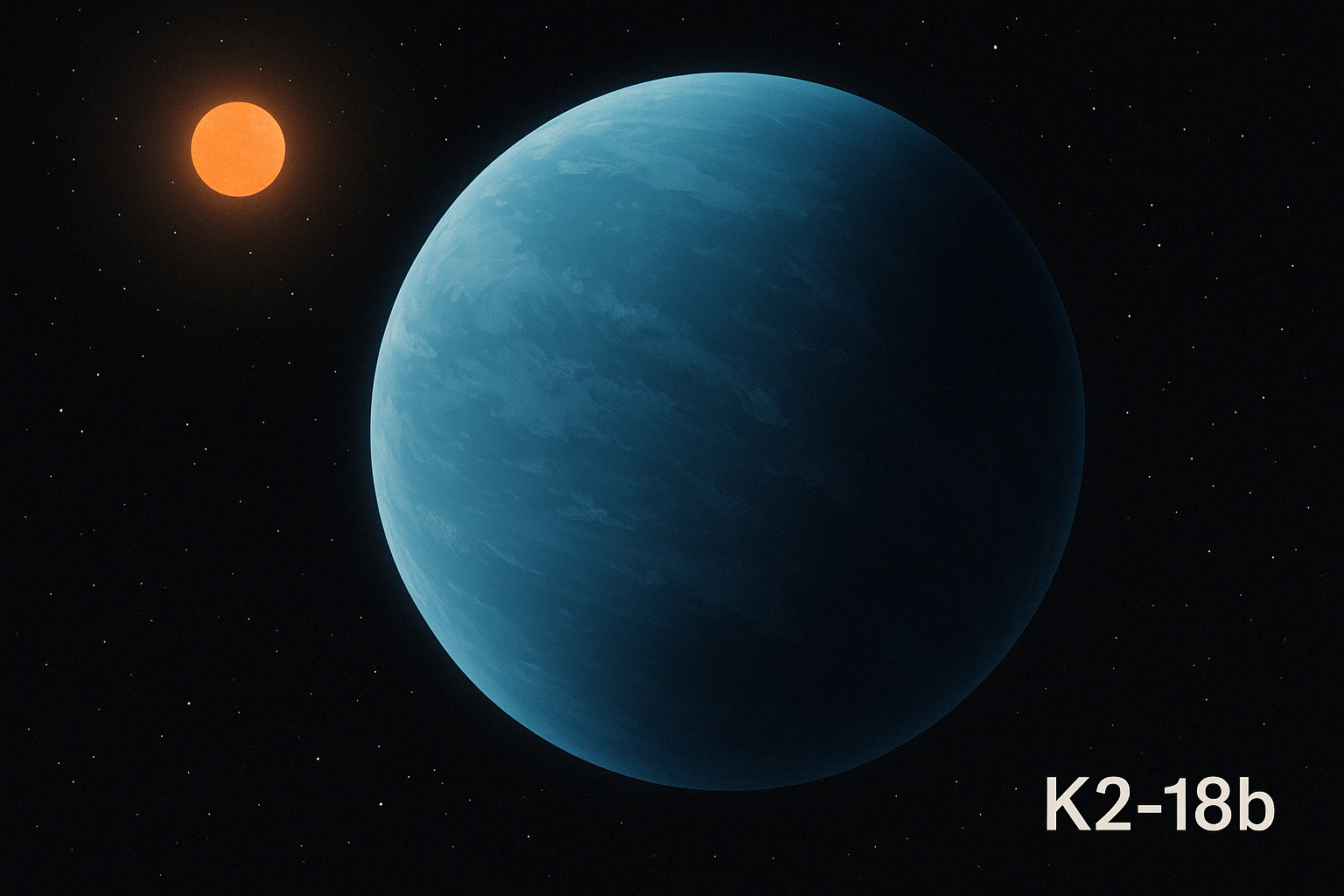
Last week, a team led by Cambridge University astrophysicist Nikku Madhusudhan published findings in a preprint submitted to The Astrophysical Journal Letters, reporting what they described as the strongest evidence yet for life beyond Earth. The study focuses on exoplanet K2-18b, located 124 light-years away in the constellation Leo. Using NASA’s James Webb Space Telescope (JWST), scientists identified dimethyl sulfide (DMS)—a molecule associated with marine life on Earth—alongside methane and carbon dioxide in the planet’s atmosphere. The detection sparked global interest, though researchers emphasize that the findings remain inconclusive.
K2-18b, classified as a sub-Neptune with 8.6 times Earth’s mass and 2.6 times its radius, was first discovered in 2015 by NASA’s Kepler telescope. It orbits a cool M-dwarf star in the habitable zone, where liquid water could potentially exist. In 2019, observations from the Hubble Space Telescope detected water vapor in its atmosphere—marking the first such discovery on a non-gas-giant exoplanet—and introduced the idea that K2-18b could be a “Hycean” world, with a hydrogen-rich atmosphere and possible subsurface oceans.
The new data came from JWST’s 2023 and 2024 observations using its Near-Infrared Spectrograph (NIRSpec) and Near-Infrared Imager and Slitless Spectrograph (NIRISS). By analyzing the starlight that passes through K2-18b’s atmosphere during transits, scientists detected methane and carbon dioxide and noted a relative absence of ammonia—suggesting possible interaction with a liquid water layer below. Most notably, they reported a tentative signal of DMS in 2023, followed by a detection in 2025 with a three-sigma confidence level, equivalent to 99.7%. Though statistically suggestive, this does not meet the five-sigma standard typically required for scientific confirmation.
On Earth, DMS is primarily produced by phytoplankton, and its presence on K2-18b—at levels that could correspond to production rates 20 times higher than Earth’s oceans—raised hopes about biological activity. Madhusudhan told the BBC that the signal’s strength implies ongoing production, as DMS is a short-lived molecule that would otherwise dissipate without a replenishing source.
However, many experts urge caution. Critics such as Ryan MacDonald at the University of Michigan point out that the DMS signal may overlap with methane’s spectral lines, making it difficult to isolate the molecule with high certainty. A 2024 study by Nicholas Wogan proposed that the high levels of methane observed could stem from geological processes rather than life. Some researchers have also suggested that K2-18b might be a gas-rich mini-Neptune with no habitable surface. As reported in Sky & Telescope, some models of the planet’s atmosphere fit a non-biological explanation just as well. Laboratory experiments also show that DMS can form abiotically under specific conditions, such as on comets or during volcanic activity.
The detection process relies on spectroscopy—splitting light into wavelengths to identify chemical signatures. JWST’s instruments offer unprecedented sensitivity, but the signals remain faint. New Scientist described the data as “tenuous,” and the analysis requires sophisticated atmospheric modeling. Madhusudhan’s team has scheduled additional JWST observations in 2025, which may allow for higher-resolution infrared analysis to test the presence of DMS and other potential biosignatures. “We’re one to two years from certainty,” he told The New York Times.
Public excitement has surged, with #K218b trending on X and accumulating over two million posts. Still, some users and scientists alike point to past false positives, such as the now-contested phosphine detection on Venus in 2020, as a reason for skepticism. While life has not been confirmed, K2-18b remains one of the most promising candidates in the ongoing search for biosignatures beyond Earth. As Astronomy.com noted, even without confirmation of life, the findings have expanded our understanding of exoplanet atmospheres and the capabilities of JWST.
This image is the property of The New Dispatch LLC and is not licenseable for external use without explicit written permission.