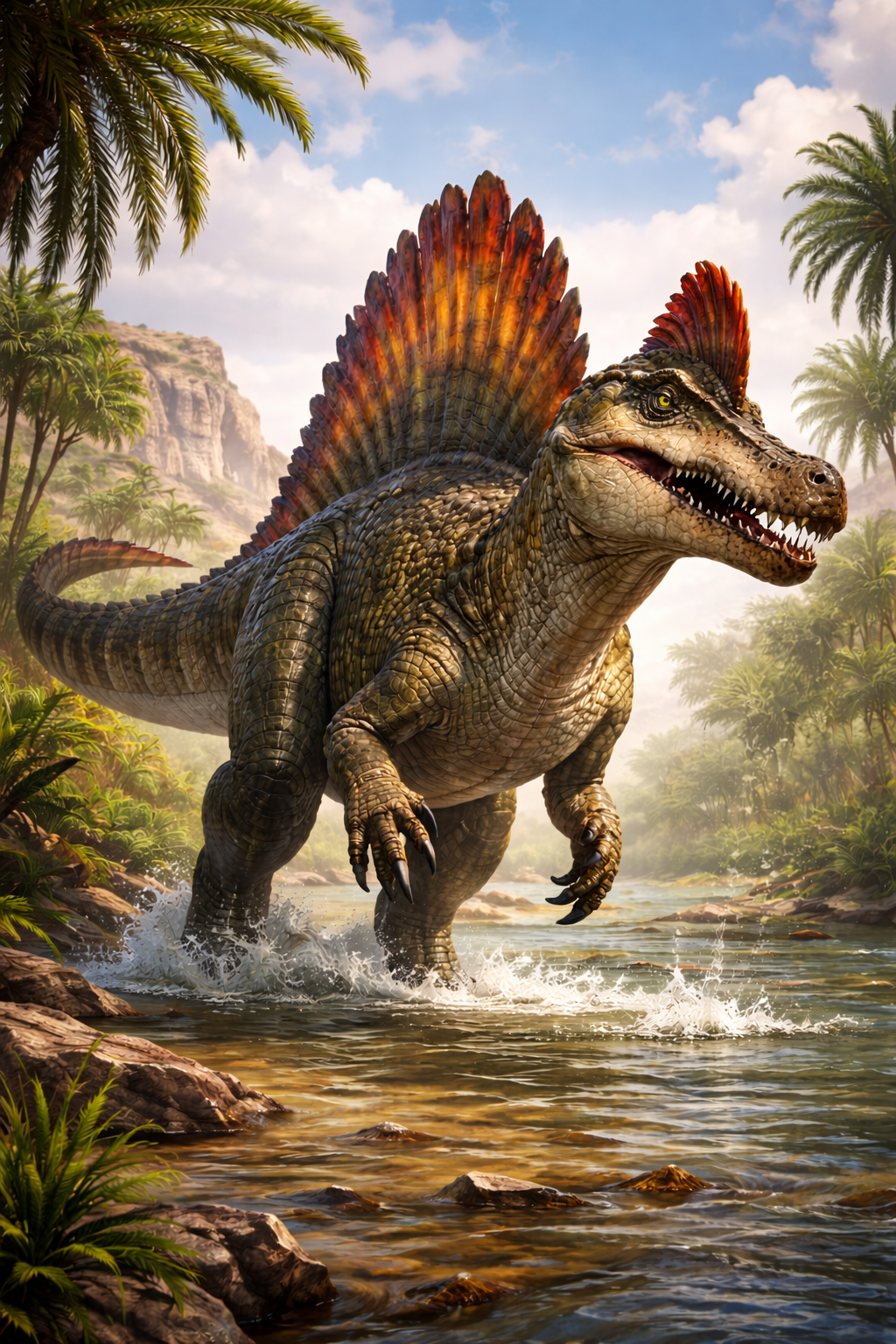
Scientists exploring one of the most isolated regions of the Sahara Desert have uncovered fossils belonging to a previously unknown species of Spinosaurus, offering fresh insight into one of the largest predatory dinosaurs ever to walk the Earth. The discovery, announced in research published in the journal Science, reveals a massive fish-hunting dinosaur that lived roughly 95 million years ago in what is now Niger.
Named Spinosaurus mirabilis, the new species measured about 40 feet long and weighed between five and seven tons, placing it among the largest carnivorous dinosaurs alongside giants such as Tyrannosaurus and Giganotosaurus. Researchers say the animal likely resembled a towering wading bird in behavior, stalking prey through shallow rivers and wetlands in a lush inland environment that once covered parts of the Sahara.
Its most striking feature is a tall, blade-shaped crest rising about 20 inches from the skull. Shaped like a curved scimitar, the crest was made of solid bone and probably covered in keratin, similar to a bull’s horns. Scientists believe it may have displayed bright colors and played a role in attracting mates or signaling dominance rather than serving as a weapon.
The dinosaur also possessed an elongated snout resembling that of a crocodile and rows of conical teeth that locked together when the jaws closed. This interlocking arrangement created what researchers describe as an effective “fish trap,” allowing the predator to grip slippery prey such as large coelacanths without letting them escape. According to study co-author Daniel Vidal, these adaptations suggest the animal specialized in catching fish rather than hunting other dinosaurs.
Unlike earlier Spinosaurus fossils discovered near ancient coastlines in Egypt and Morocco, the remains of S. mirabilis were found hundreds of miles from the nearest prehistoric shoreline. That location challenges earlier theories suggesting spinosaurs were fully aquatic swimmers capable of deep diving in marine environments. Instead, the anatomy and inland setting support the idea that they hunted primarily in shallow freshwater habitats.
Lead researcher Paul Sereno of the University of Chicago described the animal as a “hell heron,” capable of wading confidently into deeper water while breathing through nostrils positioned far back on its skull. This placement allowed much of the snout to remain submerged while stalking prey.
The path to discovery was as dramatic as the dinosaur itself. Sereno’s team first became interested in the area after reading a brief reference in a 1960s geological report describing a single dinosaur tooth found in Niger decades earlier. After multiple attempts hindered by harsh desert conditions, the researchers returned in 2022 with an international team, armed escorts, and a convoy that drove off-road for nearly three days across shifting sand dunes.
Their persistence paid off. Guided by a local Tuareg man, the scientists located massive bones protruding from sandstone outcrops at Jenguebi, a fossil-rich site surrounded by dunes. The expedition recovered parts of three skulls along with dozens of additional fossils, totaling more than 55 tons of material.
For Sereno and his colleagues, assembling digital models of the skull confirmed they were looking at something entirely new. Emotional reactions spread through the camp as researchers realized the crest represented a species never before seen.
The discovery adds another chapter to the evolving story of spinosaurs, a group whose origins and migration patterns across ancient continents are still being explored. Scientists believe further study of the Niger fossils may help explain how these unusual predators spread between Africa and South America during the age of dinosaurs.
This image is the property of The New Dispatch LLC and is not licenseable for external use without explicit written permission.