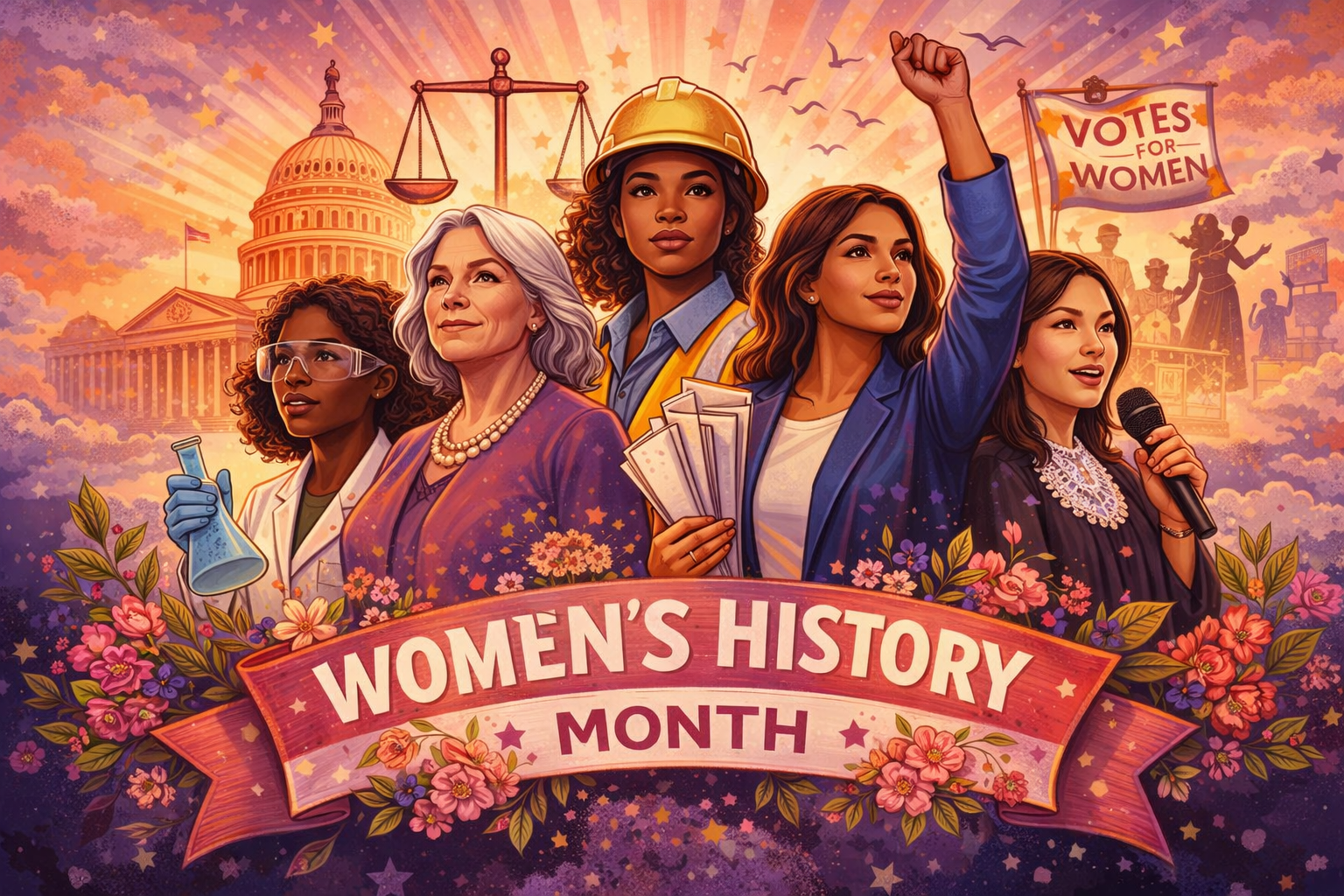
March is Women’s History Month, a time set aside to honor the contributions, achievements, and resilience of women across history and in modern society. In 2026, the observance takes place from March 1 through March 31. Each year, the National Women’s History Alliance selects a theme that highlights different dimensions of women’s influence and the ongoing pursuit of equality.
The roots of Women’s History Month go back to 1978, when educators in Sonoma County, California, organized a local Women’s History Week to align with International Women’s Day on March 8. The idea spread rapidly. Two years later, in 1980, President Jimmy Carter formally recognized the celebration at the national level by issuing a proclamation that acknowledged the week of March 8 as Women’s History Week. In 1987, Congress expanded the recognition to cover the entire month of March, establishing the annual tradition observed today.
Women’s History Month aims to bring attention to the many ways women have shaped society, often without recognition. This includes leaders in movements for voting rights, pioneers in science and technology, influential voices in the arts, and advocates for social justice. The observance encourages education, reflection, and a deeper appreciation of these contributions.
The 2026 theme, “Leading the Change: Women Shaping a Sustainable Future,” focuses on the role of women in addressing global challenges and building stronger, more equitable communities.
This year also marks important milestones in voting rights history. It has been 106 years since the ratification of the Nineteenth Amendment to the United States Constitution, which extended voting rights to women in 1920. It is also the 61st anniversary of the Voting Rights Act of 1965, a law that outlawed racial discrimination in voting and helped broaden access to the ballot, including for many women of color.
Across the country, Women’s History Month is recognized through educational programs, museum exhibitions, panel discussions, film presentations, literary events, and community gatherings. Resources provided by the National Women’s History Alliance support educators and organizations in highlighting women’s achievements in areas such as science, government, the arts, and social movements.
On a global level, March 8 is observed as International Women’s Day, a celebration supported by the United Nations that has its origins in early twentieth century labor activism. While the United States marks Women’s History Month in March, other countries observe similar recognitions at different times. For instance, Canada celebrates Women’s History Month in October, while the United Kingdom and Australia also observe it in March.
In 2026, Women’s History Month arrives during a period of both advancement and ongoing inequality. Women continue to reach new levels of leadership in government, business, and science, yet disparities remain in pay, representation, and access to essential resources in many parts of the world.
Ultimately, Women’s History Month is both a celebration of progress and a reminder of work still to be done. It underscores the importance of including women’s stories in our understanding of history and encourages continued efforts toward a more just and inclusive future.
This image is the property of The New Dispatch LLC and is not licenseable for external use without explicit written permission.