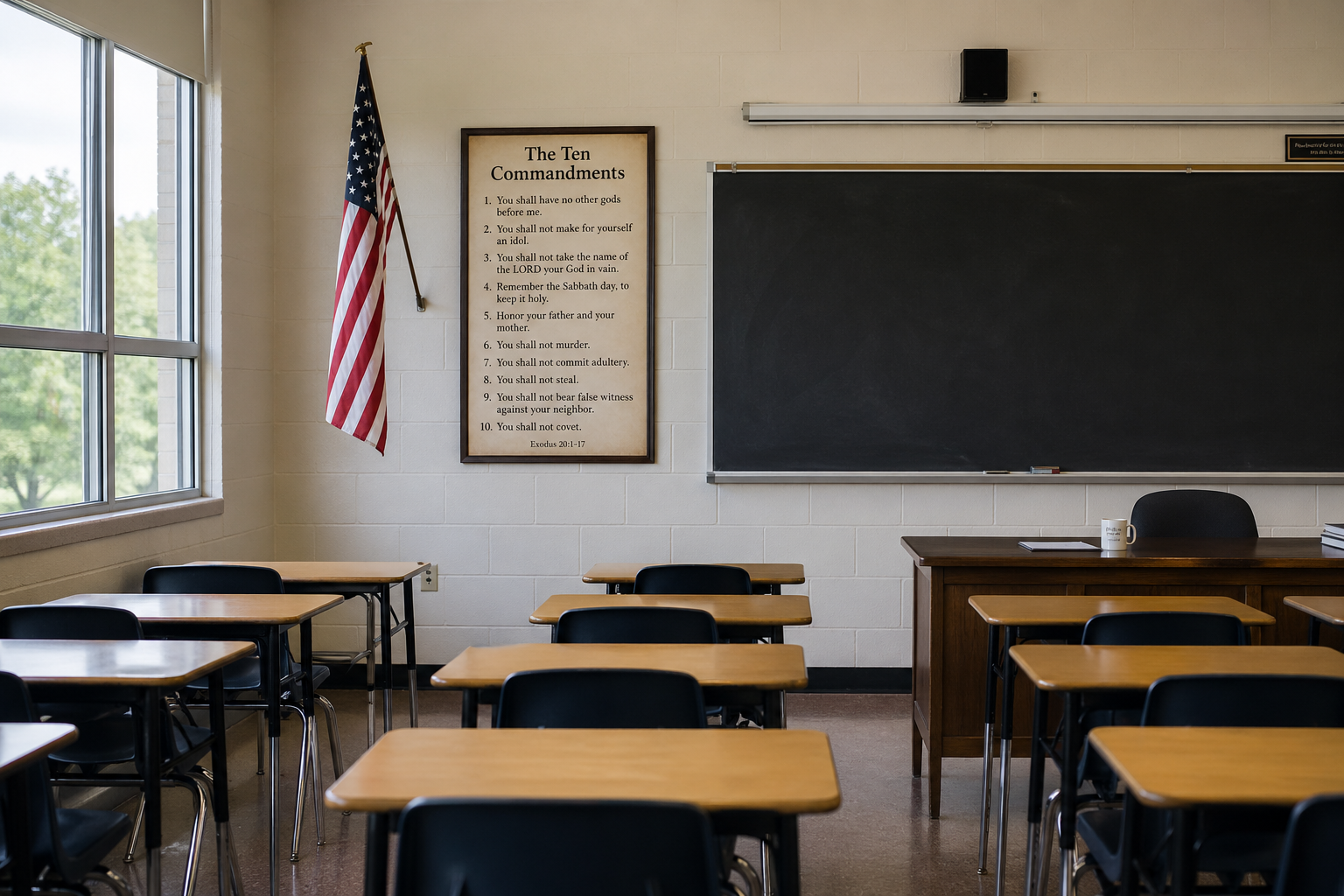
A federal appeals court ruled Tuesday that Texas can require public school classrooms to display the Ten Commandments, giving state officials a win in a legal fight over religion in schools.
The decision came from the 5th U.S. Circuit Court of Appeals in a close 9-8 vote. Judges said the Texas law does not break the First Amendment rights of students or parents. The ruling also reversed a lower court decision that had blocked some school districts from putting up the displays.
In the majority opinion, the court rejected claims that the posters force religion onto students. Judges wrote that students are not required to recite the commandments, agree with them, or treat them as religious truth.
Groups representing families who challenged the law said they were disappointed and expect to appeal to the U.S. Supreme Court. Those groups included the American Civil Liberties Union. They argued that families should decide for themselves whether children receive religious teaching, not the state.
Texas Attorney General Ken Paxton praised the ruling and said the Ten Commandments have shaped the country’s legal tradition. He called the outcome a victory for Texas.
The law was signed by Greg Abbott and took effect in September. It became the largest statewide effort in the nation to place the Ten Commandments in public school classrooms. Texas public schools serve about 5.5 million students.
Under the law, schools must display donated posters in a visible place inside each classroom. The measure also gives exact size rules. Posters must be 16 inches wide and 20 inches tall, with lettering large enough to be read from anywhere in the room by a person with average vision. Very specific, maybe unusually specific.
Reaction around Texas has been mixed since the law passed. Some districts accepted donated posters quickly. Others waited for court rulings or local direction before doing anything. School board meetings in some communities turned tense, with parents and residents arguing over what belongs in classrooms.
The requirement also created practical questions. Staff needed guidance on what to say if students asked about religion or the displays. In some places, boxes of posters were delivered straight to campuses. One suburban Dallas district spent nearly $1,800 to print around 5,000 posters, even though the law only requires schools to hang donated copies.
The case could matter outside Texas too. In February, the same appeals court allowed Louisiana to move forward with its own Ten Commandments classroom law.
Louisiana Attorney General Liz Murrill said the Texas ruling used much of the same legal reasoning as the Louisiana case. In Alabama, Kay Ivey signed a similar law earlier this month.
Not every judge agreed with Tuesday’s outcome. In a dissent joined by four others, Judge Stephen A. Higginson wrote that the Constitution was designed to stop political majorities from using government power to impose religion on others.
Texas lawmakers passed the measure with support from the Republican-controlled Legislature. Republicans, including President Donald Trump, have backed posting the Ten Commandments in classrooms.
This image is the property of The New Dispatch LLC and is not licenseable for external use without explicit written permission.