Rosh Hashanah occupies an unusual place on the Jewish calendar. It welcomes a new year, but its traditions have little in common with the countdowns, fireworks and late-night celebrations often associated with Jan. 1. Instead, the holiday asks people to look backward as well as forward. Prayer, repentance and an examination of one’s conduct are central themes, alongside family meals and hopes for a better year ahead.
That combination is the product of a long history. Some elements reach back to the Bible, while others appeared centuries later. The name Rosh Hashanah comes from Hebrew and refers to the beginning of a year. It takes place during Tishrei, which arrives during the fall in the Northern Hemisphere.
There is an apparent puzzle in the calendar because Tishrei does not occupy the first position in the traditional numbering of Hebrew months. Jewish tradition has used different starting points depending on what is being measured. The Torah gives the spring month of Nisan the first position, while Tishrei eventually became the point at which the count assigned to the year advances.
The earliest biblical instructions are much less detailed than the holiday observed today. Leviticus 23 tells the Israelites to set aside a date early in the seventh month for religious observance, to refrain from their usual work and to mark the occasion with blasts. Numbers 29 contains another set of instructions for the same occasion. Neither passage uses the later name Rosh Hashanah or presents the day as the beginning of another year.
That distinction matters because the holiday did not appear in biblical times with all of the meanings and customs familiar today. Its character accumulated gradually as Jewish religious thought and practice developed. One element that survived and gained greater significance was the use of a horn.
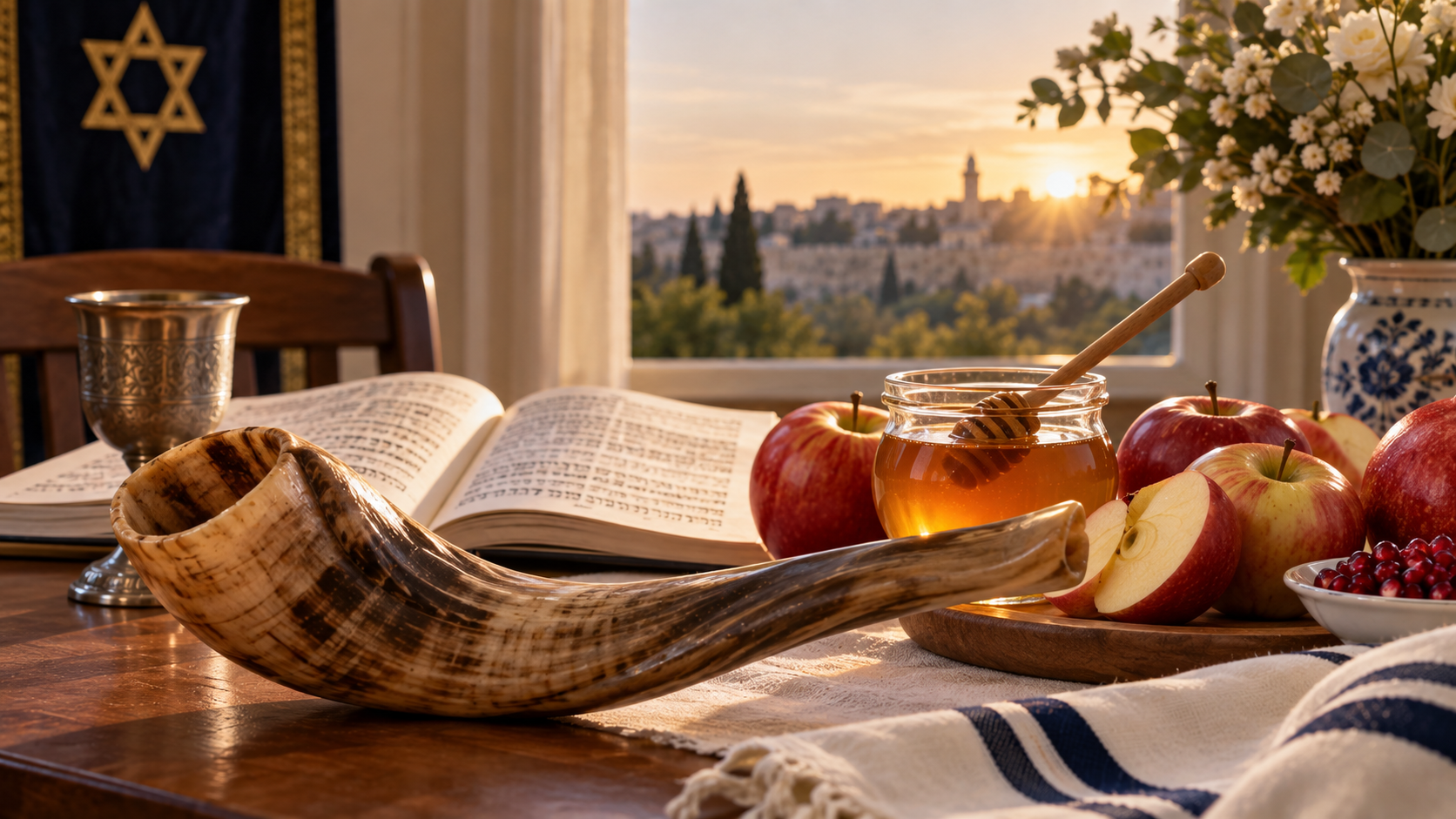
The instrument used for this purpose became known as the shofar. It is fashioned from an animal horn, with a ram traditionally providing a familiar source, and produces several distinct patterns of sound during worship. Generations of Jewish thinkers gave those blasts additional religious significance, particularly as reminders for people to consider their conduct and responsibilities.
Jewish religious life changed significantly after Roman forces destroyed the Second Temple in Jerusalem in 70 CE. Without the Temple, practices once centered there could no longer continue in the same form. Prayer, communal worship and rabbinic teaching took on even greater importance, and writings from the rabbis provide a clearer picture of how the ancient observance developed into a New Year.
The Mishnah, an influential compilation of Jewish law completed around 200 CE, identifies four separate occasions that function as yearly starting points for different purposes. Tishrei is important in this system because its arrival is connected with reckoning the passage of years and with certain legal calculations.
The Mishnah also presents this season as a time when human conduct comes before God for judgment. That idea contributed greatly to the character Rosh Hashanah eventually assumed. Beginning another year consequently involves more than turning a page on a calendar; it also provides an occasion to consider how the previous one was lived.
For observant Jews, that process can include recognizing mistakes, asking forgiveness and attempting to repair relationships. Those concerns remain prominent in the days following Rosh Hashanah and lead toward Yom Kippur, when repentance and atonement receive particular emphasis. Together, the holidays create a period in which personal conduct and relationships receive unusual attention.
Reflection, however, is only one side of Rosh Hashanah. The arrival of another year also brings optimism, and some of the holiday’s best-known food traditions express that outlook. Apples served with honey are a familiar example, using sweetness to represent good wishes for what lies ahead.
The foods served are by no means identical from one Jewish household to another. Communities that developed in different regions created their own menus and customs, influenced in part by the ingredients and traditions around them. As a result, a Rosh Hashanah meal can reflect both a shared religious heritage and the particular history of a family or community.
Other familiar practices appeared much later than the biblical instructions. One is tashlich, a custom that emerged during the medieval period and eventually spread among numerous Jewish communities. It involves going to a waterfront setting for prayers and readings concerned with repentance and forgiveness, drawing on biblical imagery about wrongdoing being removed.
The history of tashlich illustrates how Jewish observance continued to change long after antiquity. Customs could appear in one era, spread to other communities and eventually become so familiar that they seemed inseparable from the holiday. Jews living during biblical times would not necessarily recognize every practice found at a Rosh Hashanah observance today.
There are variations in the length of the holiday as well. Traditional Jewish practice observes Rosh Hashanah across two days, including in Israel. This differs from the pattern followed for several other Jewish festivals, in which an additional day is traditionally observed outside Israel. Some Reform and other liberal congregations follow a shorter observance.
Geography produced other differences as Jewish populations established communities throughout Europe, the Middle East, North Africa and eventually many other parts of the world. Local foods, music and customs became intertwined with older religious traditions. Two families separated by thousands of miles could therefore recognize the same holiday while experiencing it in noticeably different ways.
That mixture of old and new remains visible in modern observance. A person attending services can participate in a ritual with roots in antiquity and later sit down to a meal shaped by customs passed through more recent generations. Another practice followed by the same family may have originated during the Middle Ages.
Looking at that history also shows why treating Rosh Hashanah as simply a Jewish equivalent of Jan. 1 leaves out much of its significance. The changing of the year is important, but so are questions about personal conduct, obligations to other people, forgiveness, prayer and the possibility of making different choices in the future.
Rosh Hashanah as it is known today was shaped over a very long period. What began as an ancient sacred observance acquired additional meanings through rabbinic interpretation and customs developed by Jewish communities in later centuries. The result is a holiday that looks in two directions at once, asking people to consider the year they have completed while deciding how they want to approach the one ahead.
This image is the property of The New Dispatch LLC and is not licenseable for external use without explicit written permission.