The European Union and the Republic of Korea signed a new Digital Trade Agreement during their summit in Brussels, taking another step in expanding economic cooperation between the two partners. The agreement adds a digital trade framework to the free trade agreement that has linked the EU and South Korea since 2011.
Leaders from both sides said the new deal is meant to support open, transparent and rules-based digital trade at a time when online business continues to grow. The agreement is also part of the EU’s effort to develop common digital trade rules with countries it considers trusted partners.
The agreement introduces legally binding rules covering several areas of digital commerce. Electronic contracts and electronic signatures will be recognized as legally valid, making it easier for businesses and customers to complete transactions online. Officials said the changes could be especially useful for micro, small and medium-sized businesses that depend on digital services to reach customers.
The deal also includes measures aimed at creating a safer online marketplace. Consumer protection rules are intended to increase confidence in digital transactions while supporting continued growth in online trade. The agreement allows data to move across borders more easily and prevents governments from requiring companies to transfer their source code as a condition of doing business.
Privacy protections will remain unchanged under the agreement. Both the European Union and South Korea said they will continue applying their own standards for protecting personal data while keeping the ability to introduce policies they consider necessary for public interests.
European Commission President Ursula von der Leyen met with South Korean President Lee Jae-myung during the summit. After the meeting, von der Leyen said the two sides are working together to strengthen economic security and encourage innovation. Discussions between leaders also covered clean energy, defense cooperation and ways to improve economic resilience.
The Digital Trade Agreement has not yet entered into force. It must first complete the approval process on both sides. Within the European Union, the European Parliament will need to approve the agreement before it can be formally concluded by the Council. South Korea will follow its own ratification procedures before the agreement becomes official.
The EU describes South Korea as one of its key partners in the Indo-Pacific region. Digital trade already represents a large share of economic activity between the two economies. In 2023, digitally delivered services accounted for more than €11 billion of trade in services between the EU and South Korea. More recent figures also show goods trade exceeded €124 billion in 2025, while trade in services reached €33 billion in 2024.
This is the second stand-alone Digital Trade Agreement signed by the European Union. The first was reached with Singapore. The new agreement also builds on the EU-Republic of Korea Digital Partnership launched in 2022, expanding cooperation as businesses and consumers continue relying more on digital transactions.
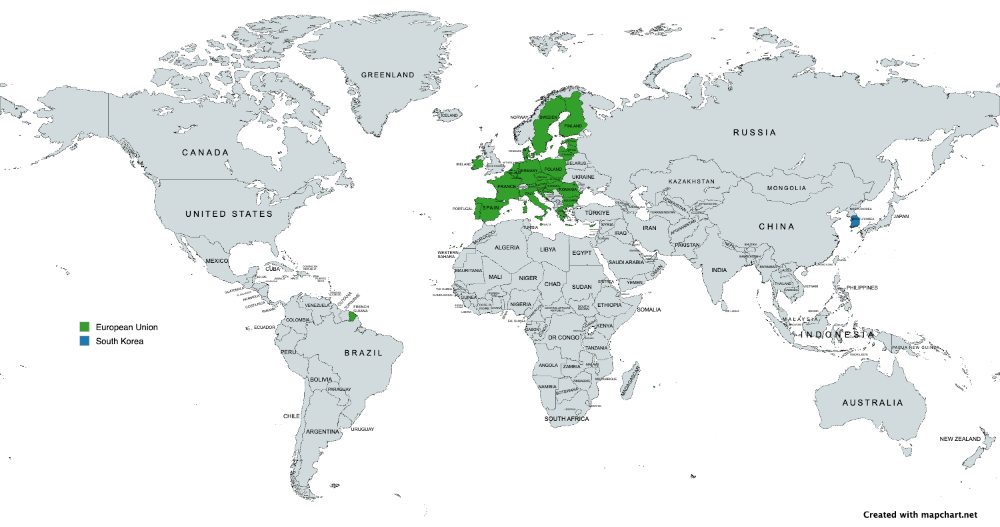
European Union = Green
South Korea = Blue
Image is licensed under the Creative Commons Attribution-Share Alike 4.0 International license and was created using MapChart (https://mapchart.net).