The United States has drawn criticism from China after a recent revision to a State Department fact sheet on Taiwan. The updated document no longer includes the phrase stating that the U.S. does not support Taiwan’s independence, a change that Beijing has condemned as a serious regression in Washington’s policy.
China’s Foreign Ministry spokesperson, Guo Jiakun, said Monday that the revision sends the wrong message to pro-independence factions in Taiwan and could disrupt peace in the Taiwan Strait. He urged the U.S. to reverse the change and adhere to the long-standing “One China” policy. The Taiwan Strait, a strategically vital waterway, has been a frequent flashpoint between China and Taiwan, with Beijing asserting sovereignty over the island.
Taiwan’s government welcomed the State Department’s update, viewing it as a sign of a strong and friendly partnership between Washington and Taipei. In a statement, Taiwan’s Ministry of Foreign Affairs described the revised fact sheet as reflecting a close relationship with the U.S. The ministry did not directly address the removed phrase but expressed appreciation for the support indicated in the document.
The U.S. has long maintained a delicate stance on Taiwan, recognizing Beijing’s claim to the island under the “One China” policy while simultaneously providing arms and political support to Taiwan. Although Washington does not formally recognize Taiwan as an independent nation, it is legally bound by the Taiwan Relations Act to assist in the island’s defense.
This is not the first time the phrase has been removed from a U.S. government document. A similar revision occurred in 2022 during the Biden administration, only for the language to be reinstated weeks later following a strong response from Beijing. The timing of this latest revision, just weeks after President Donald Trump returned to office, has raised questions about whether it signals a new approach to Taiwan policy.
Trump has made several comments about Taiwan that have fueled speculation about the direction of U.S. policy. Last week, he accused the island of taking semiconductor business away from the United States and expressed interest in reshaping trade agreements. Despite these remarks, his administration has also signaled support for Taiwan, including through naval patrols in the Taiwan Strait and strengthened economic ties.
Meanwhile, tensions in the region continue to rise. China has intensified its military presence near Taiwan, conducting frequent naval and air force maneuvers around the island. Taiwan’s Defense Ministry reported that in the past 24 hours alone, 41 Chinese aircraft and nine naval vessels had been detected near its territory.
As Taiwan seeks to bolster its international position, its government has pledged to expand investment and dialogue with the U.S. President Lai Ching-te stated that Taiwan would work to address U.S. concerns over trade and technology cooperation, particularly in the semiconductor industry.
While the updated fact sheet does not explicitly endorse Taiwan’s independence, the removal of language rejecting it has caused diplomatic strain between Washington and Beijing. With China viewing Taiwan as a core national interest, any perceived shift in U.S. policy could have lasting consequences for relations between the world’s two largest economies.
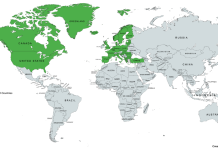
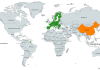
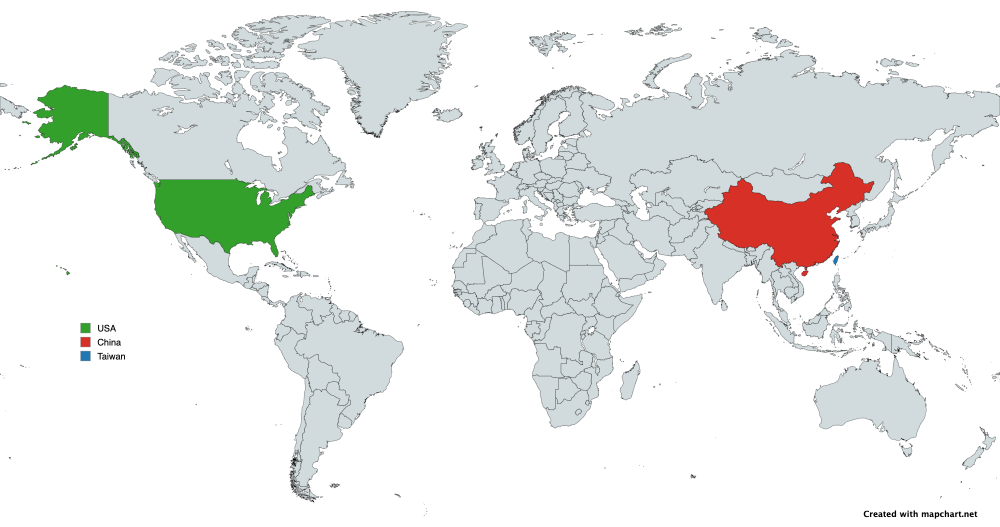
USA = Green
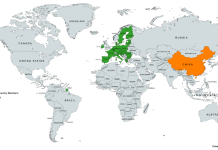
China = Red
Taiwan = Blue
Image is licensed under the Creative Commons Attribution-Share Alike 4.0 International license and was created using MapChart(https://mapchart.net).