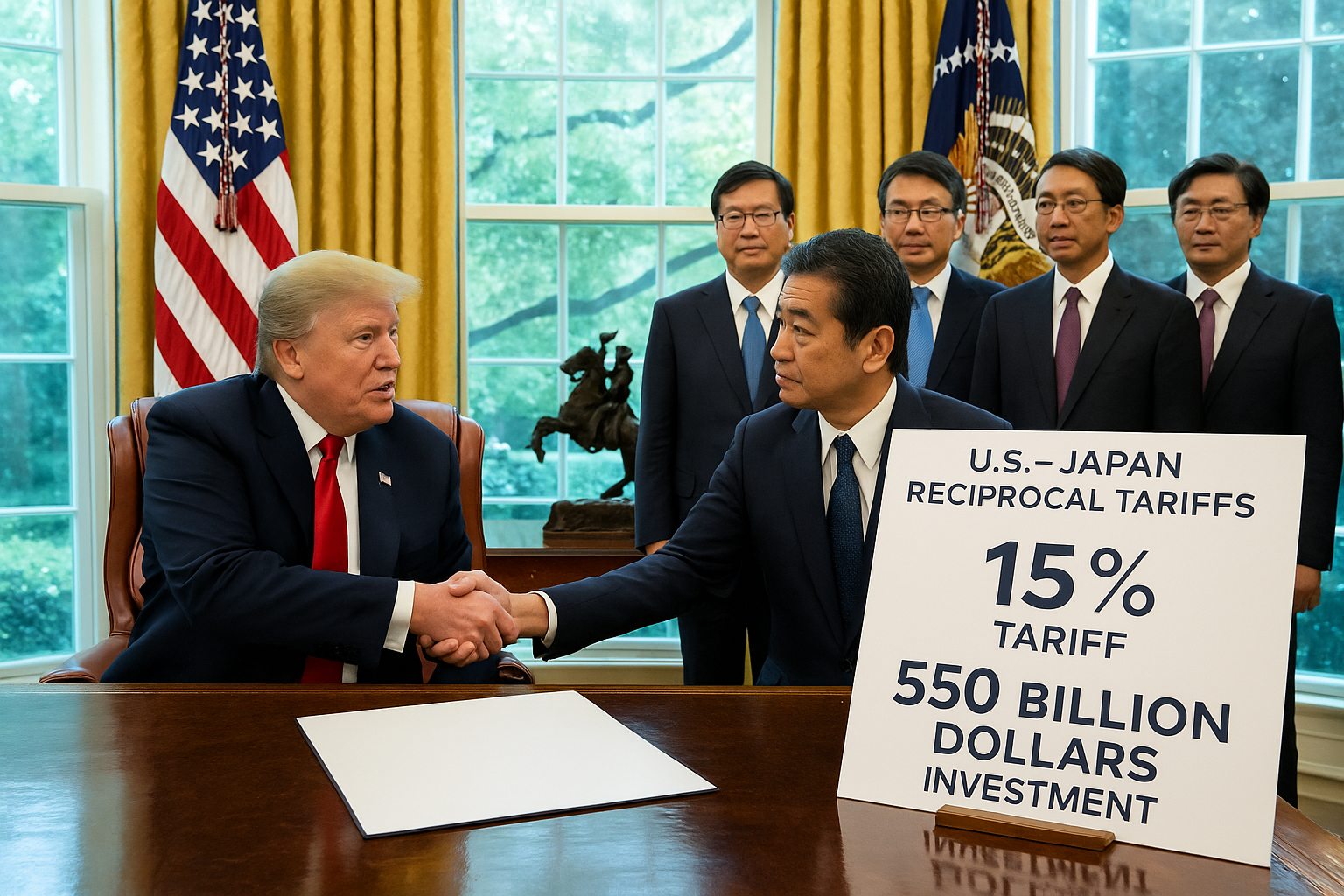
President Donald Trump has unveiled a wide-reaching trade agreement with Japan that includes a 15% tariff on various imports and a pledge of $550 billion in Japanese investment into the U.S. economy. The announcement, made Tuesday via Trump’s Truth Social platform, was touted as one of the most impactful trade pacts yet negotiated by the current administration.
The deal follows weeks of back-and-forth between U.S. and Japanese negotiators as Japan sought to avoid a previously announced 25% tariff set to take effect on August 1. Instead, the agreement places a uniform 15% rate on Japanese auto, semiconductor, and pharmaceutical imports to the U.S.
Trump described the deal as a major victory for American industry and employment, saying it would result in “hundreds of thousands of jobs” and open up Japanese markets to U.S. exports such as trucks, rice, and other agricultural products.
However, the fine print of the deal has prompted some confusion. A photo posted by White House deputy chief of staff Dan Scavino showed a placard on the president’s desk listing a 10% rate alongside the now-agreed 15%, with edits visible on the investment figures. The card originally read “$400B” in large text, but the “4” was crossed out and replaced with “500.” In his Truth Social post, Trump stated the investment total as $550 billion — raising questions about whether the changes were last-minute revisions, clerical errors, or adjustments made during negotiations.
Commerce Secretary Howard Lutnick told Bloomberg he was responsible for preparing the materials but emphasized that the final terms were driven by the president. “The negotiator in chief is the one behind the desk,” Lutnick said.
Treasury Secretary Scott Bessent also spoke on the matter, explaining that Japan’s commitment to funding large U.S. infrastructure and defense projects helped them secure the 15% rate, even as other nations still face higher tariffs in upcoming trade talks.
Market response was swift and largely positive. Japan’s Nikkei index surged 3.5%, driven by automakers who saw relief in the lower tariff rates. U.S.-listed shares of Toyota and Honda also rose sharply. Analysts noted the agreement was a welcome sign of stability following months of tariff threats and uncertainty.
Still, questions remain about the nature of Japan’s financial commitment. Piper Sandler’s Andy Laperriere noted that Japanese officials view the $550 billion as a cap, not a floor, and suggest some of the amount may include loan guarantees rather than direct investments.
Critics of the administration’s approach have expressed concern over transparency and the risk of setting unclear precedents with trade partners. Nevertheless, the White House is pressing forward with additional negotiations, having set an ambitious goal of striking numerous trade deals before the next tariff deadline.
Trump’s agreement with Japan is one of several reached in recent weeks, including those with the United Kingdom, Vietnam, and Indonesia. The European Union and China remain in talks, with upcoming deadlines placing pressure on both sides to finalize terms.
This image is the property of The New Dispatch LLC and is not licenseable for external use without explicit written permission.