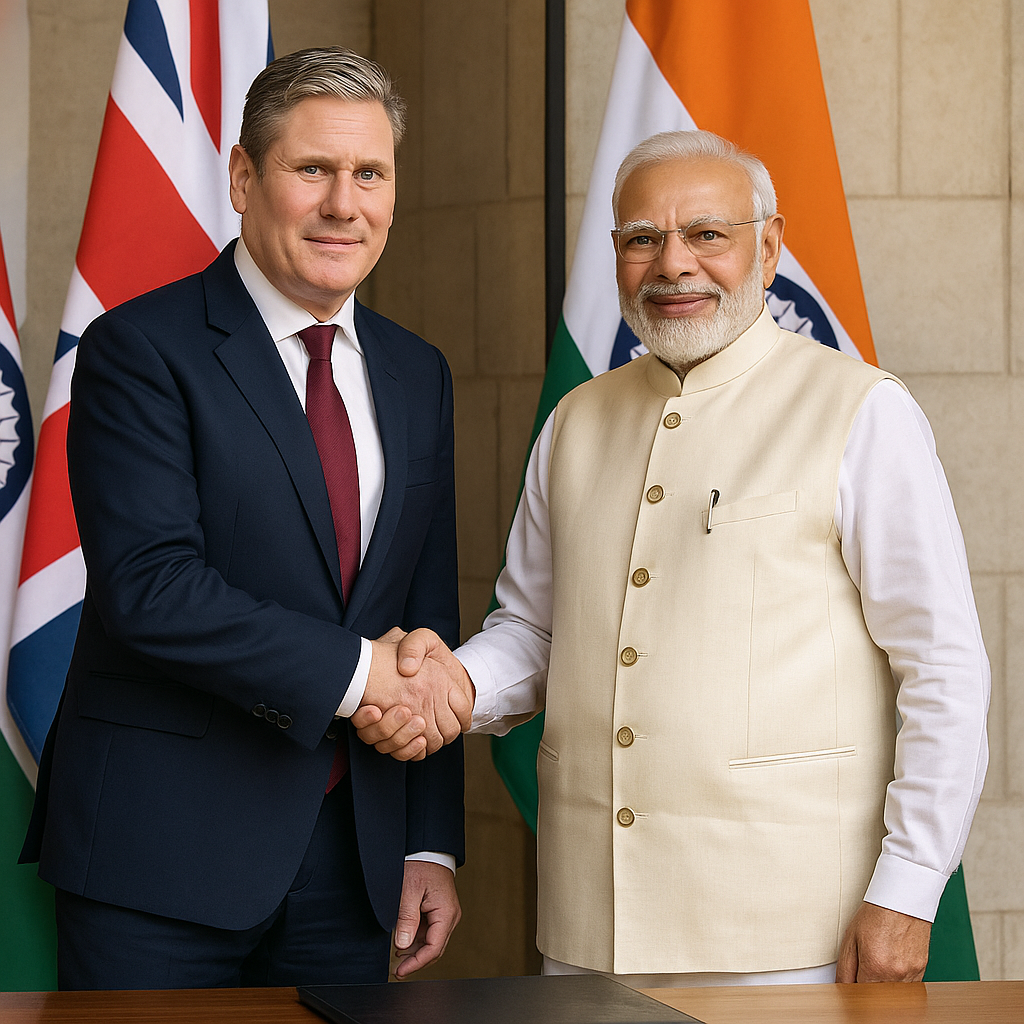
After more than three years of negotiation, the United Kingdom and India have finalized a wide-ranging trade agreement projected to benefit both economies. Signed at Chequers, the UK prime minister’s official residence, the deal was formally concluded by Prime Minister Sir Keir Starmer and his Indian counterpart, Prime Minister Narendra Modi.
The agreement is expected to reduce trade barriers and expand access to each other’s markets for goods such as cars, clothing, spirits, food, and medical equipment. For the UK, average tariffs on exports to India will fall from 15% to 3%, with luxury vehicles, Scotch whisky, and aerospace components among the sectors likely to benefit. For India, the deal lowers costs on textiles, shoes, seafood, and electronics entering the British market.
Speaking at the signing ceremony, Starmer described the accord as a crucial step in building economic momentum and strengthening the long-standing ties between the two nations. “This deal is now signed, sealed, delivered,” he said, while also emphasizing the broader nature of UK-India cooperation: “We want to strengthen our relationship further.”
Modi, likewise, hailed the deal as a shared plan for economic growth, noting that Indian exporters would gain improved access to British consumers, while Indian businesses could more easily acquire British technology and components. “This is a blueprint for our shared prosperity,” he said.
The UK government projects the deal will generate an additional £4.8 billion annually for the British economy and create more than 2,000 jobs. The agreement includes nearly £6 billion in trade and investment pledges covering sectors like artificial intelligence, aerospace, dairy, and climate innovation.
Beyond trade, the agreement commits both governments to deeper collaboration in defense, education, technology, and law enforcement. Plans are underway to expand intelligence sharing, improve criminal record cooperation, and assist in handling irregular migration through better data exchange.
A longstanding sticking point in the negotiations involved social security contributions for workers on international assignment. Under the new agreement, staff temporarily relocated from one country to the other will only contribute to their home system, not both. UK officials emphasized that similar arrangements are already in place with numerous countries and that this clause does not provide an incentive to hire foreign workers over domestic employees.
While the agreement has been signed, it still requires ratification by the UK Parliament. It is expected to come into effect in 2026.
Despite enthusiasm around the accord, not every concern was resolved. The UK had sought broader access to India’s financial and legal services markets, and those talks are still ongoing. Similarly, a separate bilateral investment treaty, long desired by British officials to support UK-based firms operating in India, remains under negotiation.
Still, the overall reaction from both governments has been optimistic. As Modi put it, “On the one hand, our industries gain access; on the other, our people gain opportunity.” For two countries connected by deep cultural and economic ties, this agreement marks a major step toward a closer, more dynamic partnership.
This image is the property of The New Dispatch LLC and is not licenseable for external use without explicit written permission.