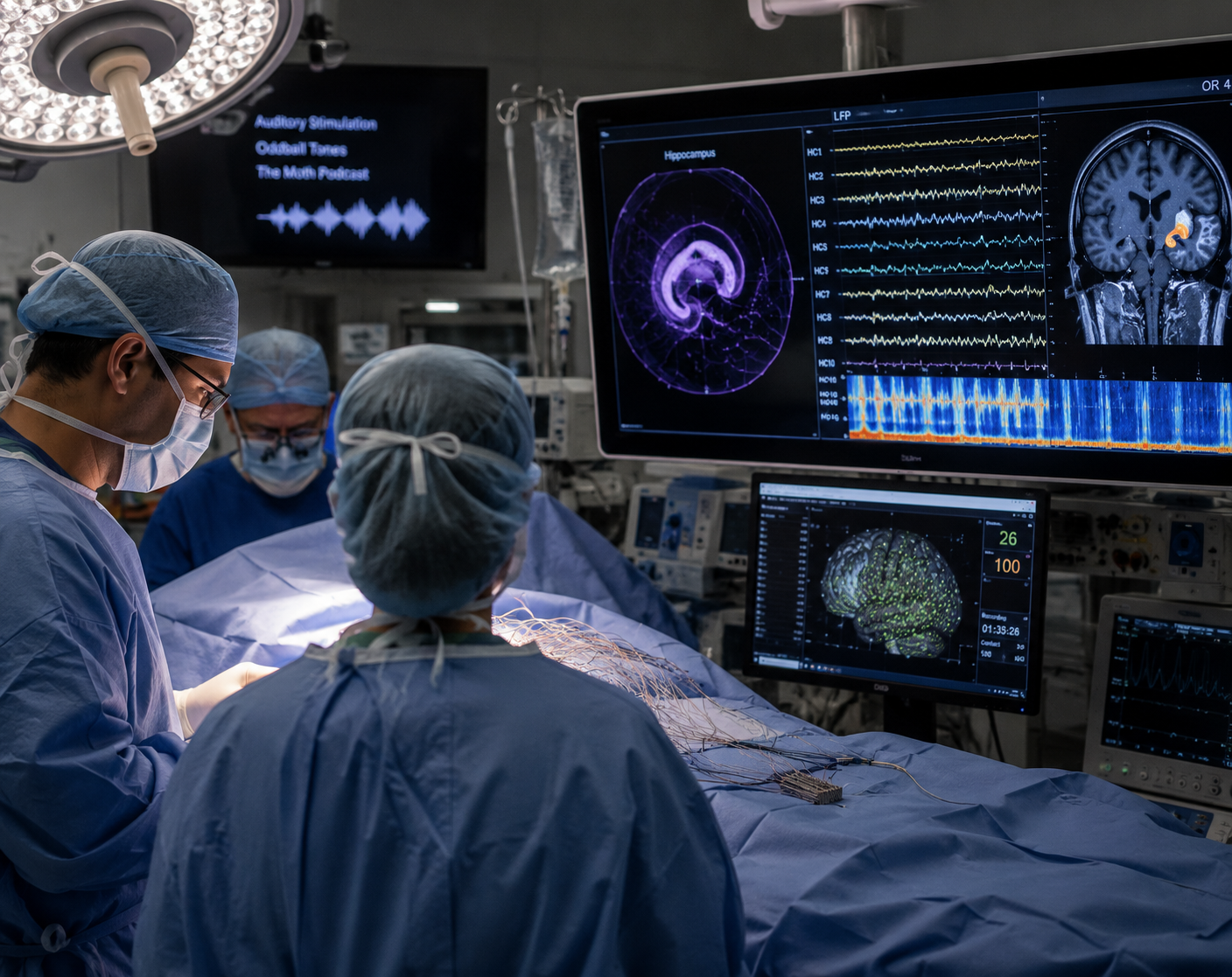
Deep in the brain, a curved structure called the hippocampus helps people organize memories and process experiences. Scientists have long linked it to learning and awareness. A new study suggests the hippocampus may keep working even when consciousness shuts down under anesthesia.
The research, published in the journal Nature, examined seven epilepsy patients who underwent surgery to remove parts of their brains. During the operations, researchers monitored activity from individual neurons inside the hippocampus while the patients were fully anesthetized.
Doctors played sounds and spoken audio in the operating room. Some patients heard repeating tones interrupted by unusual “oddball” sounds. Others listened to episodes of The Moth Radio Hour. The patients later reported no memory of hearing anything during surgery, but their brains still appeared to react in complicated ways.
Dr. Sameer Sheth, a neurosurgery professor at Baylor College of Medicine and one of the study’s authors, said the project grew out of earlier research suggesting unconscious patients may still retain traces of information presented during surgery. Past studies found patients were more likely to recognize words they heard under anesthesia, even if they could not consciously remember them afterward.
In the new study, neurons in the hippocampus responded differently to unexpected sounds than to repeated ones. The distinction became stronger over about 10 minutes, which researchers said could point to a form of learning taking place during unconsciousness.
The podcast experiment surprised the team even more. Researchers found patterns of neural activity that looked similar to those seen in awake people processing language. Some neurons reacted more strongly to nouns. Others appeared tuned to verbs or different parts of speech. According to the researchers, certain cells also seemed to track meaning, grouping related words together. Words like “cat” and “dog” triggered responses that looked more connected than unrelated words such as “pen.” The neurons even appeared to predict what type of word might come next in a sentence.
Benjamin Hayden, another neurosurgery professor at Baylor and co-author of the paper, said the findings showed a level of complexity they did not expect. He said the hippocampus appeared to continue carrying out language-processing tasks despite the absence of conscious awareness.
Dr. Kirill Nourski from the University of Iowa, who was not involved in the research, called the findings surprising because many scientists did not expect sophisticated sound processing to continue under anesthesia. Researchers stressed that the study does not mean patients understand conversations happening around them during surgery. Leon Deouell, a neuroscience professor at the Hebrew University of Jerusalem, said the work instead suggests some parts of language processing happen automatically and unconsciously.
The study also connects to broader questions about consciousness itself. Scientists still do not fully understand how awareness emerges from electrical activity inside the brain. Under anesthesia, those patterns become slower and more uniform.
Other research has explored this process in animals. Emery Brown of Massachusetts Institute of Technology and Harvard Medical School has studied how anesthetics like propofol disrupt communication between neurons. In experiments with monkeys, Brown and his colleagues found neural activity slowed sharply under anesthesia, with brain signals collapsing into lower-frequency rhythms.
One experiment involved stimulating the thalamus, another deep brain structure involved in communication across the cortex. Monkeys briefly showed signs of increased awareness after the stimulation. Their neurons became more active again, though only for a few minutes. It was strange looking results, even to the researchers themselves.
Scientists say the newer hippocampus findings could eventually help doctors better understand anesthesia and how unconscious brains process information during surgery.
This image is the property of The New Dispatch LLC and is not licenseable for external use without explicit written permission.