Elon Musk became the world’s first trillionaire on Friday, at least on paper, after SpaceX made its stock market debut and investors drove its share price sharply higher during its first day of trading.
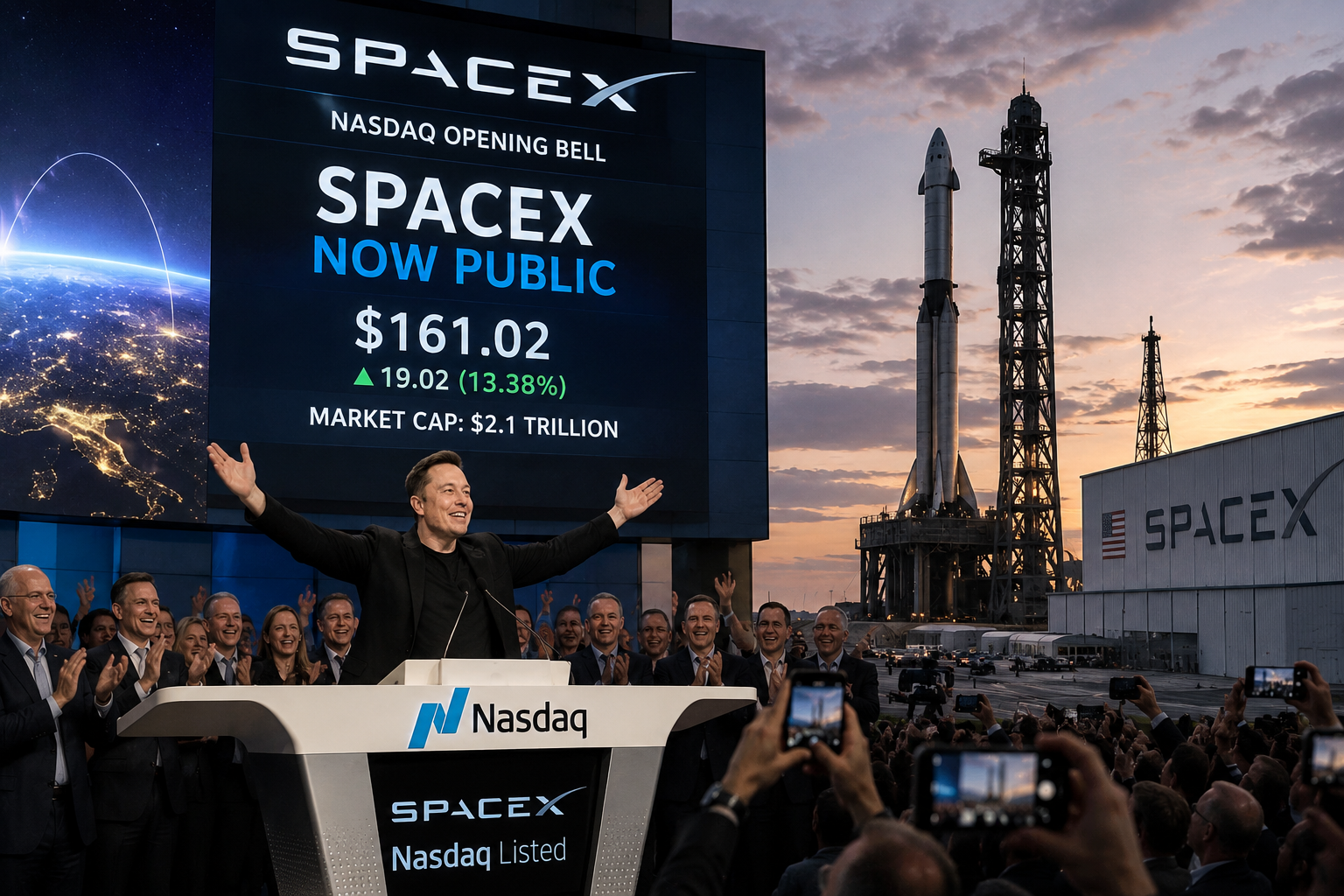
The company priced its initial public offering at $135 a share before trading opened on the Nasdaq. Once the market opened at noon Eastern time, SpaceX shares began at $150, climbed to around $168 during the day and finished just above $161. The closing price gave the company a market value of about $2.1 trillion, making it the sixth-largest publicly traded company in the United States. It also moved ahead of Tesla, Musk’s electric vehicle company, in overall market value.
According to Forbes, Musk’s combined ownership in SpaceX and Tesla is now worth about $1.1 trillion. Before the IPO, his estimated fortune was around $813 billion. The strong first day of trading added hundreds of billions of dollars to the value of his SpaceX stake and pushed his net worth past the trillion-dollar mark.
Musk took part in Nasdaq’s ceremonial opening from SpaceX’s Starbase facility in South Texas. During the event, he said the company is going public to raise money for projects that include expanding satellite operations, developing orbital data centers and supporting future missions to Mars. He described a future where ordinary people, rather than only professional astronauts, could eventually travel deeper into space. Musk also said the company is still focused on the long-term goal of building a large human settlement on Mars.
Investor demand was strong from the start. Both large investment firms and individual buyers purchased shares at the $135 offering price before trading began. The IPO raised $75 billion, setting a new record for the largest public stock offering and passing the previous mark set by Saudi Aramco in 2019.
The enthusiasm came even though SpaceX is still reporting large financial losses. Between the beginning of 2025 and March 31, 2026, the company lost $8.7 billion as it continued investing heavily in future projects. Company filings also acknowledge that some of its plans depend on technology that has not yet been proven. Its artificial intelligence business, xAI, is still spending heavily while working toward profitability.
Some investors said they remain confident despite those risks. Yordys Coro, an IT support contractor in Miami, watched his $14,000 investment grow to roughly $17,000 within hours. He said he believes many investors are placing their trust in Musk’s ability to deliver on ambitious goals and plans to keep holding his shares.
Others are much more cautious. Analysts at Morningstar estimated SpaceX is worth about $780 billion, far below its value after the IPO. They pointed to the company’s large spending, uncertain technology and the amount of money it will still need to fund future projects. Shareholder groups and public pension funds have also criticized the company’s share structure, which gives Musk voting control that is much larger than his ownership stake.
During a livestream discussion before trading started, Musk spent much of his time talking about future ideas, including hotels on the Moon, solar-powered data centers in orbit and permanent communities on Mars. When asked about Grok, his flagship chatbot, he shifted the conversation back to the company’s satellite business. SpaceX is expected to be the first of several major technology companies to enter the public market this year, with Anthropic and OpenAI also expected to pursue public offerings.
This image is the property of The New Dispatch LLC and is not licenseable for external use without explicit written permission.