By the time most people hear about a wildfire, it’s already on the news. There are maps on TV, evacuation alerts buzzing on phones, and long lines of cars leaving town. Lately, there’s been something else too: people online trying to predict what the fire will do next.
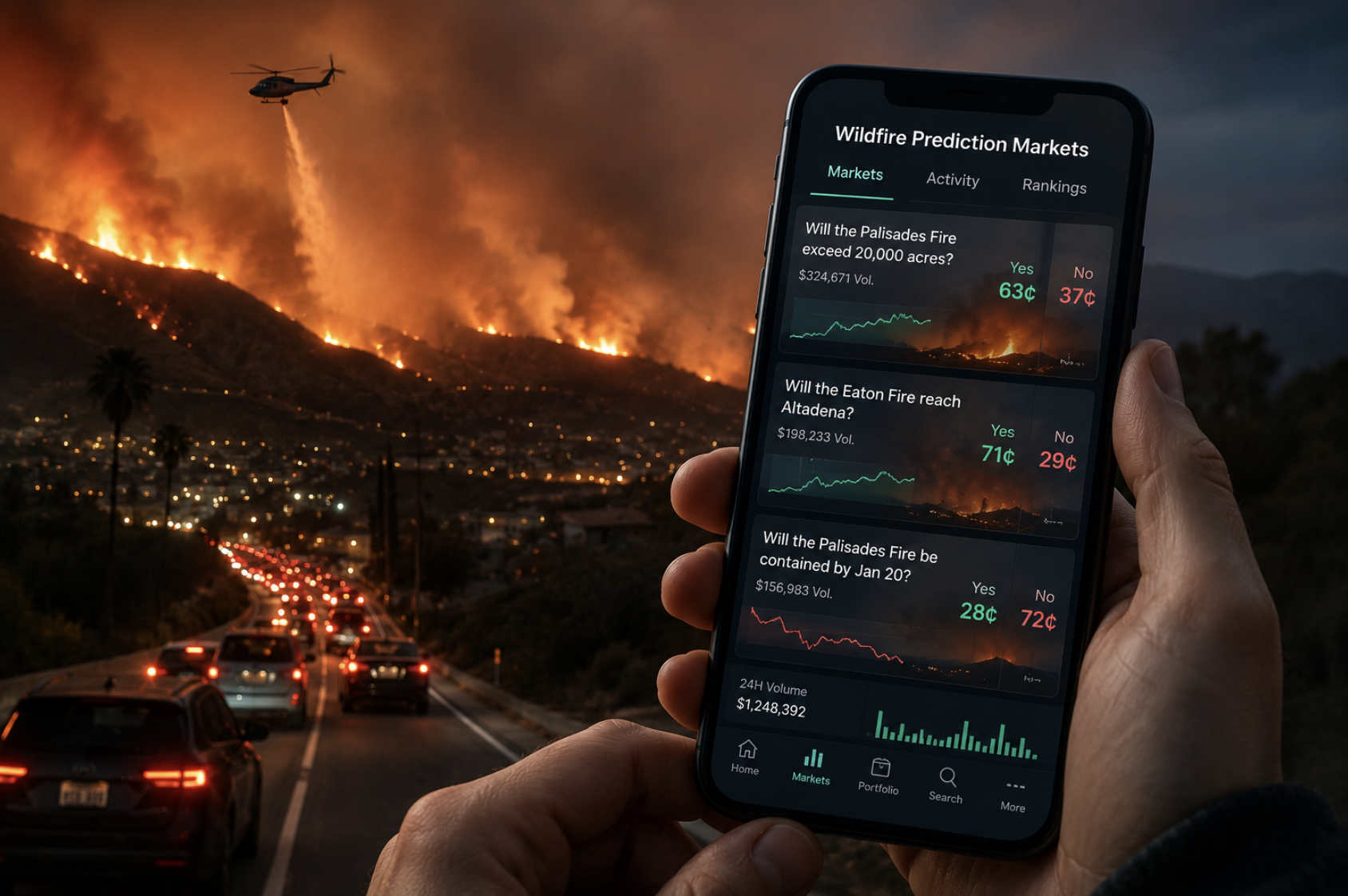
Prediction markets have been around for years, but wildfire-related markets have started getting more attention. These websites let users speculate on future events. In the case of fires, that can mean guessing whether a blaze will hit a certain acreage, when it might be contained, or if it will reach a particular location. It’s an odd thing to stumble across if you’ve never seen it before.
That happened to some people affected by the Los Angeles fires last year. During the Eaton and Palisades fires, about $1.2 million changed hands through prediction markets tied to those events. Several survivors interviewed by reporters said they didn’t even know these kinds of websites existed until after the fires were over. One described the whole thing as hard to process. Another simply couldn’t believe people were following their community’s disaster like a scoreboard.
The industry behind these sites is much bigger than wildfire markets alone. People use prediction platforms to speculate on elections, sports championships, and all kinds of internet trends. If enough people are interested in a question, chances are somebody has turned it into a market.
There’s even a website dedicated entirely to California wildfires. It’s called Wyldfyre, and at the moment it only uses virtual money. The company says its goal is to improve forecasting by combining public participation with data sources such as satellite imagery and emergency reports. Whether that actually works is still an open question. Scientists interviewed in recent coverage didn’t seem especially convinced.
Part of the discomfort comes from the fact that fires are different from many other disasters. You can’t cause an earthquake. You can’t steer a hurricane. Wildfires are more complicated. Investigators and psychologists who study fire-setting behavior say that’s why some experts are paying attention to this issue, even though there is no evidence that prediction markets have caused anyone to commit arson.
Former Los Angeles County arson investigator Ed Nordskog said there isn’t much research available yet. He has spent years looking into why people intentionally start fires, and he believes the topic deserves a closer look as these platforms become easier to access. Others have raised concerns that financial incentives, even small ones, can sometimes change how people think.
Not everyone sees prediction markets as entirely negative. A few researchers argue that crowd forecasting has been useful in other areas and could eventually help identify trends that traditional models miss. At the same time, wildfire experts note that fire behavior changes quickly and depends on many factors, including weather, terrain, and vegetation. That’s a lot to boil down into a single yes-or-no question on a website.
Government agencies don’t appear interested in finding out. Cal Fire and the U.S. Forest Service have both said they don’t use prediction market information when modeling fires, and there are no plans to start doing so.
Meanwhile, fire crews continue their work across the Southwest. The Pocket Fire near Sedona has grown to roughly 27,000 acres and has required more than 1,200 personnel to fight it. For most people watching these events unfold, that’s enough information on its own. Others, though, are still refreshing prediction markets to see where the odds move next.
This image is the property of The New Dispatch LLC and is not licenseable for external use without explicit written permission.