Spanish officials said Friday that most of the migrants who entered Ceuta over the past two days had already gone back to Morocco after one of the largest border crossings the enclave has seen. The Interior Ministry estimated that about 50,000 people crossed into the Spanish territory beginning Thursday morning. By Friday evening, roughly 48,300 had returned. Local government leader Juan Jesus Vivas said the total number of people who entered may have been closer to 60,000.
The crossing came at a heavy cost. Authorities reported recovering 57 bodies on the Spanish side of the border and said more victims could still be found on the Moroccan side. Officials said some migrants drowned while attempting to swim into Ceuta, while others died after being caught in crowds trying to get over the breakwater near the border fence.
As the situation unfolded, security forces tried to stop more people from entering. Moroccan police used tear gas and batons against crowds gathered near the border gates, while water cannon trucks were brought into the area. Burned buses and cars could be seen after clashes. On the Spanish side, military vehicles were positioned along sections of the border as groups of migrants remained gathered on hills overlooking Ceuta.
Not everyone who reached the enclave stayed. Many people started making the trip back after realizing they could not find basic necessities. Some returned through official checkpoints, while others used gaps in the border fence. A young man from Tangier told Reuters that he had not eaten since the previous day and no longer wanted to remain in Ceuta. Another migrant, Ayman, a 20-year-old hairdresser from Larache, said he swam for five hours to reach the territory but later left because there was no food and he said soldiers forced people out.
Spain’s prime minister, Pedro Sanchez, traveled to Ceuta on Friday as officials worked with Morocco to send migrants back. During the visit, some protesters shouted at him. Sanchez described the large-scale entry into Ceuta as an attack on Spain’s control of its territory and said authorities were accelerating the return process.
The events also affected relations across Europe. Italy announced temporary border measures affecting travel with Spain, a move the Spanish government argued went against European Union rules. France also said it would increase police patrols and surveillance near its border with Spain.
Officials pointed to several possible reasons for the sudden increase in crossings. Spain’s Territorial Policy Minister Angel Victor Torres said a recent Supreme Court ruling involving migrants intercepted at sea may have encouraged more people to try the journey, although experts noted that deportations were still possible under the law. Spain’s Guardia Civil police association also said there were not enough officers stationed along the border when the crowds arrived. Even after most people had returned, groups were still gathering near the Moroccan town of Fnideq and searching for other routes into Ceuta.60K Migrants Cross Morocco-Spain Border Into Ceuta
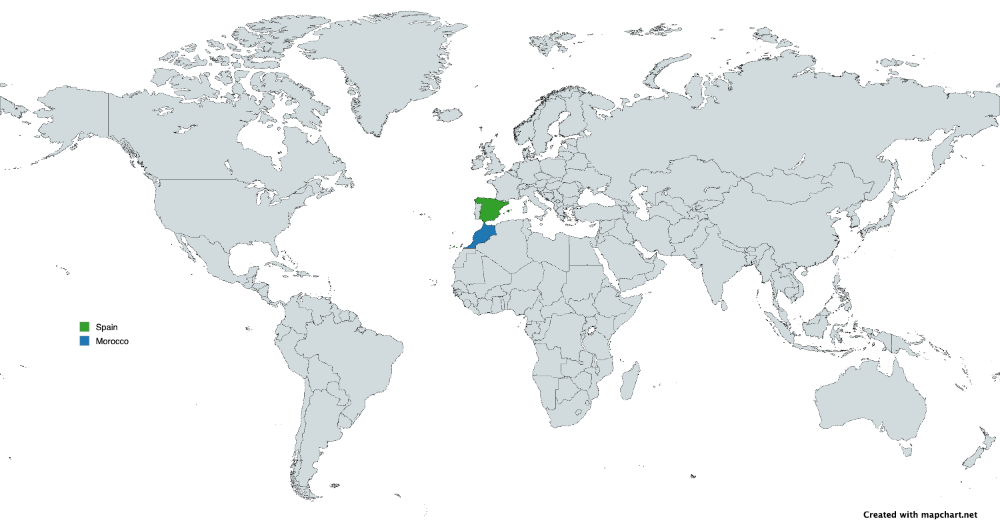
Spain = Green
Morocco = Blue
Image is licensed under the Creative Commons Attribution-Share Alike 4.0 International license and was created using MapChart (https://mapchart.net).