A ballistic missile detected near Turkish airspace was intercepted by NATO defense systems on Wednesday, drawing Turkey directly into the widening conflict linked to recent U.S. and Israeli military operations against Iran. Turkish authorities said the projectile originated from Iran and was tracked as it moved across Iraq and Syria before being destroyed over the eastern Mediterranean.
According to Turkey’s Ministry of National Defence, NATO air and missile defense assets responded quickly once the missile’s path was identified. The system neutralized the threat before it could enter Turkish airspace. Officials confirmed that the interception caused no casualties, though debris from the defensive system landed in Hatay province in southern Turkey.
Hatay lies near the Syrian border and is not far from Incirlik Air Base, a joint facility used by the Turkish Air Force and NATO allies, including the United States. The base has long served as a logistical hub for military operations in the Middle East. Turkish officials emphasized, however, that the installation has not been used by U.S. forces in the current air campaign targeting Iran.
The missile incident comes amid growing instability in the region following coordinated U.S. and Israeli strikes against Iranian military and nuclear infrastructure. Tehran has responded with a series of missile and drone attacks aimed at American interests and allied countries throughout the Middle East.
Although Turkey is a NATO member and maintains one of the alliance’s largest armed forces, its leaders have indicated that they do not want the confrontation to expand further. Turkish authorities called on all sides involved in the conflict to act responsibly and avoid steps that could intensify tensions.
President Recep Tayyip Erdogan said the government is closely monitoring developments and taking precautions to safeguard the country’s borders and airspace. He added that Turkey is working with NATO partners while strengthening its own defensive capabilities.
Following the interception, Turkey’s top diplomat, Hakan Fidan, spoke with Iranian Foreign Minister Abbas Araqchi to communicate Ankara’s concerns regarding the missile’s trajectory. Turkish officials said they expect respect for their country’s territorial integrity and warned that Turkey maintains the right to respond to hostile acts if necessary.
Iran, however, rejected the claim that it fired a missile toward Turkish territory. In a statement reported by Iranian state media, the country’s armed forces said they respect Turkey’s sovereignty and denied directing any missile at the country.
NATO responded to the event by expressing support for Turkey and condemning attacks that could threaten alliance members. A spokesperson said the alliance maintains strong defensive readiness across multiple domains, including missile defense.
The situation has also drawn attention to NATO’s internal security mechanisms. Under Article 4 of the alliance treaty, members may request consultations if they believe their security or territorial integrity is at risk. A more serious measure, Article 5, requires collective defense if a member is attacked.
U.S. Defense Secretary Pete Hegseth said there is currently no indication that the missile incident would trigger Article 5. The clause has only been activated once in NATO’s history, following the terrorist attacks on the United States in 2001.
Before the outbreak of hostilities, Turkey had attempted to facilitate dialogue between Washington and Tehran. As the confrontation continues, Ankara appears focused on preventing the conflict from spilling further into neighboring countries while maintaining close coordination with NATO allies.
The interception illustrates how the ongoing confrontation is increasingly affecting countries beyond the original participants, raising concerns about the potential for broader regional instability.
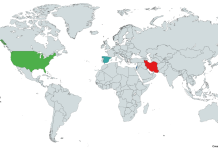
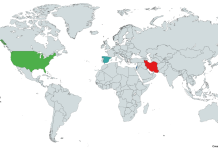
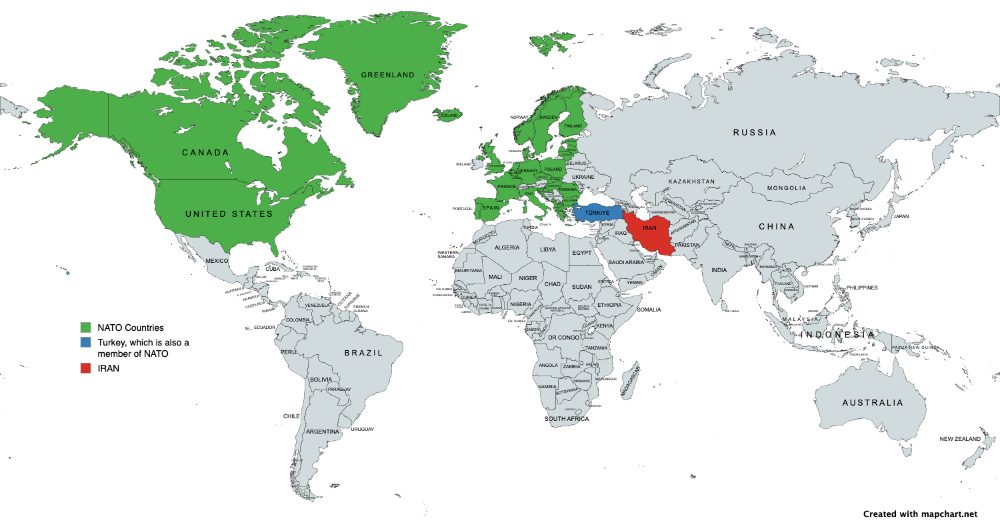
NATO Countries = Green
Turkey = Blue, Also a member of NATO
Iran = Red
Image is licensed under the Creative Commons Attribution-Share Alike 4.0 International license and was created using MapChart (https://mapchart.net).