Fighting involving Yemen’s Houthi movement continued Sunday as the group claimed attacks on an oil facility in Saudi Arabia and a Red Sea port in Yemen. The developments came while Iran was setting new conditions involving the Strait of Hormuz and the Pentagon was seeking faster weapons production in the United States.
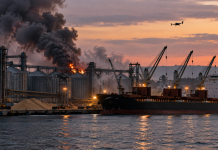
Saudi Arabia’s Energy Ministry said a fire broke out early Sunday at an Aramco facility in Jizan, a coastal city in southwestern Saudi Arabia. The fire was extinguished and no casualties were reported, but Saudi officials did not identify what caused it.
The Houthis later claimed responsibility for attacking the facility. Houthi military spokesperson Yahya Saree said the group used a drone against the refinery in response to Saudi drones entering Yemeni airspace over the provinces of Saada and Hajjah.
The strike followed other missile and drone attacks claimed by the Houthis against Saudi targets. The group has previously said it attacked Aramco facilities in Jizan and oil installations in Yanbu, and it has also threatened shipping in the Red Sea.
Another attack Sunday hit Mocha port on Yemen’s Red Sea coast. Fayed al-Noman, an official in Yemen’s information ministry, said missiles and drones were used in the attack, while the Houthis later said they targeted military equipment and warehouses with ballistic missiles and drones.
Mocha is controlled by Yemen’s internationally recognized government and has been renovated in recent years. The port handles shipping that avoids Houthi-controlled ports in Hodeida, making the latest attack another part of the growing pressure on transportation routes in the area.
The new fighting is also putting more strain on a truce reached in 2022 that reduced major combat in Yemen’s civil war. Days before Sunday’s attacks, a military source said at least 58 government troops were killed Thursday in Houthi missile and drone strikes, while Saudi officials reported 11 civilians wounded in the Najran region.
At the same time, discussions are continuing over shipping through the Strait of Hormuz. Iranian Foreign Minister Abbas Araghchi said talks with Oman about possible new maritime routes were in their final stages, though he said an agreement on those routes would not automatically reopen the strait.
Iran’s Supreme National Security Council has laid out several conditions involving the waterway. Its demands include ending the war with Iran and its armed allies, lifting the U.S. naval blockade of Iranian ports and withdrawing American forces from the region.
Iran has also called for sanctions to be removed, frozen assets to be released and compensation to be paid for war damage. Two people familiar with the discussions said a temporary proposal could allow ships to enter the strait closer to Iran and leave near Oman without paying fees or tolls, though the terms could still change.
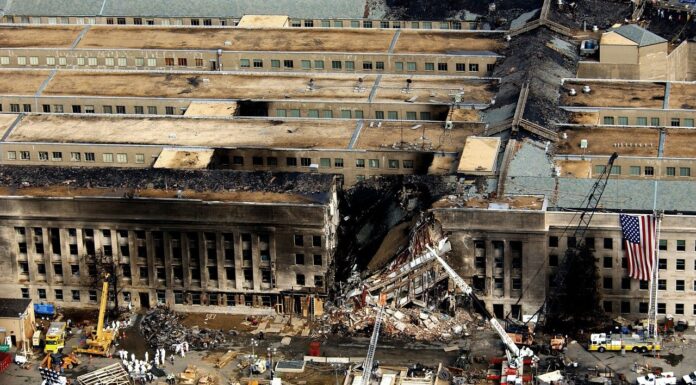
The conflict is also affecting U.S. weapons supplies. Pentagon spokesperson Sean Parnell said the Defense Department is working to increase munitions purchases and speed up deliveries as part of a modernization effort that began before the current conflict.
An analysis from the Center for Strategic and International Studies said the war has further reduced U.S. supplies of advanced missile interceptors. Those stockpiles were already diminished before the five-month-old conflict, while the Pentagon is now pressing the defense industry to increase production.
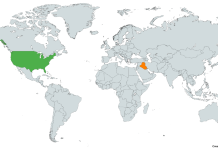
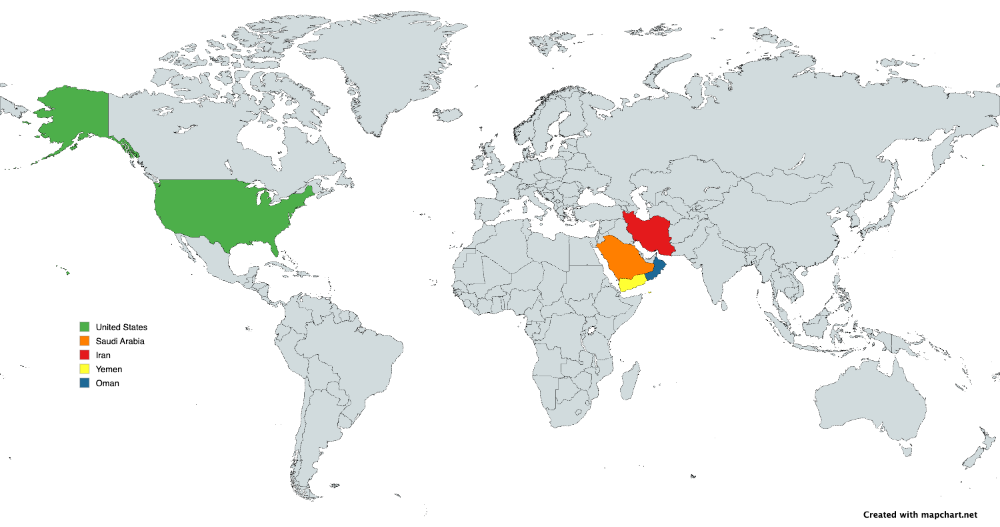
United States = Green
Oman = Blue
Iran = Red
Yemen = Yellow
Oman = Blue
Image is licensed under the Creative Commons Attribution-Share Alike 4.0 International license and was created using MapChart (https://mapchart.net).