Canada and the European Union have signed a wide-ranging security and defense partnership as both sides seek to recalibrate their international alignments. The agreement was formalized in Brussels on June 23, 2025, during a summit that brought Canadian Prime Minister Mark Carney together with European Commission President Ursula von der Leyen and European Council President António Costa.
The pact reflects a growing effort by Ottawa to reduce reliance on the United States amid growing uncertainty about future cooperation under President Donald Trump’s leadership. Trump has recently suggested absorbing Canada into the U.S., fueling concerns among Canadian policymakers and citizens. In response, Carney campaigned earlier this year on a platform of strengthening Canada’s ties with Europe and other international partners.
The newly signed agreement enables Canada to participate in the EU’s expanding defense initiatives, including potential access to SAFE (Security Action for Europe), a €150 billion joint procurement program. The EU’s SAFE initiative allows close partners to collaborate on weapons development and acquisition while aiming to enhance interoperability among allied forces.
Von der Leyen said that Canada is now well-positioned to engage in joint capability building and procurement efforts, especially in areas such as air defense and cybersecurity. Carney echoed this, describing the partnership as a step toward quicker and more cost-efficient delivery of defense capabilities for both sides.
Although NATO remains central to the security arrangements of both Canada and EU member states, this bilateral agreement introduces a parallel track of cooperation that goes beyond existing transatlantic frameworks. In particular, Canada and the EU plan to cooperate on military mobility, personnel deployment logistics, and PESCO (Permanent Structured Cooperation) projects focused on operational readiness within Europe.
Support for Ukraine was another key theme. The two sides pledged to expand coordination on military aid and share resources to back Kyiv’s efforts in the ongoing conflict with Russia. Maritime and space security, arms control, and cyber resilience are also included in the pact’s scope, highlighting areas where both parties see shared threats.
The deal mirrors a similar agreement the EU recently struck with the United Kingdom. It also places Canada among a small group of countries outside Europe—including Japan and Norway—that have entered into structured defense arrangements with the EU.
During the summit, Carney emphasized that Canada intends to play a larger role in European defense planning and industrial cooperation. He also pointed to the need to reduce Canada’s current heavy dependency on U.S. suppliers. “Three-quarters of our defense capital spending goes to the United States. That’s not a balanced approach,” he said during an interview before the summit.
Carney’s European visit also included a stop at Schoonselhof military cemetery in Belgium, where he and his wife laid wreaths in honor of Canadian soldiers who fought in past wars. The visit carried symbolic weight, reinforcing Canada’s longstanding commitment to defending Europe.
Looking ahead, Canadian defense companies are expected to begin negotiations to qualify for EU contracts under SAFE. The full implementation of the partnership will depend on technical agreements and regulatory alignment in areas such as procurement standards and dual-use technologies.
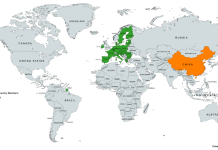
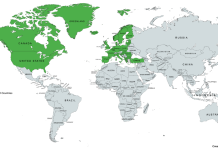
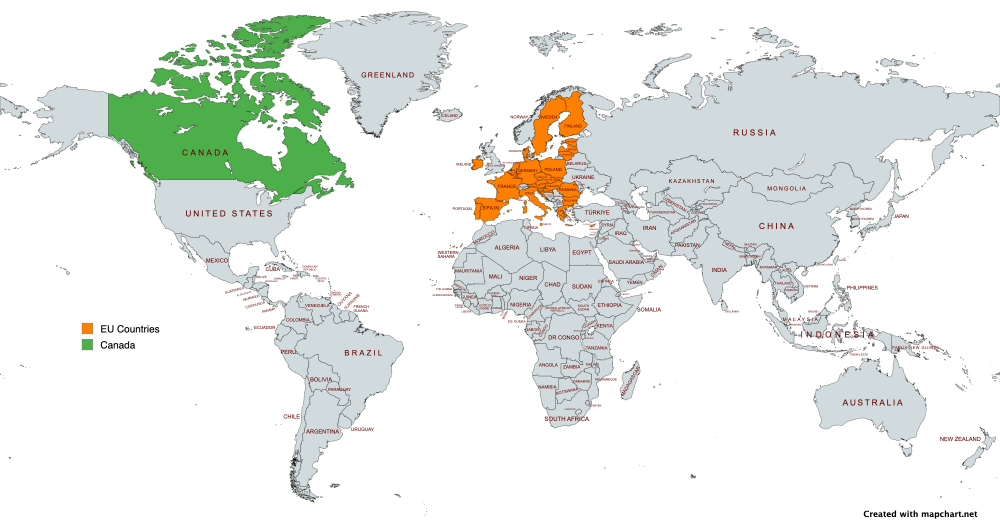
EU Member Countries = Orange
Canada = Green
Image is licensed under the Creative Commons Attribution-Share Alike 4.0 International license and was created using MapChart (https://mapchart.net).