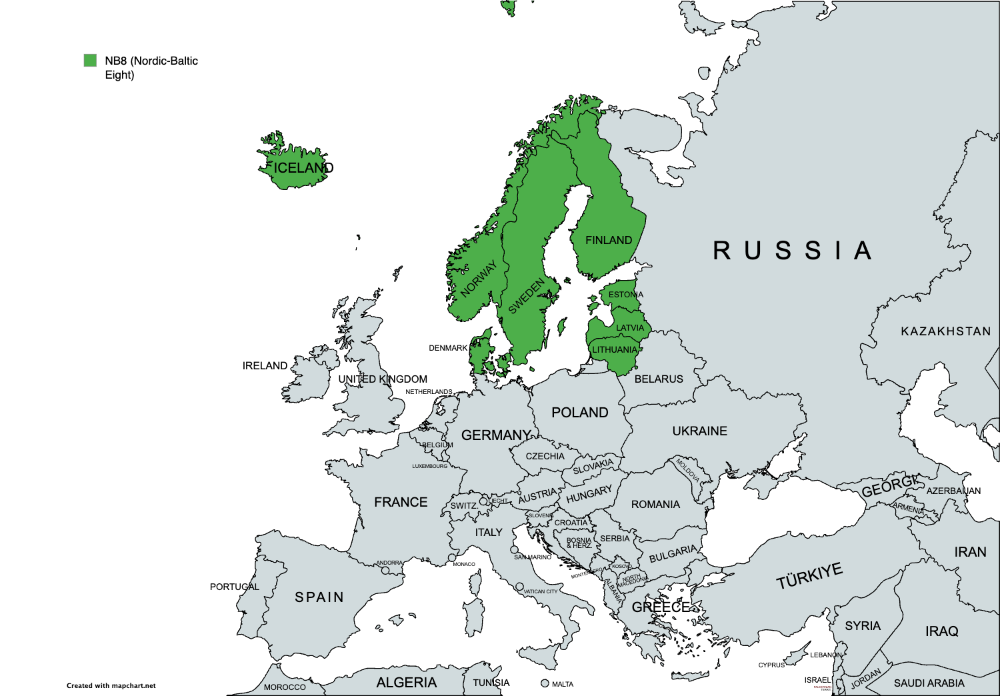
The Nordic-Baltic Eight, usually shortened to NB8, is an informal regional cooperation format made up of eight Northern European countries: Denmark, Estonia, Finland, Iceland, Latvia, Lithuania, Norway, and Sweden. Five are Nordic countries, while Estonia, Latvia, and Lithuania are the Baltic states.
NB8 is not a formal organization like the European Union or NATO. It has no permanent headquarters, separate institution, or large standing staff. Instead, it works through regular meetings, coordination, and contacts between governments.
The format developed in the early 1990s as Estonia, Latvia, and Lithuania restored their independence during the collapse of the Soviet Union. Cooperation was initially known as “5+3,” meaning five Nordic countries plus three Baltic states. On August 30, 2000, foreign ministers meeting in Middelfart, Denmark, agreed to use the name Nordic-Baltic Eight, or NB8.
NB8 cooperation covers issues of regional and international importance. Foreign policy and security are regular topics, especially since Russia’s full-scale invasion of Ukraine. Energy, transport, digital infrastructure, cybersecurity, trade, environmental issues, and emergency preparedness are also common areas of discussion.
The format does not have a permanent leader. Each year, one member country coordinates the work, helps organize meetings, and sets priorities. Estonia holds that role in 2026.
Geography is one reason NB8 matters. The countries are connected through the Baltic Sea region, trade, transport routes, energy systems, digital networks, and shared security concerns. Events in one part of the region can quickly affect the others, making regular communication useful.
The members are not identical politically or economically. They differ in population, industries, and national priorities. Six are members of the European Union, while Norway and Iceland are outside the EU. Historically, their security policies also differed, but all eight are now NATO members.
NB8 usually works in a low-profile way. It does not have the public visibility of larger institutions, but its value comes from steady contact, coordination, and trust between governments. The format has also supported cooperation with outside partners, including the United States through the Enhanced Partnership in Northern Europe.
For the countries involved, that quiet style is part of its usefulness. When problems arise, NB8 gives them an existing channel for consultation and coordination. That is why the format has remained relevant even though it is still not widely known outside Northern Europe.
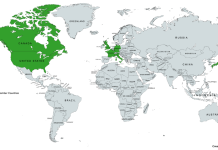
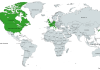
NB8 member countries = Green
Image is licensed under the Creative Commons Attribution-Share Alike 4.0 International license and was created using MapChart (https://mapchart.net).