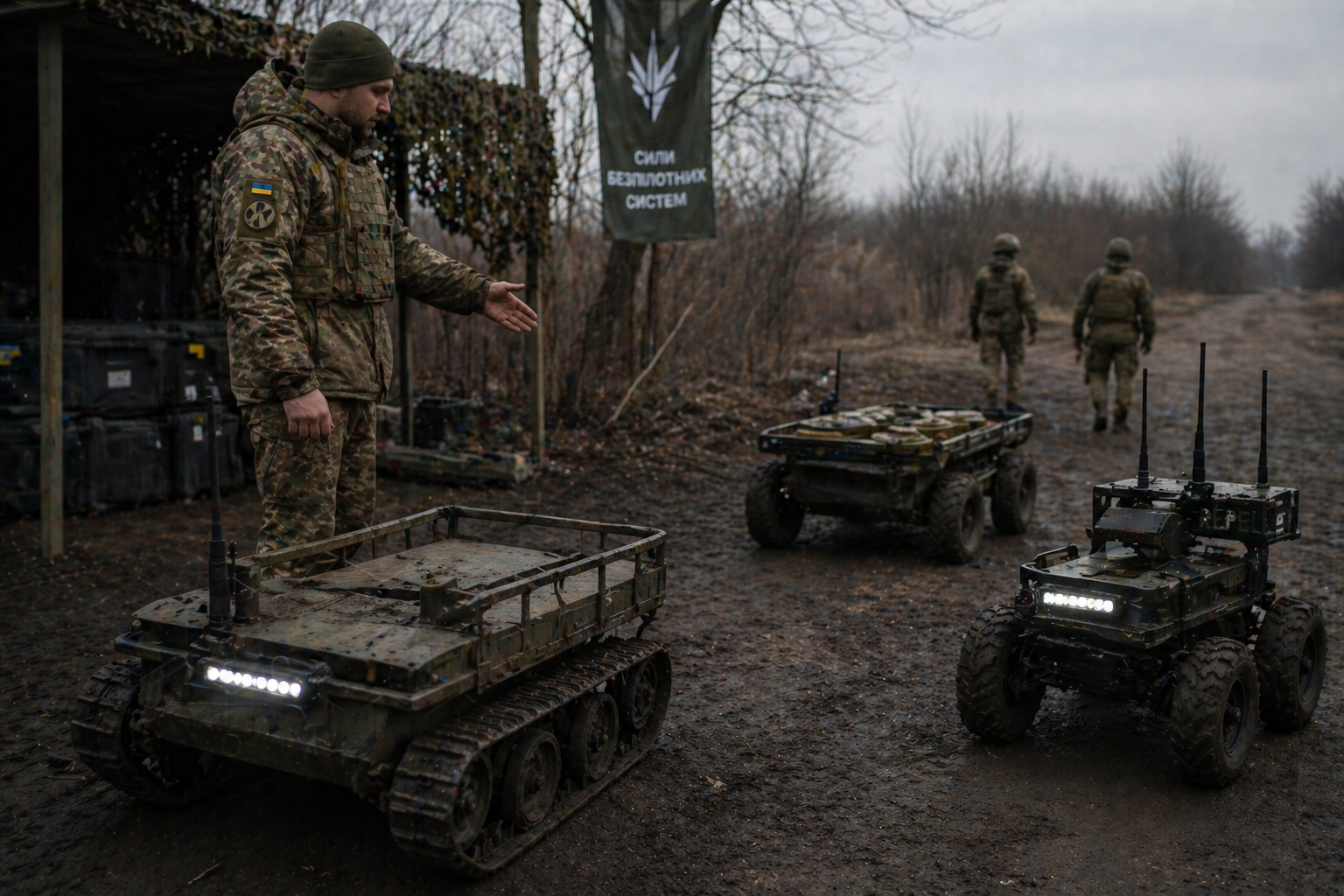
In a workshop not far from the front, Lieutenant Victor Pavlov stood next to a line of small, battery-powered machines. At first glance, they didn’t look like weapons. One moved on tracks and looked a bit like a stripped-down cart. Another had wheels and thin antennas poking up. A third carried anti-tank mines.
They’re part of a growing group of unmanned ground vehicles, or UGVs, now used across Ukraine’s military.
“This is what modern warfare looks like,” Pavlov said, gesturing toward them.
The war, now in its fifth year since Russia’s full-scale invasion of Ukraine, doesn’t look the same as it did at the start. Drones have already changed things in the air. Now something similar is happening on the ground, just a bit slower, maybe less visible.
Pavlov said these robots now handle most logistics work. Around 90%, by his estimate. Moving supplies by hand has become risky because of constant drone surveillance. A person walking across open ground can be spotted quickly. A smaller robot, sometimes not.
They bring food, ammunition, even logs for building shelters. Some can carry wounded soldiers out. Up to three at a time, depending on the model. It’s not always smooth. Sometimes they get stuck or damaged. But they keep being used.
In January, Ukrainian forces carried out about 7,000 operations using these ground systems. That number sounds high. A year or two ago it would have been hard to picture.
Some of the robots now go beyond support roles. They’re fitted with machine guns or grenade launchers and sent forward to hold positions. One system, the DevDroid TW 12.7, stayed in place for more than a month, according to Ukrainian officials.
There have been more unusual cases too. A robot carrying explosives traveled roughly 12 miles to a building used by Russian troops and detonated there. In another situation, Russian soldiers reportedly surrendered after being confronted by a ground robot. One of them was already wounded.
A drone operator known as Bambi tried to explain what that feels like. “The frontline is more like Terminator,” he said. Not in a dramatic way, just the basic idea. Machines arriving at positions, controlled by someone far away.
He pointed out something simple. Shooting a person stops them. Shooting a robot doesn’t really do the same thing. It just keeps going until it can’t.
Training has had to adjust. At the KillHouse academy, part of Ukraine’s 3rd army corps, soldiers practice driving these machines using remote controls and simulators. Some of the better operators come from gaming backgrounds. That part sounds odd, but instructors mention it a lot.
The system behind all this moves quickly. Engineers build something, soldiers use it, then send feedback. Changes happen fast. There isn’t much delay between idea and use.
Not every robot makes it back. Pavlov said his unit can lose a few each day, mostly to aerial attacks. He didn’t dwell on it. The trade-off is clear to him. Fewer soldiers are exposed.
Russia is working on its own versions too, including vehicles that can carry heavy loads or jam signals. Pavlov said Ukraine still has more systems for now, though scaling production remains a challenge.
President Volodymymyr Zelenskyy has pointed to these technologies as part of a wider shift in the war. Ukrainian forces have regained some territory in the south, while Russia still holds about 20% of the country.
Commanders say what happens next may depend less on troop numbers and more on how these systems are used. Some expect robots to take on a larger share of both logistics and combat tasks.
For now, they’re already out there, moving back and forth along the front. Quiet most of the time.
This image is the property of The New Dispatch LLC and is not licenseable for external use without explicit written permission.