British and French air forces carried out a coordinated strike in central Syria over the weekend, targeting what officials believe was an underground weapons storage site linked to the Islamic State group. The operation took place in rugged terrain north of Palmyra, an area that has seen repeated militant activity in recent years.
The UK Ministry of Defence said the strike followed extensive intelligence work indicating that the site was being used to hold weapons and explosives. According to officials, the location consisted of tunnel networks carved into the mountains, a method often used by militant groups to hide supplies and reduce exposure to aerial surveillance.
Royal Air Force Typhoon FGR4 aircraft participated in the mission, deploying Paveway IV guided munitions against several tunnel access points. A Voyager tanker aircraft provided aerial refueling support, allowing the jets to remain on station as needed. French aircraft were also involved, reflecting continued cooperation between the two countries within the broader international coalition operating in the region.
Early assessments suggest the strike achieved its objective, though defence officials said a full review of the damage is still underway. The Ministry of Defence stated that all coalition aircraft returned safely after completing the mission. Officials also said the targeted area was uninhabited, and there were no indications that civilians were harmed during the operation.
UK Defence Secretary John Healey described the strike as part of an ongoing effort to prevent extremist groups from rebuilding their operational capacity. He said Britain remains committed to working alongside allies to disrupt militant networks and deny them access to weapons and resources. Healey also praised the service members involved, noting that many British personnel remain deployed during the holiday period.
Islamic State once controlled large swaths of Syria and Iraq, enforcing a brutal system of rule until losing its remaining territory in 2019. While the group no longer governs land, international officials continue to warn that it retains the ability to carry out attacks through dispersed cells and hidden infrastructure. United Nations estimates suggest several thousand fighters remain active across the two countries.
Coalition forces have maintained a steady presence in Syrian airspace since the group’s territorial defeat. Surveillance flights, patrols, and targeted strikes are intended to disrupt attempts by militants to reorganize or exploit gaps in security. British forces have been part of these efforts since 2014, using both manned aircraft and drones.
The Palmyra region has drawn particular attention following recent violence. In December, an ambush attributed to Islamic State fighters killed two US service members and a civilian interpreter. That incident prompted renewed scrutiny of militant activity in central Syria and led to arrests by Syrian authorities of suspects linked to the attack.
France and the United Kingdom have repeatedly emphasized the importance of joint action in addressing remaining extremist threats. Defence officials say cooperation allows for shared intelligence, coordinated planning, and faster responses when credible targets are identified.
While officials caution that militant groups adapt quickly, Western governments maintain that continued pressure remains necessary. The latest strike near Palmyra reflects that approach, aiming to limit the ability of Islamic State remnants to store weapons, plan attacks, or regain influence in an already fragile security environment.
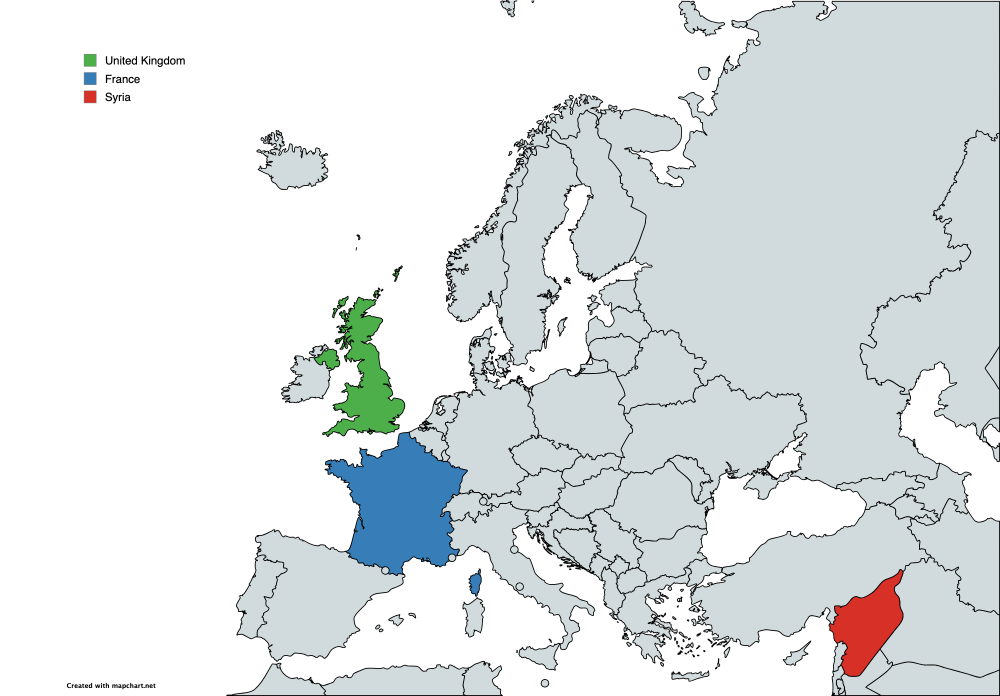
United Kingdom = Green
France = Blue
Red = Syria
Image is licensed under the Creative Commons Attribution-Share Alike 4.0 International license and was created using MapChart (https://mapchart.net).