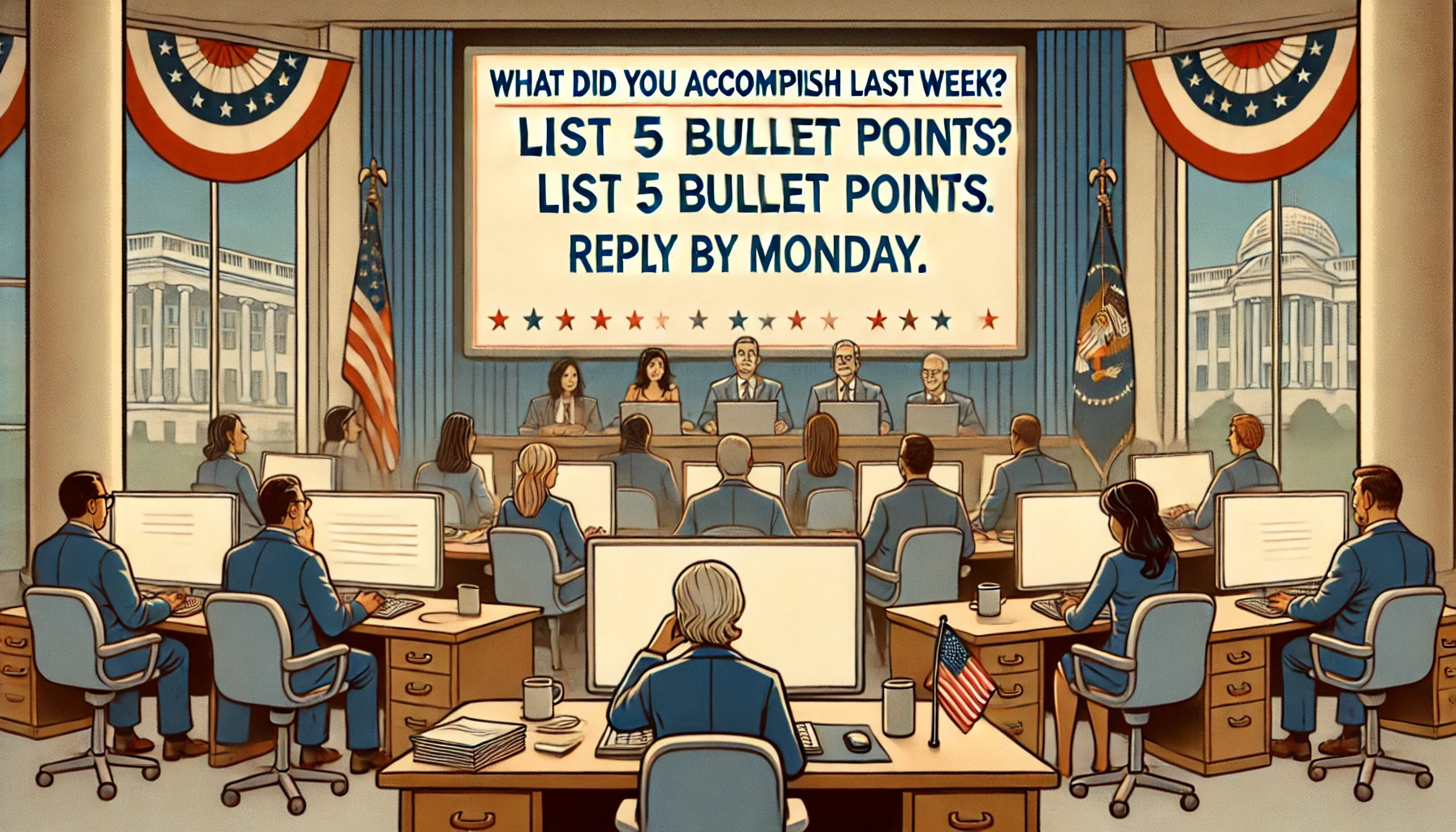
President Donald Trump’s administration sent an email to federal employees on Saturday, asking them to list their work accomplishments from the previous week or risk losing their jobs. The email, titled “What did you do last week?” instructed employees to provide five bullet points summarizing their achievements, excluding classified information. The email also required them to copy their manager on the response by midnight on Monday.
The directive followed a message from Elon Musk, head of the Department of Government Efficiency (DOGE), who stated on X that employees who did not respond to the email would be considered to have resigned. Musk has been leading efforts to reduce government spending through layoffs and funding cuts as part of his role in DOGE, which aims to streamline federal operations.
The Office of Personnel Management (OPM) confirmed the email’s authenticity, stating that the initiative aligns with the Trump administration’s focus on creating a more efficient and accountable federal workforce. OPM added that each agency would decide the next steps based on employee responses.
The American Federation of Government Employees (AFGE), the largest union representing federal workers, criticized the email as “cruel and disrespectful.” AFGE President Everett Kelley argued that the measure demonstrates a lack of regard for federal employees and the services they provide to the public. The union vowed to challenge any terminations resulting from the initiative, labeling it as an attack on public servants.
The email directive followed Trump’s speech at the Conservative Political Action Conference (CPAC), where he criticized federal employees for inadequate performance and announced his commitment to reducing government size. Trump emphasized his plan to retain only the most effective employees, arguing that remote work had reduced productivity. He praised Musk’s cost-cutting measures and encouraged him to take even more aggressive steps in streamlining the federal workforce.
Musk reported on X that many employees had already responded to the email, suggesting that those who replied should be considered for promotion. He described the task as straightforward, emphasizing that even a brief summary would be sufficient.
Not all agencies complied with the directive. Newly appointed FBI Director Kash Patel instructed his staff to pause their responses, emphasizing that the FBI would conduct its own review process. Patel stated that the FBI, through the Office of the Director, oversees its internal evaluations and would coordinate any required reports. The State Department also advised employees not to respond, assuring them that it would handle communication with OPM.
The email’s tone and the threat of forced resignation were reminiscent of Musk’s management style at Twitter, now called X, where he previously issued ultimatums requiring employees to commit to a “hardcore” work ethic or resign. This approach has sparked criticism from labor advocates who argue that it fosters a hostile work environment.
Since being appointed by Trump to lead DOGE, Musk has overseen the elimination of thousands of federal positions across multiple agencies, including the Internal Revenue Service (IRS), the Pentagon, and the Federal Aviation Administration (FAA). This restructuring effort aims to create a leaner federal government and reduce operational costs.
The Senate is expected to scrutinize the administration’s actions, with Democratic lawmakers expressing concerns about the potential politicization of the federal workforce. Republican leaders, however, have supported the initiative, viewing it as necessary for reducing government spending and increasing accountability.
As federal employees await further guidance from their agencies, the controversy surrounding the email continues to escalate, highlighting tensions over Trump’s approach to government reform.
This image is the property of The New Dispatch LLC and is not licenseable for external use without explicit written permission.