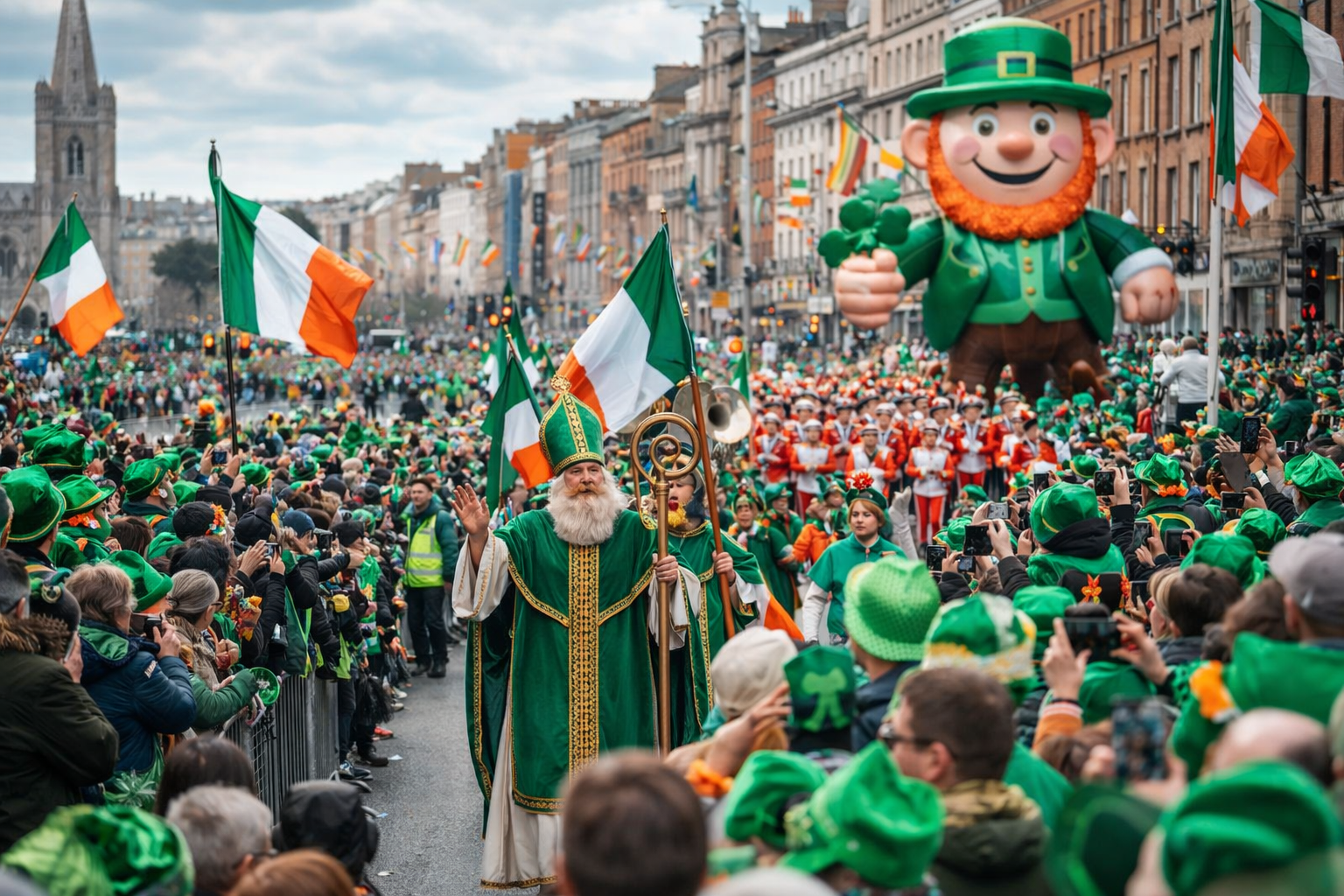
Saint Patrick’s Day is celebrated each year on March 17 and honors Saint Patrick, the missionary traditionally regarded as Ireland’s patron saint. Over time the holiday has grown far beyond its religious roots and is now widely recognized as a celebration of Irish culture and heritage. Parades, green clothing, music, food, and public festivals are common parts of the day in many countries. In 2026, Saint Patrick’s Day falls on Tuesday, March 17.
Saint Patrick lived during the fifth century. He was born in Roman Britain in the late fourth century to a Christian family. According to his own writings, he was captured at about sixteen years old by raiders from Ireland and taken across the sea as a slave. During the years he spent tending animals in rural Ireland, he turned increasingly to prayer and religious devotion.
Patrick eventually escaped captivity and returned to Britain. After further religious study, he chose to become a missionary. In the early fifth century he traveled back to Ireland, where he spent many years preaching and helping organize Christian communities. Tradition holds that he baptized many converts and helped establish churches and monasteries across parts of the island.
Many well-known stories about Patrick come from later legends rather than historical records. One of the most famous claims is that he used the three-leaf shamrock as a teaching tool to explain the Christian concept of the Trinity. Although this idea became a powerful symbol associated with Ireland, the story appears in sources written many centuries after Patrick’s lifetime.
Patrick is traditionally believed to have died on March 17 in the mid-fifth century, and the date became associated with a feast day in his honor. By the early medieval period he was widely revered as Ireland’s principal patron saint. Over the centuries stories about his life expanded, and his reputation became deeply woven into Irish cultural identity.
The religious feast that commemorated Patrick gradually developed into a broader cultural celebration. Observances of the day can be traced back many centuries in Ireland. However, many of the large public festivities familiar today developed outside Ireland, especially among Irish immigrant communities.
Public parades honoring Saint Patrick appeared in North America long before they were common in Ireland. One early celebration took place in St. Augustine, Florida, in 1601, and similar events later occurred in cities with large Irish populations. Over time, these gatherings evolved into major civic celebrations that highlighted Irish identity and community pride.
Today Saint Patrick’s Day is marked in cities around the world. Large parades take place in the United States, Canada, and elsewhere, while Ireland hosts its own festivals and cultural events. A famous modern tradition occurs in Chicago, where the city began coloring the Chicago River green in 1962 as part of its celebrations.
Although the holiday is now widely known for festive gatherings and public celebrations, its origins remain connected to the life of a missionary who helped shape early Christianity in Ireland. For many people, Saint Patrick’s Day continues to combine cultural pride with remembrance of the historical figure whose story inspired the tradition.
This image is the property of The New Dispatch LLC and is not licenseable for external use without explicit written permission.