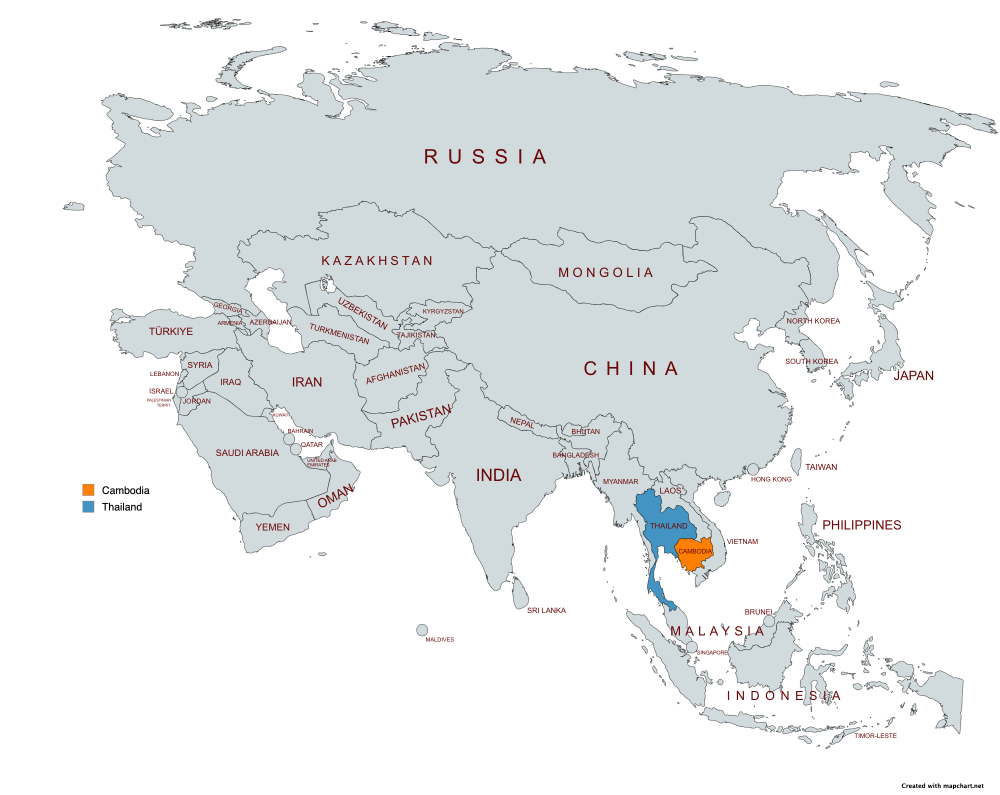
Thailand and Cambodia held a round of talks on Saturday in Phnom Penh to address a flare-up in border tensions that began after a fatal clash in late May. The meeting, part of the Joint Boundary Commission (JBC), took place amid military deployments, tightened border restrictions, and growing pressure on both governments to contain the fallout from the territorial dispute.
The disagreement centers on long-contested areas along the 820-kilometer (510-mile) shared border, including sites of ancient temples. These zones, many of which remain undemarcated, have periodically sparked confrontations. The most recent occurred on May 28 in the Emerald Triangle region, where the borders of Thailand, Cambodia, and Laos converge. One Cambodian soldier was killed in the exchange of fire, with both sides claiming self-defense.
Despite calling for dialogue, both governments have taken retaliatory steps in recent days. Thailand reduced operating hours at a key border crossing, prompting Cambodia to fully close that checkpoint, stranding Thai trucks. In response to perceived provocations, Cambodian authorities ordered local television stations to stop airing Thai content, halted Thai boxing broadcasts, and began disconnecting internet bandwidth sourced from Thailand.
Cambodia’s Prime Minister Hun Manet has reiterated that his country will take the matter to the International Court of Justice (ICJ) and plans to submit a formal filing on Sunday regarding four disputed zones, including three temple sites and the area near the May 28 clash. Thailand has rejected this approach, emphasizing a preference for bilateral resolution and asserting that it does not accept the ICJ’s compulsory jurisdiction.
While Thai Foreign Ministry officials have stated that Saturday’s meeting “made progress in building mutual understanding,” neither side expected a resolution to be reached over the weekend. Thailand was represented by a foreign ministry adviser, while Cambodia sent a minister-level official. The atmosphere of the talks was described as constructive, though outcomes remain uncertain.
On the eve of the meeting, Cambodian military leaders ordered troops to remain on high alert, and former Prime Minister Hun Sen, father of the current premier, accused elements within Thailand’s military of escalating the conflict. He criticized the Thai government for failing to manage its armed forces and ordered preparations for civilian evacuation and 24-hour combat readiness.
Thai Prime Minister Paetongtarn Shinawatra responded by stating that Cambodia had misinterpreted Thailand’s actions, particularly allegations that Bangkok was preparing to cut electricity or internet services to Cambodian communities. She emphasized that her administration had no such plan and instructed the foreign ministry to clarify the matter.
The underlying tension dates back decades, rooted in colonial-era boundary lines from when France administered Indochina. While previous skirmishes have occurred over disputed religious and cultural sites—such as the Preah Vihear temple, awarded to Cambodia by the ICJ in 2013—both countries have struggled to reach a long-term agreement on several remaining areas.
With both armies now repositioned to avoid immediate clashes, and public sentiment stirred on both sides, pressure remains high. Migrant workers, particularly Cambodians in Thailand, are closely monitoring developments. Some have already returned home, citing concerns about safety and rising hostility. Others are waiting to see what the outcome of ongoing talks will bring.
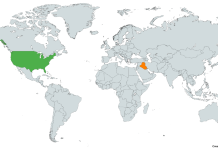
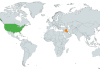
Cambodia = Orange
Thailand = Blue
Image is licensed under the Creative Commons Attribution-Share Alike 4.0 International license and was created using MapChart (https://mapchart.net).