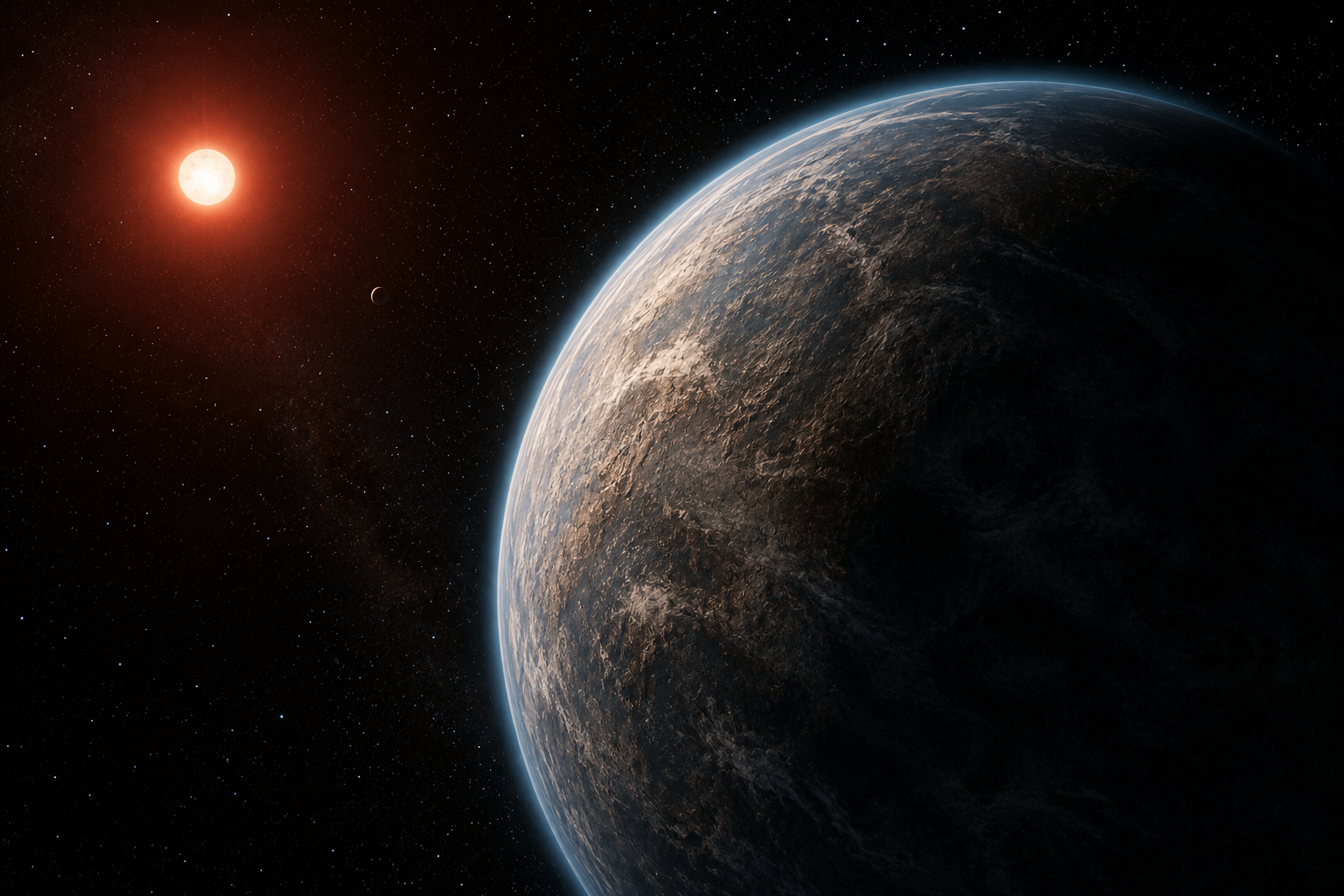
A rocky planet nearly 49 light-years away has become the focus of new research after astronomers found evidence suggesting gases may surround it. The planet, LHS 1140b, circles a small star at a distance where temperatures are considered mild enough for liquid water to remain on the surface if the right conditions exist. Scientists stress that this does not mean the planet supports life. At this stage, the observations only point to the possibility that an atmosphere is present, and additional studies will have to confirm it.
Researchers classify LHS 1140b as a super-Earth because it is much larger than our own planet, with about five times Earth’s mass. Measurements of its size and density indicate that it is likely made mostly of rock with an iron-rich center. The team also thinks water and a layer of gas could be part of the planet’s makeup. Their findings were published in the journal Science.
Instead of searching every known exoplanet, the researchers narrowed their list first. Lead author Collin Cherubim developed a model that predicted which rocky planets were most likely to keep traces of helium after losing lighter gases over billions of years. LHS 1140b fit those conditions, so the team observed it from the Magellan Clay Telescope in Chile during September 2024. The observations revealed helium escaping from the planet, providing evidence that some type of atmosphere may still exist.
The result is encouraging, but scientists are not treating it as proof. Helium alone cannot show whether the planet could support living organisms, and no other atmospheric gases have been confirmed. The researchers say the planet simply offers one of the better opportunities for future study because it appears rocky, receives moderate amounts of heat from its star, and may still have an atmosphere.
The host star is a red dwarf, which presents both advantages and challenges. Its smaller size allows astronomers to study passing planets more easily, yet these stars often release intense radiation capable of removing planetary atmospheres. That makes LHS 1140b an interesting case if later observations confirm that it has managed to hold onto one.
A second observation in 2025 did not detect helium. The team suggested that the escape of the gas may have slowed enough to fall below the telescope’s sensitivity, although they said the reason is still uncertain. More observations are planned with telescopes in Chile, along with the James Webb Space Telescope and the Hubble Space Telescope, as researchers continue collecting evidence before reaching a final conclusion.
This image is the property of The New Dispatch LLC and is not licenseable for external use without explicit written permission.